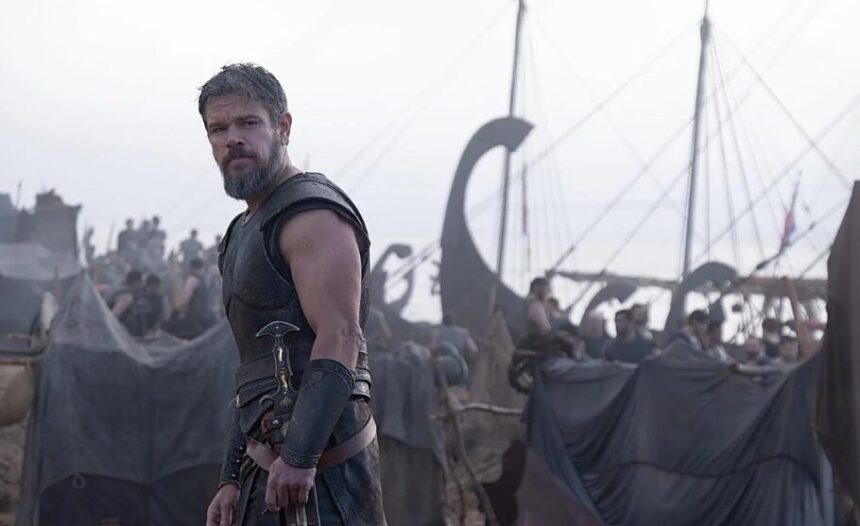
The upcoming premiere of “The Odyssey,” the new production by Christopher Nolan, has sparked intense controversy in Greece even before reaching theaters. Based on Homer’s epic, the film features an international cast led by Matt Damon in the role of Ulysses, alongside Tom Holland, Zendaya, Charlize Theron, Anne Hathaway, Lupita Nyong’o, and Elliot Page, among others.
The controversy in Greece began in May, following the release of the first trailer, when the deputy of the ultra-conservative ‘Niki’ party, Dimitris Natsios, submitted a parliamentary question addressed to the Greek Minister of Culture, Lina Mendoni, to request explanations regarding the 6.5 million euro state subsidy granted for the filming of the movie.
According to the deputy, the State should not fund a production inspired by one of the pillars of Hellenic cultural heritage without first knowing how “Greek history, mythology, and collective memory” would be presented. In his text, the politician denounced that the aid had been granted “without criteria for the protection of Greek cultural heritage.”
Natsios also lashed out at some casting decisions, especially the choice of actress Lupita Nyong’o for the role of Helen of Troy and trans actor Elliot Page for the role of Achilles, criticisms that were widely disseminated by conservative media and social networks.
The Greek Government rejects censorship
More Read
The Minister of Culture responded by rejecting any attempt to interfere with the film’s artistic content and defended that the aid granted by the Greek Film Centre, Audiovisual Media and Creativity (Ekkomed) was carried out through a “predetermined and completely meritocratic” procedure, and within the tax incentive program (‘cash rebate’) aimed at attracting large international productions. This program allows international production companies to recover up to 40% of eligible expenses incurred during filming in Greece, with a maximum limit of eight million euros.

An important part of Nolan’s film was shot in various Greek locations, especially in the southern Peloponnese, thanks to the aforementioned tax incentives.
The minister insisted that “there is no political or ideological interference in the artistic content of the work” and stressed that “it is not the State’s role to dictate to a creator how they should artistically express a work or a myth.”
More Read

The new trailer reignites the controversy
The release of the film’s latest teaser has reignited the controversy. Numerous social media users and several Greek media outlets have once again questioned certain aspects of the film, from the cast to the design of the armor and other historical elements that appear fleetingly in the trailer. Criticism of Nyong’o’s performance has once again taken up a large part of the debate, along with comments regarding the alleged lack of historical accuracy in Nolan’s recreation.
For Greek film critic Robbie Eksiel, all this controversy is “understandable” due to the enormous anticipation surrounding the project: “The stir that has been generated is logical because we are talking about a film whose promotional campaign began more than a year ago and, furthermore, it is one of the most anticipated releases in daily cinema,” he explains to ABC.
Eksiel points out that Nolan has millions of followers around the world and that his previous film, ‘Oppenheimer’, was a huge international success that managed to gross a billion dollars at the box office. Furthermore, he highlights that ‘The Odyssey’ has been shot entirely in 70mm IMAX format, a technical commitment “unprecedented in history.” “In Greece, the controversy is greater because ‘The Odyssey’ is part of our cultural identity. It is not just a literary work; it is part of Greek history and mythology,” he states.