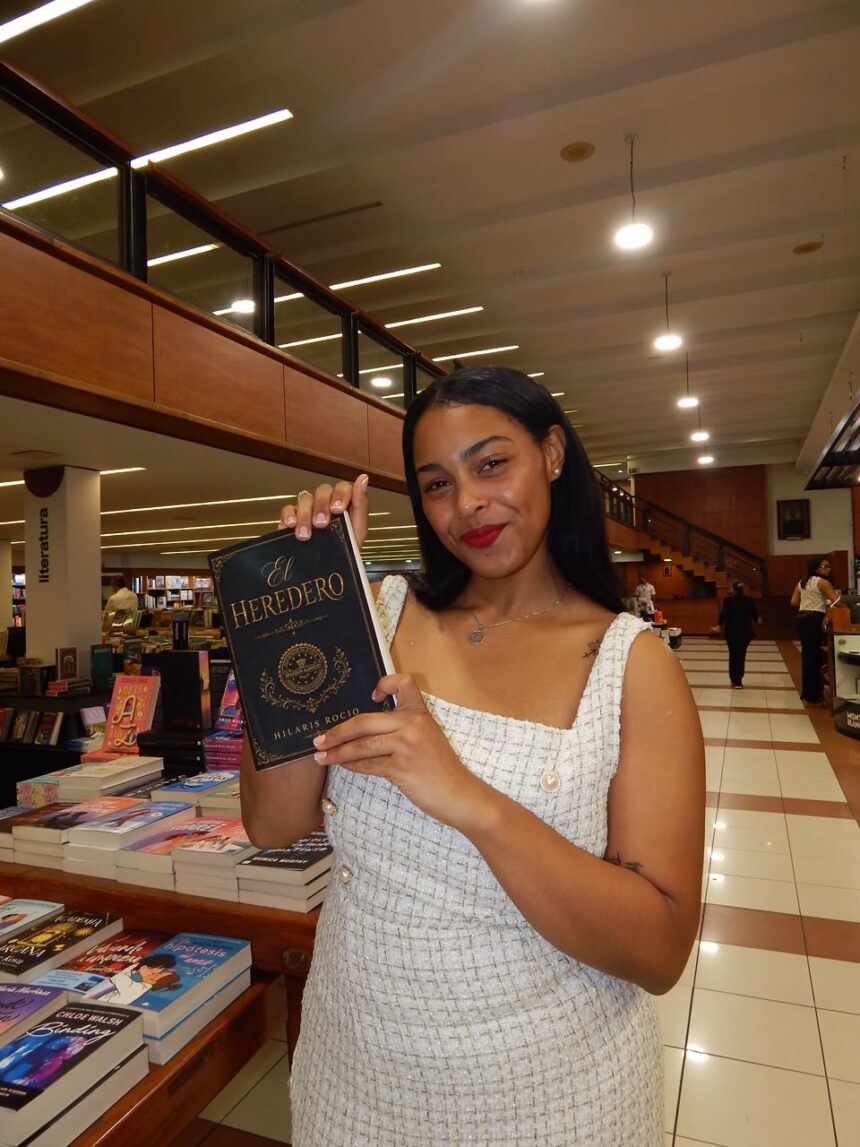
Santo Domingo. — Dominican writer Hilaris Rocio, author of Perfectas Imperfecciones, officially presented her latest novel, El Heredero, during an interview held at the Cuesta Libros bookstore, where she shared details about her literary career, the creative process behind her new work, and the importance that writing has had in her life.
For Rocio, becoming a writer was not the result of a plan laid out in advance, but rather a personal necessity that found in words a form of expression and refuge.
Her approach to literature began in 2013, when she started writing as a personal exercise on the digital platform Wattpad. What initially seemed like an intimate experience ended up becoming the beginning of a literary path that would later lead her to publish her stories in physical format.
The author acknowledges that writing acquired an even deeper meaning during the pandemic. In that particularly complex period, writing became a tool to cope with the circumstances and stay connected to her creative world. For Hilaris, literature was then a true “lifeline during the pandemic”.
You can also read: Dominican writer Esther A. Castillo presents
A story with drama, action and a young adult audience
More Read


The Heir is presented as a novel that combines elements inspired by dramatic soap operas and action movies, two references that, according to the author, influenced the construction of the story and its narrative universe.
Rocio emphasizes that the work is aimed primarily at a young adult audience, to whom she seeks to offer a dynamic, intense story loaded with situations capable of keeping the reader immersed in the plot.
Published on May 23, 2025, The Heir represents a new stage in Hilaris Rocio’s literary journey. The writer presents a darker and more complex proposal, with a story designed to captivate her readers and take them through a universe full of drama, action, and narrative twists.
More Read

With The Heir, Hilaris Rocio reaffirms a career that began unexpectedly on Wattpad and that, more than a decade later, continues to grow between digital platforms and the pages of printed books.
Their story shows that, at times, great vocations are not born from a plan, but from a necessity: the need to write, to tell stories, and to find in them a place to remain.