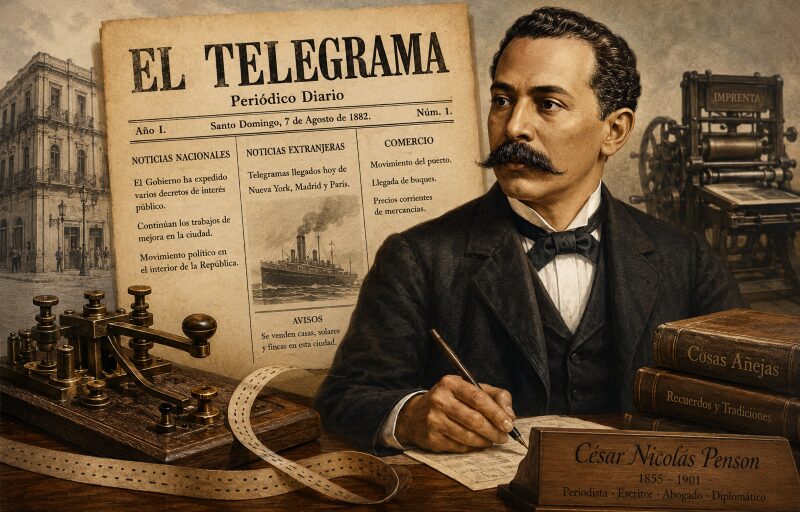
On August 7, 1882, El Telegrama began circulation, considered the first daily newspaper in the Dominican Republic, directed by the writer, lawyer, and journalist César Nicolás Penson, one of the most influential figures in national literature.
The emergence of El Telegrama represented much more than the birth of a new medium of communication. It signified the beginning of an informative culture based on consistency, immediacy, and a daily commitment to national events. Until then, most publications circulated sporadically. With this newspaper, the need to report every day was born, laying the foundations for modern journalism in the Dominican Republic.
That initiative paved the way for the emergence of new newspapers that, over the decades, consolidated a journalistic tradition that has accompanied the country’s main political, social, economic, and cultural events. It was born to report on the movement of vessels in the port of Santo Domingo and evolved to become one of the most important and longest-lasting newspapers in national history.
The name of the newspaper was not accidental. During the 19th century, the telegraph revolutionized communications by allowing information to be transmitted in a matter of minutes, reducing times that previously took days or weeks. Inspired by that technological advancement, El Telegrama adopted an identity associated with speed and current news.

Although El Telegrama ceased circulation years after its founding, its influence was decisive for the development of national journalism. The daily publication model paved the way for other media outlets to adopt a higher frequency of reporting and consolidate the press as one of the country’s main communication instruments.
More Read

Today, more than a century later, the written press continues to face enormous challenges. The digital revolution has transformed news consumption habits and artificial intelligence has changed the speed at which information is produced and distributed. However, no technology can replace the journalistic judgment, rigorous research, fact-checking, context, and human sensitivity that distinguish a good journalist.
True journalism continues to be built in the streets, in the communities, in the courts, in the hospitals, in public institutions, and wherever the news happens. It requires perseverance to work long hours, courage to ask questions when others remain silent, and ethics to publish only that which has been verified.