
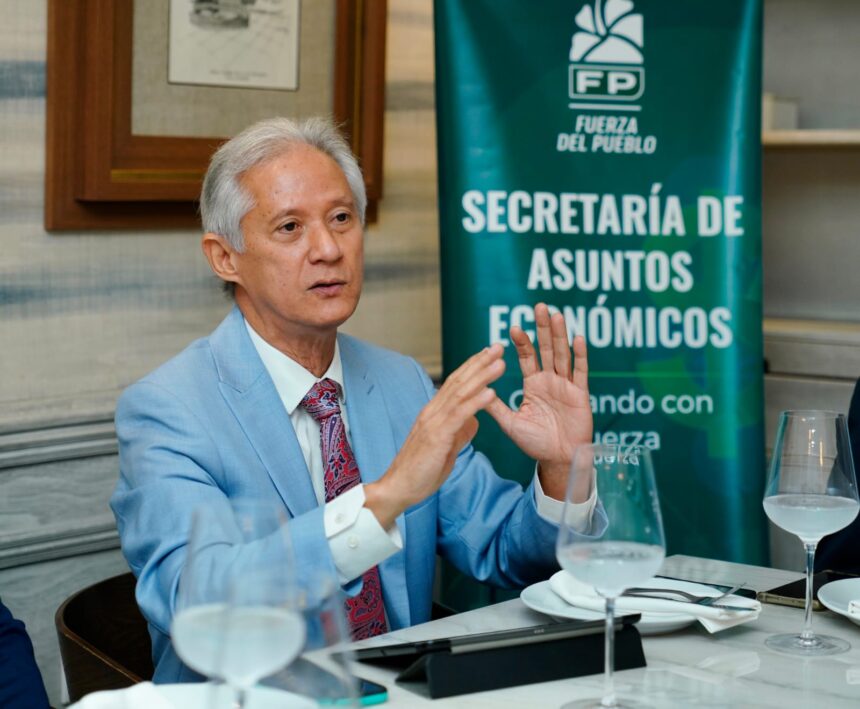
Santo Domingo. The Secretary of Economic Affairs of the People’s Force, Haivanjoe Ng Cortiñas, stated that the Central Bank’s data as of July 15, 2026, reflect an economy under inflationary pressure, lower liquidity for the population, and a sustained increase in quasi-fiscal debt.
During a meeting with the economic press, the economist maintained that the withdrawal of cash from circulation this year was twice as deep as in the two previous cycles, while the Central Bank’s debt continues to grow, the peso has appreciated, and credit support to the financial system has been reduced.
As explained, this combination of factors favors financial intermediation and importers, but harms lower-income households, remittance recipients, and export sectors.
Food inflation exceeds target
Ng Cortiñas indicated that the accumulated inflation in 2026 reached 5.7%, while that corresponding to food stands at 7%, both above the upper limit of the Central Bank’s target range, set at 5%.
He explained that this situation is regressive in nature because lower-income households allocate about RD$36 out of every RD$100 to food purchases, while higher-income households only dedicate RD$14 out of every RD$100 to that item.
More Read

We recommend reading: PRM ranks first among the governments that have indebted the Dominican State the most since 2004, asserts Haivanjoe Ng
In his view, the appreciation of the peso, which has reached 7.57% so far this year, has not managed to reduce the prices of basic products.
“The strong peso benefits those who import cars, appliances, or designer clothing. It hasn’t lowered the price of chicken, plantains, or rice,” he stated.
More Read

Less cash in circulation
Ng Cortiñas pointed out that the decrease in cash held by the public during the December-July period was significantly greater than in previous years.
In the December 2023 to July 2024 cycle, banknotes and coins held by the public went from RD$233,691.7 million to RD$222,265.9 million, representing a 4.89% reduction.
Between December 2024 and July 2025, they decreased from RD$255,127.9 million to RD$241,591.1 million, equivalent to a 5.31% drop.
In the period from December 2025 to July 15, 2026, they decreased from RD$292,959.4 million to RD$267,427.6 million, which represents a reduction of 8.72%.

He stated that, while historically the seasonal low hovers between 4.9% and 5.3%, this year it reached 8.72%, which evidences, according to him, an additional withdrawal of liquidity that cannot be attributed solely to seasonal behavior.
He considered that this situation mainly affects the informal economy, small businesses, and families that depend on cash for their daily transactions.
More Read

Quasi-fiscal debt increases
Ng Cortiñas expressed concern regarding the increase in Securities in Circulation issued by the Central Bank.
He specified that these went from RD$866,342 million in July 2025 to RD$828,345.5 million in December of the same year and reached RD$884,787.6 million as of July 15, 2026, for an accumulated growth of 6.81% so far this year.
He explained that these instruments represent the quasi-fiscal debt used to absorb liquidity from the market and generate a financial cost that is ultimately assumed by the State and the taxpayers.
Peso appreciation
Regarding the foreign exchange market, he indicated that the Dominican peso has appreciated significantly during 2026.
He recalled that the exchange rate went from RD$60.54 per dollar in July 2025 to RD$62.90 in December of that year and fell to RD$58.14 as of July 15, 2026, equivalent to an appreciation of 7.57% so far this year.
In their view, this behavior benefits importers and reduces the cost in pesos of the Government’s external debt service, but harms families who receive remittances, exporters in free trade zones and agro-export sectors, as well as the tourism sector.
Decrease credit to the financial system
The economist also highlighted that the Central Bank’s credit to other deposit-taking entities went from RD$106,399 million in July 2025 to RD$73,991 million in December and to RD$67,819 million as of July 15, 2026, which represents a year-on-year reduction of 36.26%.
Although he acknowledged that this decrease may be due to the normalization of the extraordinary measures implemented after the pandemic, he warned that it raises questions about the Central Bank’s responsiveness to potential liquidity tensions in the financial system during the second half of the year.
The statements were offered during a breakfast with journalists organized by the Secretariat of Economic Affairs of the Fuerza del Pueblo, in which the deputy secretaries Daris Javier, Erika Infante, Héctor Sánchez, and Bryan Ureña participated, along with the head of the entity, Haivanjoe Ng Cortiñas.