
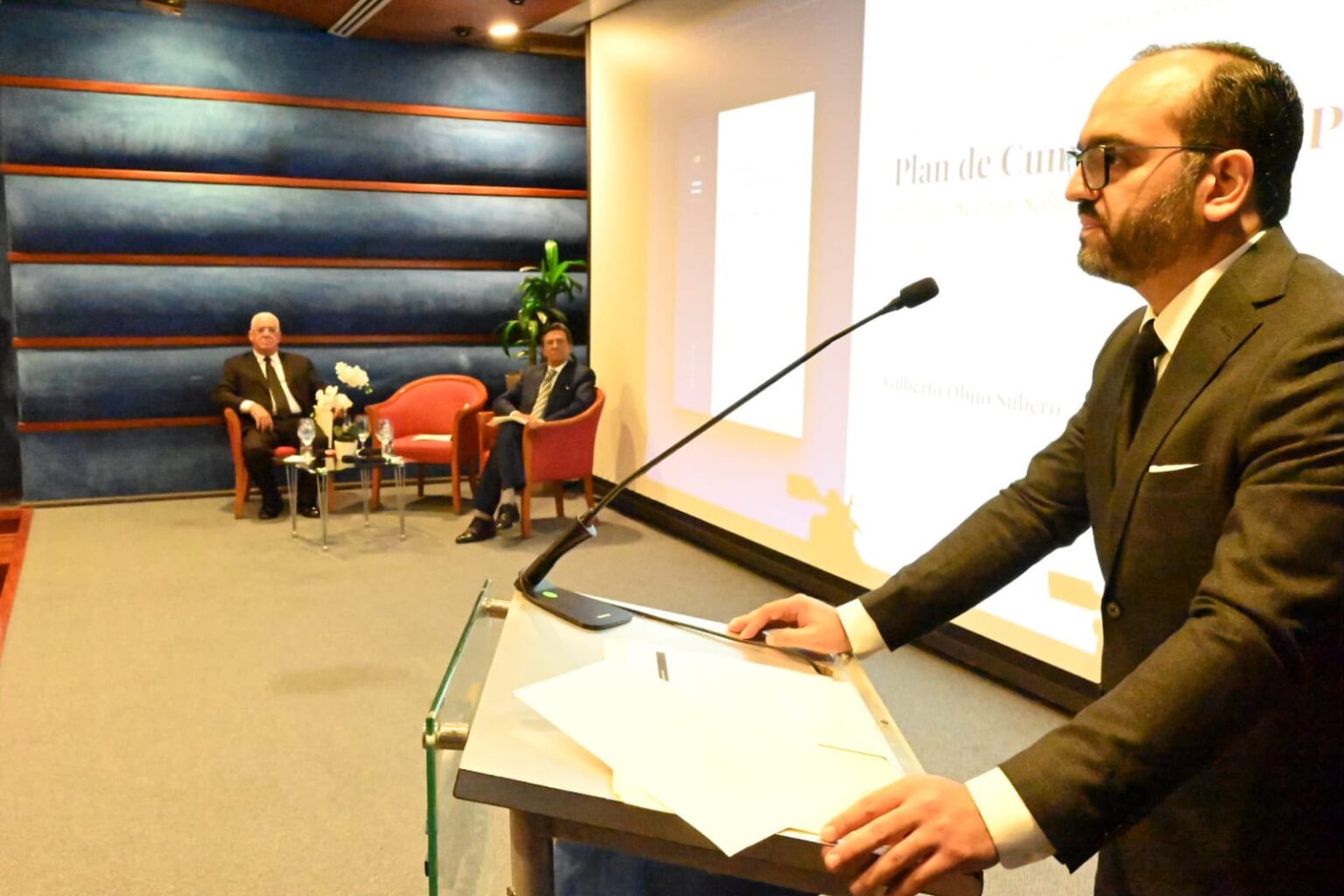

Santo Domingo. — The Global Foundation for Democracy and Development (Funglode) hosted, within the framework of its twenty-fifth anniversary, the launch of the Criminal Compliance Plan for the Health Sector, a work by lawyer Gilberto Objío Subero, MA and PhD(c) in Applied Artificial Intelligence. The work is aimed at health service providers, insurers, diagnostic centers, and other actors in the healthcare industry who must adjust their internal structures to the new regime of criminal liability for legal entities.
The act took place at a unique juncture. Three days earlier, on July 27, the Executive Branch promulgated the law amending the Penal Code, Law No. 74-25, and rewrote its article 8 to require eleven minimum elements for prevention programs, where the original text required only four. The book, written and composed months earlier under the previous wording, had already developed those eleven components based on the international compliance standard.
The presentation
The presentation of the work was in charge of its prologue writer, Dr. Severo Antonio Mercedes Acosta, a plastic, reconstructive, and aesthetic surgeon, holder of a law degree, head of the Plastic Surgery Service at the Salvador B. Gautier Hospital, and Master of Dominican Medicine. His dual training—medical and legal—allowed him to place the work at the exact point where both disciplines converge: the internal organization of the health center as an object of criminal assessment.
You can also read: FUNGLODE presents its cultural agenda and reaffirms its commitment to culture, thought, and the development of creative industries | De Último Minuto | Today’s news in the Dominican Republic
On behalf of the Funglode Center for Health Studies, its director, Dr. Héctor Eusebio, addressed those present and framed the work within the agenda that the department has been developing regarding the impact of the new Penal Code on the practice of medicine and the governance of healthcare institutions.

During the meeting, the compliance components that the new Penal Code introduces for the industry were analyzed, with particular attention to how these require the health sector to have a verifiable internal organization: identification of criminal risks specific to healthcare activity, an autonomous supervisory body, reporting channels with whistleblower protection, action protocols, internal disciplinary regime, continuous training, periodic review of the model, and document traceability.
The core of the exchange was that these elements do not operate as documentary formalities, but as conditions whose actual effectiveness determines the criminal treatment of the entity.
The author identified the calendar as the most immediate consequence. The bulk of the new Penal Code enters into force in the first days of August 2026. Articles 8 through 11—regarding the criminal liability of legal entities—were deferred by Article 31 of the amending law, which provides for their entry into force within a period of three months from August 5, 2026, intended for legal entities to adapt to the provisions of the Penal Code.
In that sense, the author pointed out that the implementation of the compliance program should not be approached as a reactive exercise after the full entry into force of the regulation, but as a task that must be completed and operational before it.

A work tool
When explaining how to use the book, Objío Subero highlighted that the work, in addition to its doctrinal development, incorporates templates and models ready for implementation, so that it functions as a work tool and not just as an academic reference text. The copies released include an insert with the updated status of the law, which includes the reformed article 8 and a comparative table between the original text and the current one.
Criminal Compliance Plan for the Health Sector is part of the line of work that its author has been developing at the intersection of medical law, civil liability, and regulatory compliance in the Dominican health sector.
About the author:
Gilberto Objío Subero is a lawyer, MA, and PhD(c) in Artificial Intelligence Applied to Business Productivity. He directs OBJIO LEGAL | MEDICAL LAW, a firm specializing in medical law, healthcare civil liability, and data-driven litigation data.