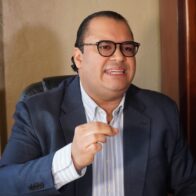
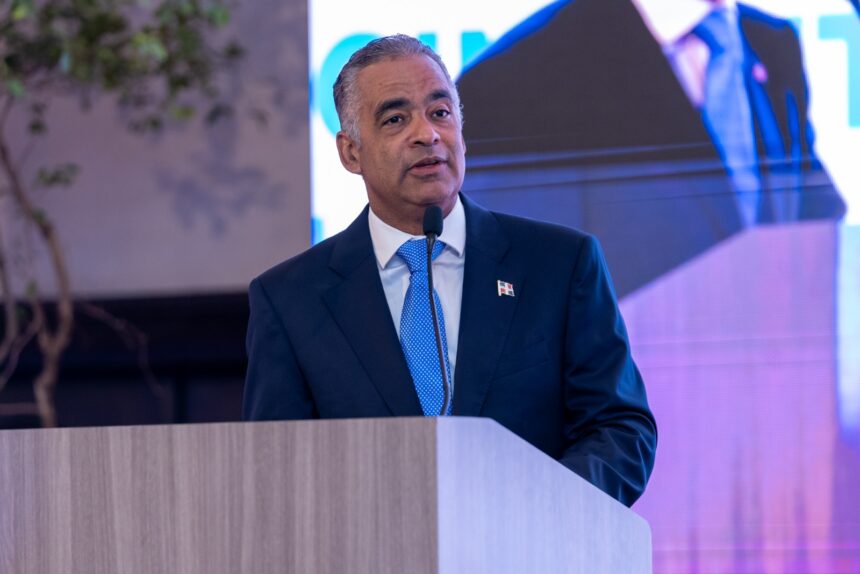
The Minister of Energy and Mines, Joel Santos, stated that the Dominican Republic has a defined strategy and planning focused on current demands and the requirements of the next decade, to face the challenges of the energy sector and the adaptation to new consumption trends and demand growth.
During the opening remarks of Energyear Caribbean 2026, a regional energy debate meeting held in Santo Domingo, with the participation of more than 600 representatives from energy sector companies and national and international experts, Santos explained that it is the Government’s responsibility to lay the foundations for energy development to be sustainable.
“What we do today will not only impact the present, but it will also impact the early years of the 2030s. If we do not initiate the generation, distribution, or transmission projects that will serve in the years beyond 2028, those who come after will not be able to deliver the results that the population deserves,” the minister noted.
The head of Energy and Mines pointed out that the increase in economic activity, together with technological changes, makes it necessary to prepare the system to respond to future needs. In that regard, he maintained that the design of that strategy is based on several premises, leaving the past aside as a sufficient reference for decision-making.
“We have a strategy,” the minister emphasized. However, he considered greater coordination between the public and private sectors to be essential, as well as regulation that anticipates structural changes and the speed of the energy transition.
More Read
“We must continue to seek firm energy capacity. A capacity that can meet the energy needs of the future, which are not those of today. Energy will be increasingly in demand and a lot of energy will not be enough,” the minister clarified.

Santos detailed that the Government’s roadmap covers areas such as the expansion of energy supply, the strengthening of electricity transmission and distribution, sector regulation, rural electrification, and the promotion of energy efficiency measures, in light of the challenges facing the sector, which include geopolitical turbulence.
During the event, the Vice Minister of Electric Energy, Ricardo Guerrero, participated in the panel “The energy future of the Dominican Republic: public-private coordination in an environment of new challenges,” a space in which he reiterated what was expressed by the minister and added that coordination among all involved actors can boost the development of the sector, guarantee supply security, and consolidate a modern and resilient electrical system.
More Read

The Energyear Caribbean 2026 agenda will address the main challenges and opportunities of the Dominican electricity system and the region as a whole, with panels focused on public-private coordination, the evolution of the regulatory framework, energy planning, the modernization of transmission and distribution networks, and the integration of new renewable technologies.
The event, which runs until today at the El Embajador Hotel, was also attended by Betty Soto Viñas, Vice Minister of Innovation and Energy Transition; Edward Veras Díaz, Executive Director of the National Energy Commission; and Alfonso Rodríguez Tejada, Executive Vice President of the Dominican Electric Transmission Company.
Also present were Charly de la Rosa, Manager of Alternate Sources and Rational Use of Energy, National Energy Commission (CNE); Aura Caraballo, member of the Board of the Superintendency of Electricity; Yomayra Martinó, Sustainability and Governance Advisor at the Dominican Electric Transmission Company (ETED); Ricardo Estevez, Senior Director of Development, EGE Haina; Monika Infante, CEO, Manzanillo Gas & Power, and Antonio Martorell, Commercial Director of the Punta Cana Macao Energy Consortium.