

Honduras leads violence in Central America with a rate of 23.2 homicides per 100,000 inhabitants, while El Salvador consolidated its decline, according to the annual homicide report by InSight Crime for 2025, which recorded at least 108,838 violent deaths in Latin America and the Caribbean.
Honduras closed 2025 with the highest rate among the countries analyzed, even after dropping from the 25.3 recorded in 2024. The 2,332 murders of the year placed the country among the most violent in the region, despite the government extending the state of exception as part of a hardline strategy that, according to the report, did not fundamentally alter criminal dynamics.
Criminal violence continues to strike regions such as Cortés, Yoro, and Colón amidst territorial disputes and drug trafficking.
Guatemala and the reactivation of MS13
Guatemala was the only country in the analyzed group that recorded a sustained increase attributable to a specific cause. Its rate rose from 16.1 to 17.4 homicides per 100,000 inhabitants, an 8% increase that InSight Crime linked to a resurgence of violence between the Mara Salvatrucha (MS13) and local criminal actors.

The organization operates on an extortion-based economy centered on bus routes and transportation networks. That territorial control, disputed with rival groups, explains a large part of the rise in murders recorded during the year.
We recommend reading: Leaders from Honduras, Guatemala, and Curaçao arrive in Colombia for the inauguration of Abelardo De la Espriella
Members of the Guatemalan Police and members of the Public Ministry (MP) inspect in front of a ceviche restaurant, where a shooting occurred that left 5 people murdered, this Monday in Guatemala City (Guatemala).
The Salvadoran case
El Salvador presented the lowest balance numbers: 82 homicides in all of 2025, equivalent to a rate of 1.3, the lowest in its history and a contrast to the 6,656 murders the country recorded in 2015.

The cumulative decline since President Nayib Bukele implemented the state of exception in 2022 has no statistical precedent in the region. The offensive managed to operationally dismantle MS13 and Barrio 18, which so far show no signs of reorganization.
An Insight Crime analysis details homicide rates and criminal dynamics in Honduras, Guatemala, Panama, and El Salvador for the 2023-2025 period. (Illustrative Image Infobae)
Costa Rica and drug trafficking
Costa Rica remained stable with a rate of 16.8, but the report points to a more worrying transformation than the number: the country has consolidated itself as a logistics hub for cocaine trafficking and violence is concentrated in the areas that serve those routes.
Costa Rican authorities dismantled last year what they consider the first transnational criminal group of local origin, the South Caribbean Cartel. President-elect Laura Fernández promised a hard-line response, although InSight Crime warns that regional evidence indicates that such strategies tend to have a limited impact.
Panama and the Dominican Republic
Panama recorded 593 murders, a figure higher than that of 2024, although insufficient to change the rate, which remained at 12.9. More than 40% of the cases were concentrated in the province of Panama and 20% in Colon, a port of entry for cocaine whose control is disputed by local gangs.
The Dominican Republic, on the other hand, completed its fourth consecutive year of decline with a rate of 8.7. Nearly half of its homicides are classified as social conflicts: personal disputes and domestic violence, while 29.2% were directly linked to criminal activities.
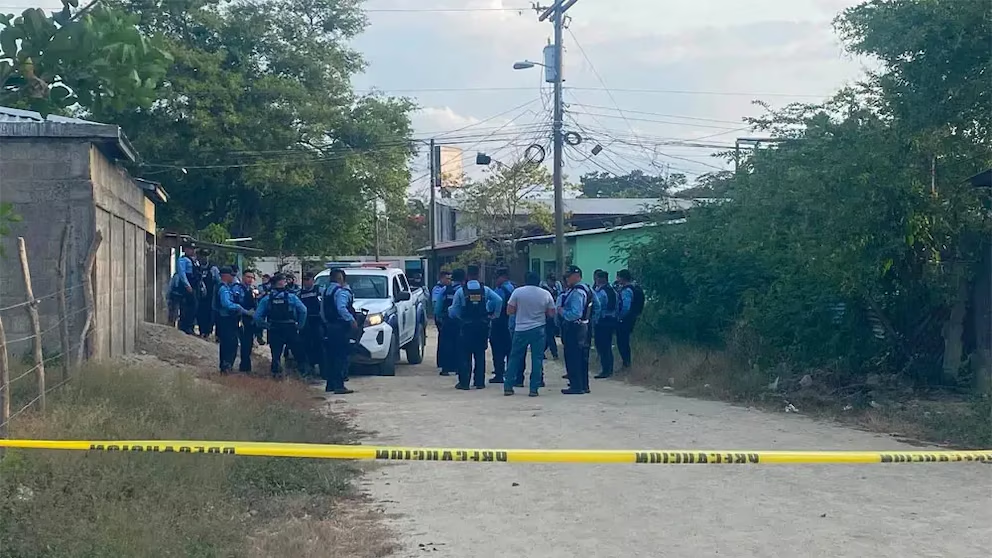
Police director Rigoberto Oseguera Mass confirms that there are already suspects wanted for the triple homicide in Atlántida.
A region with high rates
The median homicide rate in Latin America and the Caribbean stood at 17.6 per 100,000 inhabitants in 2025, more than 5% lower than the previous year, according to the same InSight Crime report. Researcher Juliana Manjarrés, from that organization, pointed out to Deutsche Welle, a German media outlet, that homicides “seem to be decreasing in the region, even taking into account the increase in disappearances.”
Territorial disputes over cocaine routes, extortion, and the expansion of illicit economies such as illegal mining and illegal loans remain the structural drivers of violence on the continent.