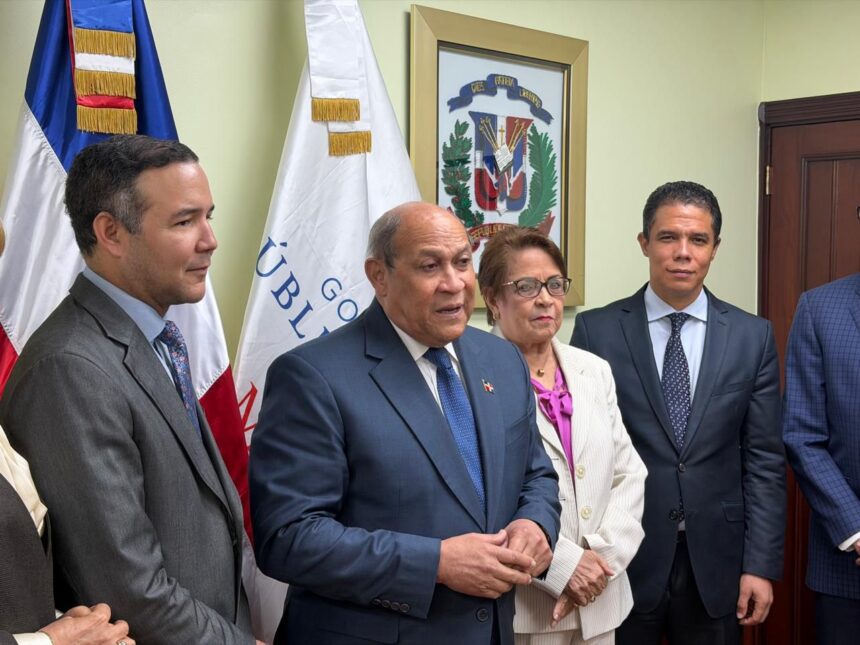
Santo Domingo. – The Minister of Higher Education, Science and Technology (MESCyT), Rafael Santos Badía, received a commission from the Academic Council of the Professor Juan Bosch Political Training Institute, with whom he discussed the progress of the evaluation process that the entity is developing with a view to obtaining its recognition as a higher education institution.
During the meeting, Santos Badía highlighted the results achieved so far in the review of the entity’s academic, organizational, and regulatory components, and explained that the evaluations carried out cover essential elements such as the academic plan, the institutional structure, and the regulations.
“I am very pleased to inform the country that all the evaluations of the academic plan, the structure, and the regulations of this institute meet the conditions to grant it recognition,” stated the minister.
The head of MESCyT reported that the technical commission responsible for reviewing the file will meet next Friday, after having carried out the evaluation visit to the institute, as part of the procedure established for this type of request.
Santos Badía expressed his expectation that the process will continue favorably and stressed that the decision must be made in accordance with the corresponding technical, regulatory, and institutional instances.
More Read

You can also read: MESCyT bets on STEM careers and announces 10,000 national scholarships on its 48th anniversary
The minister also highlighted the importance of initiatives of this nature contributing to the strengthening of academic training in the Dominican Republic, especially in areas linked to citizenship, public management, political thought, and the challenges derived from technological transformation.
In that context, he/she acknowledged the effort made to structure an academic proposal conceived to transcend the partisan sphere and be open to citizens interested in specialized training.
“It is very important that this institute functions. For me, it is a pleasure to receive this commission. It is a party that has contributed a lot to democracy in the Dominican Republic, and we can do nothing less than respect the effort they have made to have an academic training institution, where not only PLD militants will study, but also citizens of the Dominican Republic. So, count on my support and my consideration,” expressed Santos Badía.
More Read

Johnny Pujols highlights the importance of academic and technological training
During the meeting, the PLD secretary general, Johnny Pujols, thanked Minister Santos Badía and the MESCyT technical team for the attention given to the process and highlighted the relevance that the creation of formal training spaces has for the organization.
Pujols explained that the project seeks to articulate political training with technological knowledge, in response to the challenges facing Dominican society and, particularly, political activity in a context of digital transformation.
“For us, training is key, political training, but also in technology. It is a great challenge that politics and the country have,” he/she expressed.
Alejandrina Germán highlights the significance of the process
For her part, Alejandrina Germán, president of the Professor Juan Bosch Political Training Institute, described as significant the evaluation process that could allow the entity to reach the category of higher education institution.

“It is fundamental, it is very important, and it will be a great honor for me that this great institution can have the status of Higher Education Institute,” he stated.
The process is developed within the framework of the competencies of the MESCyT to evaluate compliance with the academic, institutional, and regulatory requirements applicable to entities aspiring to be recognized as higher education institutions.
If the recognition is finalized, the Professor Juan Bosch Political Training Institute could expand its academic proposal within the regulatory framework of Dominican higher education, in accordance with the scope of the corresponding authorization, strengthening training in areas linked to political thought, citizenship, public management, and contemporary technological challenges.