

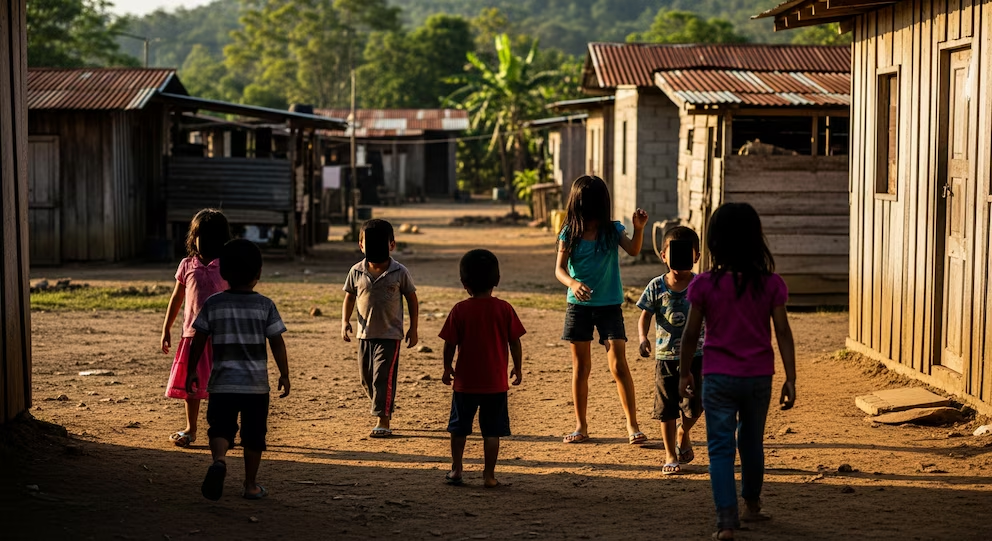

Costa Rica maintains a historical debt to its minor population. This is the conclusion of an investigation by the National University (UNA), which documents that 557,000 children and adolescents live in conditions of basic or extreme poverty, while the coverage of the National Care Network reaches barely 12% of those who require that service.
The findings are part of the publication Costa Rica’s debt to its children and adolescents, prepared by retired UNA academic Ana Teresa León Sáenz and presented at the Institute for Interdisciplinary Studies on Children and Adolescents (Ineina-UNA).
The study, the result of two years of research, compiles information from the country’s seven provinces and analyzes indicators related to poverty, violence, health, education, social protection, and early childhood. In addition to the diagnosis, the publication proposes a series of actions aimed at reducing the social gaps that affect this population.
“This publication is an effort to synthesize the main information regarding the situation of childhood by province. The idea is to motivate municipalities, institutions, and society as a whole to make a collective effort, because ignoring this debt is a gamble against us all,” stated León Sáenz.

The researcher, who was also the first director of Ineina and former executive president of the National Child Welfare Agency (PANI), warned that the lack of investment in childhood not only affects the well-being of thousands of minors, but also generates social and economic consequences that last a lifetime and are more costly to address in adulthood.
We recommend reading: Armed attack inside a home in Costa Rica leaves four men injured
The investigation warns that the National Care Network only reaches 12% of the population that requires this service. Credits: Freepik
Fewer births and greater challenges
The analysis also highlights demographic changes that could transform the composition of the Costa Rican population over the next decade.

According to research, births in the country have decreased by more than 35% over the last ten years. If that trend continues, by 2034 minors would represent only 11.6% of the national population.
Added to this landscape is another concern: the limited availability of updated official information on childhood and adolescence, as well as budget cuts that, according to the author, hinder the State’s ability to design public policies and respond in a timely manner to the needs of this population.
The document argues that the lack of timely data limits decision-making and hinders the identification of communities with the highest levels of vulnerability.
Births in Costa Rica have decreased considerably in recent years.
Proposals to reduce the social gap
As part of the recommendations, the research proposes strengthening preventive programs aimed at vulnerable families, expanding protection services for children and adolescents, and developing community strategies that allow for a comprehensive approach to the main social issues.
To achieve these objectives, the publication estimates an annual investment of nearly ₡40,000 million (USD 90 thousand) is necessary over a five-year period, resources that would allow for the expansion of care program coverage and the strengthening of prevention actions in different regions of the country.
The author maintains that investing during the early years of life generates long-term social and economic benefits by reducing factors associated with poverty, violence, exclusion, and educational lag.