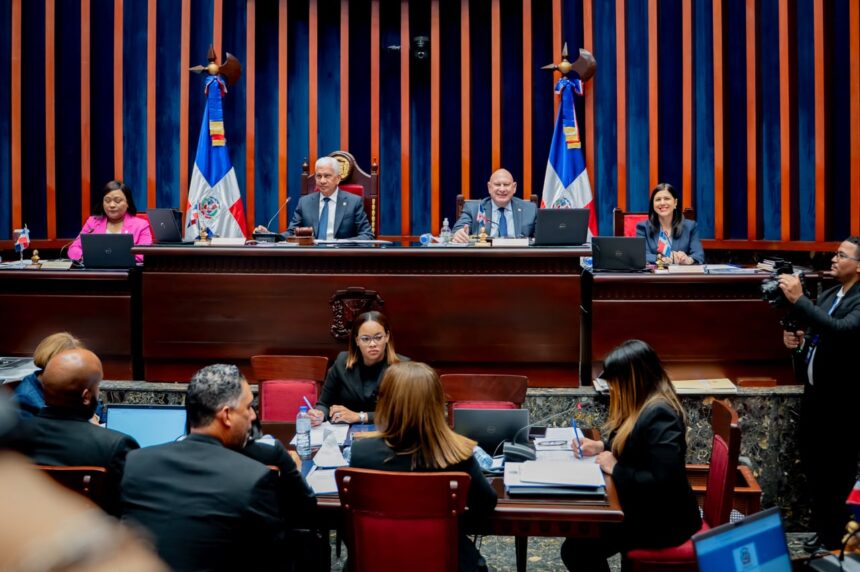
Santo Domingo. – The Senate of the Republic rejected this Wednesday three amendment proposals presented by the National District senator, Omar Fernández, during the review of the Penal Code reform bill (law 74-25).
The initiatives sought to strengthen the guarantees of freedom of expression and dissemination of thought, as well as to toughen sanctions against irresponsible celebratory gunfire when these cause permanent injury or the death of a person.
The proposals were rejected by a majority of 21 senators, who voted against the modifications submitted by the Fuerza del Pueblo legislator.
In that sense, Fernández proposed modifying article 123, regarding cyberbullying or harassment, and eliminating paragraphs I and III of article 211, concerning acts considered non-defamatory or injurious, understanding that their wording could be interpreted as a form of prior censorship, by conditioning the exercise of freedom of expression to requirements not provided for by the Constitution.
“Opinions and criticisms regarding matters of public interest should not depend on implicit authorizations or conditions that limit the exercise of that right. If an expression causes legitimate harm, that is what the courts are for. But the right to express an opinion cannot be conditioned before it is exercised,” he maintained.
More Read


We recommend reading:Senate postpones recognition of Frank Reyes due to weather conditions in New York
Likewise, he proposed modifying article 161 to establish a sanction regime proportional to the damage caused by celebratory gunfire, differentiating between non-permanent injuries, permanent injuries, and cases that result in death, with the goal of responding with greater severity to a behavior that claims innocent victims every year.
During his speech in the chamber, Fernández made it clear that he maintains his support for the approval of a new Penal Code, considering that the country cannot continue to face 21st-century criminality with legislation conceived in the 19th century.
“We need a new Code. We need to give the justice bodies a legal framework that allows them to do their job,” he expressed.
The senator recalled that the text incorporates long-awaited advances, such as the criminalization of contract killing, pyramid and real estate scams, identity theft, the use of chemical substances to assault people, child abandonment, cyberstalking, and the accumulation of sentences, figures that, he stated, strengthen the protection of victims and citizen security.
More Read

However, he maintained that acknowledging those advances does not prevent correcting aspects that could violate fundamental rights.
“This is not a debate between those who support or reject the Code. It is a debate about how to give the country the best possible Code,” he stated.