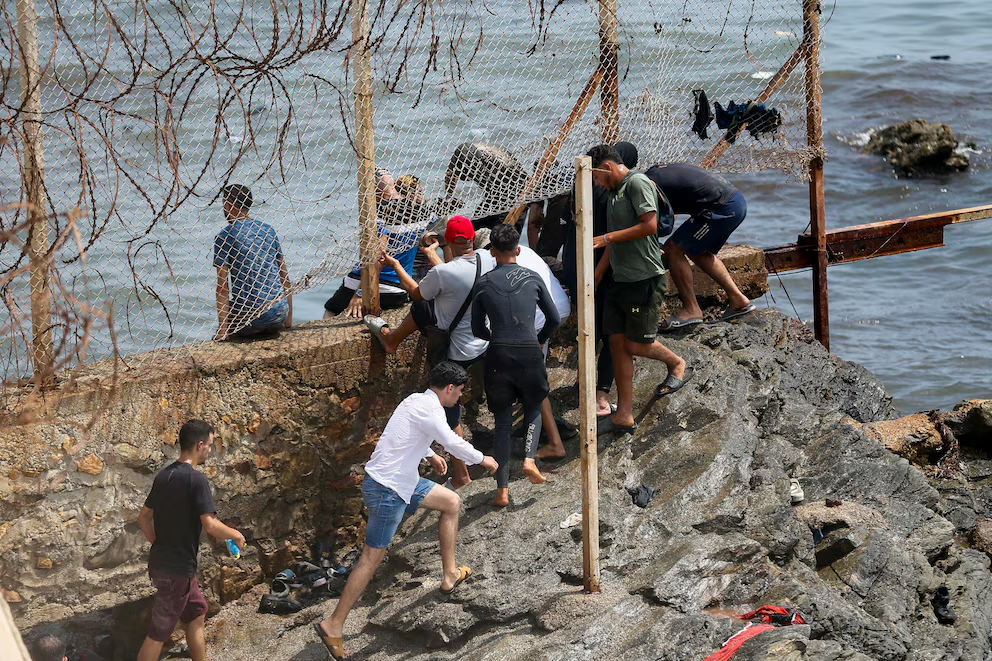
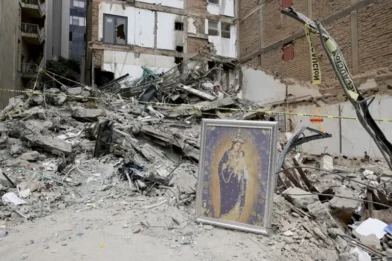
The migration crisis affecting Ceuta has opened a new front (this time diplomatic) with Italy. The Minister of Foreign Affairs, José Manuel Albares, has summoned the Italian ambassador to Spain, Giuseppe Buccino Grimaldi, following statements by his Italian counterpart, Antonio Tajani, in which he expressed support for closing the Schengen area with Spain due to the situation in the autonomous city.
“This message is unbecoming of the Foreign Minister of a partner and friendly country from whom we expect European solidarity and not partisan demagoguery,” Albares stated in a message on the social network X, in which he echoes those words from Tajani. Words in which he links the events in Ceuta to the immigrant regularization process that has taken place in Spain. On a day of maximum alert due to the massive arrival of people through the El Tarajal breakwater between Ceuta and Morocco, Meloni’s government had been raising the tone against Sánchez’s government, and the message from Tajani, his Foreign Minister, has fueled fears that migrants could move freely through the EU once they take advantage of the regularization process that Spain has launched (even though the conditions imposed do not allow it).
“Irregular and uncontrolled immigration represents a danger to national security. The images arriving from Ceuta demonstrate how the decision of the Madrid Government to grant Spanish, and therefore European, citizenship to more than 500,000 irregular immigrants is deeply wrong and incentivizes human trafficking,” Tajani wrote on X.
But the regularization process that Spain has launched grants residency in the country, not nationality: it only allows one to reside and work in Spanish territory.
A multitude of people and vehicles gather at the Ceuta border at night, at an access point to Spain.
More Read

We recommend reading:Italy considers suspending the Schengen agreement with Spain due to the situation in Ceuta

Currently, the Schengen Area includes Germany, Austria, Belgium, Bulgaria, Croatia, Denmark, Slovenia, Spain, Estonia, Finland, France, Greece, Hungary, Iceland, Italy, Latvia, Liechtenstein, Lithuania, Luxembourg, Malta, Norway, the Netherlands, Poland, Portugal, the Czech Republic, the Slovak Republic, Romania, Sweden, and Switzerland. It is the result of an agreement by which several European countries abolished controls at internal borders (between those countries) and moved those controls to external borders (with third countries). The agreement has been in force since 1995 and establishes a common area that encompasses a large part of the European continent. Participating countries apply common rules for controlling external borders and also regarding visas and cooperation between police and judicial services in criminal matters.
The Supreme Court ruling
Albares, furthermore, has stressed the same argument that the Interior Ministry put forward this morning, which is that the events in Ceuta are related to a Supreme Court ruling (alluding to the one that determines that those who enter Ceuta and Melilla by swimming cannot be summarily expelled) and has nothing to do with the regularization process.
More Read

Army members deployed at the border of Ceuta with Morocco.
Government sources state in fact that “this crisis in Ceuta has nothing to do with the regularization of migrants approved by the Government of Spain as is being falsely claimed by some quarters. It is false that any person who has crossed in these days can avail themselves of this process since it requires very defined requirements, such as proving residence in Spain before January 1, 2026, and having remained in Spain for 5 continuous months at the time of submitting the application.
ADVERTISINGShocking images showing thousands of migrants attempting to cross the maritime border between Morocco and the Spanish enclave of Ceuta. The crowd gathers at the fence and swims in a desperate attempt to reach European territory. (X: @karimprim)
“This crisis has its origin in an interpretation of the Supreme Court’s decision, which prohibits the pushbacks of people who arrive by swimming, which has been instrumentalized by mafias and criminal organizations to take advantage of the extreme vulnerability of migrants,” these same sources assert.