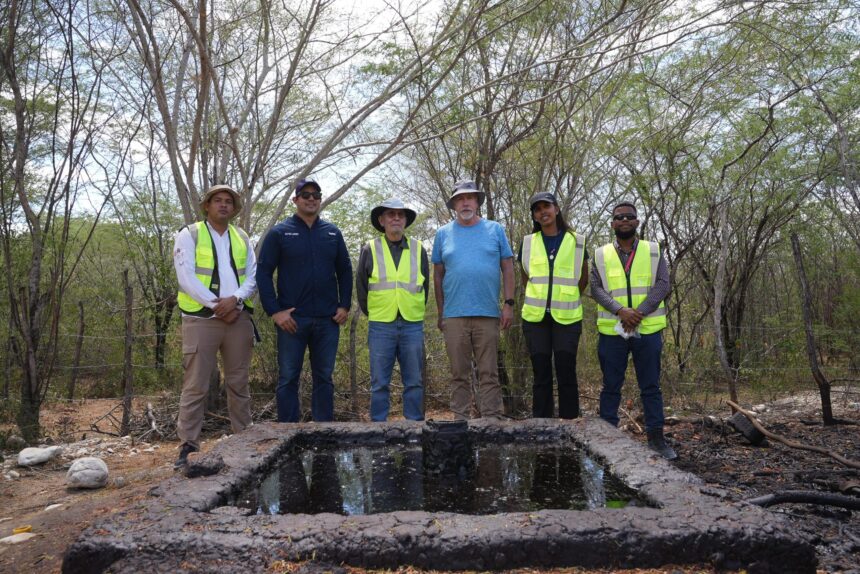
Geologists from the University of Texas at Austin (UT), accompanied by a technical team from the Ministry of Energy and Mines (MEM), conducted a field visit to the basin in the Azua province, with the objective of recognizing its formation, the types of rocks that compose it, and obtaining a geological interpretation of the area.
The mission was composed of the heads of the Energy Research Division, Mark Shustery from the Department of Petroleum and Geosystems Engineering, and Emilio Núñez, who lead a university delegation visiting the country to initiate a research project on the hydrocarbon potential available in the Dominican Republic.
The specialists, who recently met with Minister Joel Santos to present the foundations of the “Regional Assessment of Energy Potential in Terrestrial and Marine Sedimentary Basins, Dominican Republic and Adjacent Caribbean Sea,” toured the quarry where the company Cementos Santo Domingo operates and 14 points, among which the Trinchera, Sombrerito, Jura, Ventura, and Ocoa formations stand out.
Geologists took samples of the different types of rocks and were able to appreciate the varieties of rocks that make up the basin, their visible lithological characteristics, and take samples of these to deepen their knowledge and the processes that have affected them to produce their different levels of porosity, size, and aspects of interest for geological studies to determine strategic resources.

Other locations observed by experts and where there is interest in developing advanced studies were several of the Maleno wells, originally excavated by the Dominican Petroleum Company in the late 1930s, where there are crude oil outcrops that have historically been the subject of various evaluations to determine the feasibility of their potential exploitation.
More Read

The exploration route was guided by a technical team from the MEM, led by geologist Gelsa Pérez, in charge of the Hydrocarbon Promotion Department, and included the participation of technicians from the National Geological Institute (IGN), with whom they analyzed and discussed some of the findings and the history of explorations that have been carried out in the area by national and foreign companies.
The University of Texas at Austin, through its Bureau of Economic Geology (BEG), signed an agreement with the Dominican Government, represented by the MEM, to conduct a study that will allow for the alignment and strengthening of the country’s technical database in the hydrocarbon sector for its strategic and reliable use in attracting foreign and local investment.
The BEG is one of the oldest and most respected research centers in the United States, dedicated to the analysis of mineral and energy resources, including hydrocarbons. Its relationship with governments and international companies makes it an ideal strategic partner for projects such as the one announced by the Dominican Republic to determine its geological and energy potential.