New York.- The democratization of generative artificial intelligence (AI) has granted artists and enthusiasts a “god-like power” capable of subverting physical reality and merging the senses.
Through multimodality, new tools allow the creation of worlds that are both imaginative and hyperrealistic, or that music transcends the auditory to transform into interactive visual experiences, breaking traditional barriers.
Google Labs recently allowed a group of artists – from fields as diverse as architecture, fashion, journalism, and cinema – to use its latest video generation tool, Flow, to develop short films in six weeks.
Manipulating Nature
Despite their different geographical and professional origins, the projects revealed common trends such as the deliberate rejection of digital “perfection” – the artists opted for human faces with acne, scars or broken teeth – or the manipulation of nature, by creating worlds where snow rises instead of falling or nature dominates everyday spaces.
Lucas Ortiz, director and one of the participants in the project, explained in an interview with EFE this new relationship with the divine: “In some way, AI gives you a kind of deity power. Suddenly, the power to manipulate nature gives you a feeling of awe… as if the power to change it traps you.”
Ortiz is currently working on the release of his film ‘The Explorers,’ an AI-generated work that tells the story of an image creator who is asked to generate images of the conflict in Gaza, triggering a reflection on the very nature of artificial intelligence.
Conflict in the industry
The Spanish artist explains that the process of creating a film with AI is completely different from creating a conventional film: “We all looked at the screen together. I would say: ‘I like this, I don’t like this’; the assistant director would say: ‘Now we cut’,” he relates about a process that combined three months of generation and three months of editing.
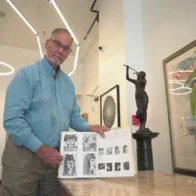
Fotografía de archivo del director de la película ‘The Brutalist’, David Jancso. EFE/Caroline Brehman
Although the director foresees an incredible “boom” in CGI (computer-generated imagery) and post-production processes that could drastically reduce costs, “like producing a ‘Superman’ for 100 million dollars instead of 300”, he considers that auteur cinema entirely made with AI is still far off.
However, technological advancement is not without legal and social conflicts. AI was one of the triggers for the recent strikes in Hollywood and the video game industry.
The film ‘The Brutalist’ was heavily criticized after editor Dávid Jancsó revealed the use of AI (Respeecher) to make actors Adrien Brody and Felicity Jones sound more authentic when speaking Hungarian. However, Brody won an Oscar for his performance in the film.
The Future of Sound
In the musical field, the rise of AI has made it difficult for the human ear to distinguish between a song created by a human being or by a machine. Free models like Suno and Udio are some of the most popular, as they allow you to create songs of any style, on any topic and in several languages.
Elias Roman, senior product director at Google Labs, tells EFE that completely new genres will emerge.
“You’ll be able to turn your song into a video game or an interactive visualizer. We’ll see more authentic relationships where people create music for their inner circle, like personalized birthday songs,” explains Roman.
The biggest headache for these new AI tools is copyright; that is why many models do not allow the user to insert song lyrics or use voices – even their own – for fear of facing a lawsuit.
«The technical part isn’t the difficult thing; the difficult thing is ensuring that there is a responsible way of doing it, so that if you say it’s your voice, it really is,» explains Roman.
In 2024, more than 200 artists, including Billie Eilish, Pearl Jam, and Katy Perry, asked technology companies to stop using AI to «infringe and devalue the rights of human artists».