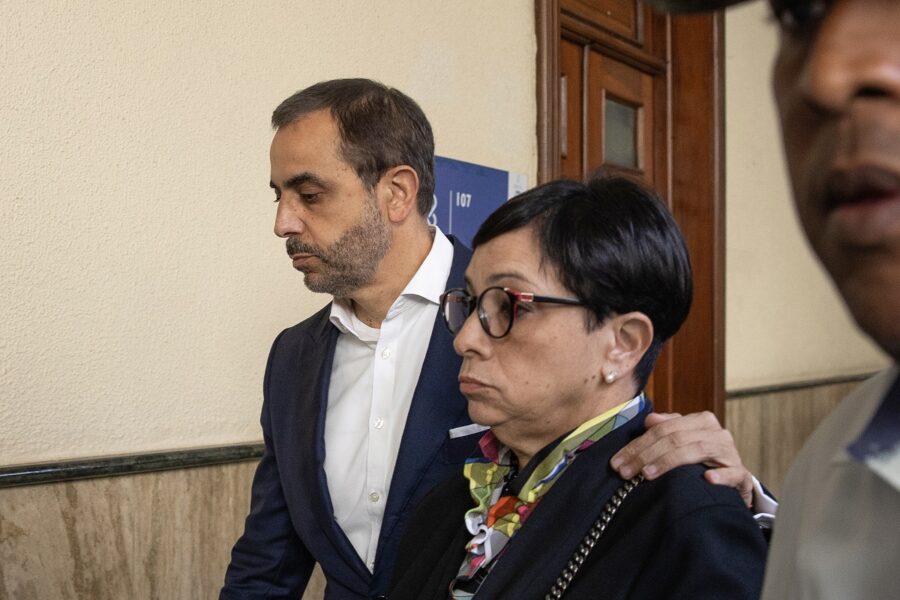

The technical defense of Antonio and Maribel Espaillat López filed an appeal against the resolution that modified the legal qualification of the proceedings following the Jet Set tragedy, considering that the decision violates the principle of criminal legality and other fundamental guarantees recognized by the Dominican Constitution.
Through the appeal, the lawyers request the revocation and annulment of Resolution No. 042-2026-TRES-00048, issued on October 15, 2026, by the Fourth Chamber of the Criminal Court of the First Instance of the National District, which substituted the classification of involuntary homicide and battery for that of voluntary homicide and battery, under the concept of so-called eventual intent (dolo eventual).
The variation of the legal qualification was requested by the plaintiff parties, without the Public Prosecutor’s Office adhering to said request. The defense questions both the legal basis of the decision and the procedure followed by the court to adopt it.
The defense maintains that the principle of legality constitutes an essential guarantee of the rule of law, as it requires that every citizen be able to know in advance, based on a prior, clear, and precise law, which behaviors are criminally prohibited and the consequences of committing them.

In that sense, it questions that the judicial decision resorts to a construction developed by legal doctrine to attribute to the provisions of the Penal Code a scope that, in the opinion of the appellants, was not established by the legislator.
Lawyers remind that criminal law is subject to strict interpretation, except when the interpretation favors the accused, and warn that doctrinal constructions, although they contribute to the development of law, cannot replace the will of the legislator nor be used to expand the criminal liability of citizens.
As an example, lawyers point out that the new Penal Code expressly contemplates deaths caused by negligence, even when there is knowledge of their possible consequences, as well as specific provisions for commercial establishments and entertainment venues where deaths occur due to breaches of certain safety obligations.
In the defense’s view, this regulation reaffirms that it is the responsibility of the legislator, and not of doctrinal constructions used to expand the scope of a criminal rule, to establish punishable conduct and its consequences. All this without prejudice to the constitutional principle of retroactivity of criminal law when it favors the accused, the application of which depends on the specific provisions and the circumstances of the case.

The defense explained that the admissibility of the appeal is based on precedents from the Supreme Court of Justice that recognize, in certain exceptional circumstances, the possibility of appealing decisions other than convictions or acquittals. According to the lawyers, two independent grounds concur in this case: the declaration of incompetence that divested the court of jurisdiction over the trial and the alleged violations of fundamental rights. It will be up to the Court of Appeal to examine the admissibility of the appeal and the arguments presented.
The appeal also denounces that the court made premature pronouncements regarding the criminal liability of the defendants while the presentation of the prosecution’s evidence had not yet concluded, nor had the defense’s begun. According to the appellants, the resolution went so far as to declare the prosecution’s theory regarding intentional crimes as proven, compromising the presumption of innocence and the guarantees of a fair trial.
Likewise, the defense questions the procedure used to vary the legal classification, considering that the court improperly applied articles 327 and 328 of the Criminal Procedure Code. As it explains, the former allows for warning about a possible classification not considered by the parties, but not for deciding in advance on a variation that had already been raised and rejected in the preliminary stage; while the latter regulates cases linked to new facts or circumstances that arose during the trial, which do not exist in this case.
In addition to these irregularities, according to the appeal, the court allowed rebuttal interventions by the accusing parties, but subsequently closed the debate without granting the defense the corresponding surrebuttal or allowing the defendants to exercise their material defense regarding the request. The lawyers consider that these actions affected the equality between the parties, the principle of contradiction, and the right to defense.

The defense reiterated that these questions do not seek to disregard the magnitude of the tragedy that occurred at the Jet Set, but rather to ensure that the process is carried out with strict respect for the Constitution, the laws, and the fundamental guarantees that must be observed in every criminal proceeding.
Finally, he requested the Court of Appeal to revoke and declare null the challenged resolution and to order the continuation of the process under the legal qualification of involuntary homicide and battery, in accordance with the indictment, before a single-judge court other than the one that issued the appealed decision.