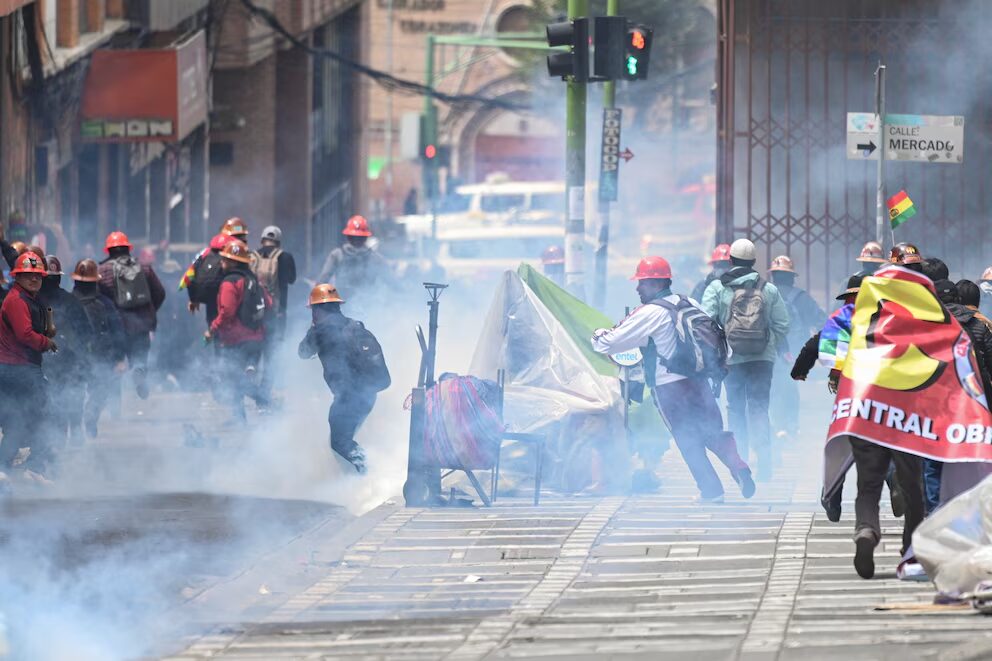
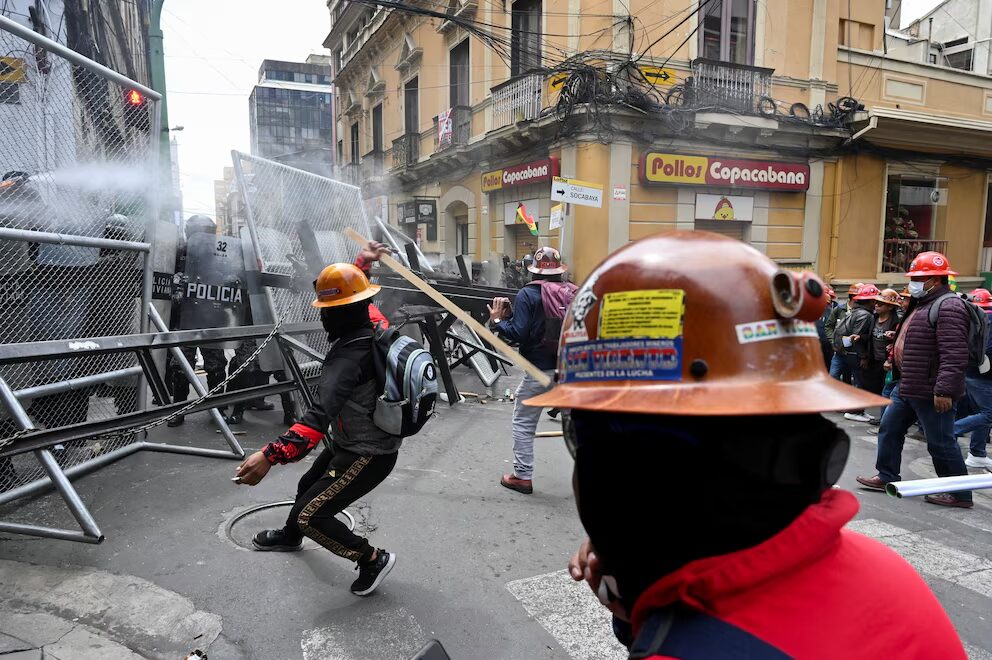
The elimination of the state subsidy for fuels in Bolivia caused an escalation of violence this Tuesday in the political heart of the country. A march called by the Bolivian Workers’ Union (COB) ended in clashes with the Police in the vicinity of Murillo square, in La Paz, where the Government Palace and the Congress operate. At least four agents were injured and had to be transferred to medical centers.
The mobilization brought together hundreds of workers, mostly state and private miners, as well as rural teachers and factory workers. The protesters tried to force their way into Murillo square from several access points, removing security barriers and pressuring the police cordons deployed to protect the zero kilometer of Bolivian political power.
During the incidents, firecracker detonations and dynamite charges were heard, a common practice in mining protests in Bolivia, which raised the level of risk in a densely trafficked area.
The Police responded with tear gas and pepper spray to disperse the protesters and prevent entry to the official perimeter. A police officer confirmed that “they have detonated dynamite; a medical evaluation will be carried out to determine the causes of the injuries and the ambulance transfer has already been activated.”
The exchange focused on key streets in the historic center, such as Yanacocha, Comercio, Socabaya and Potosí, and lasted for about 25 minutes. After the dispersal, the protesters retreated towards Mariscal Santa Cruz Avenue, one of the main arteries of La Paz, which was blocked for several hours, affecting traffic and commercial activity.
The top representative of the Bolivian Miners’ Union Federation, Andrés Paye, maintained that the mobilization was peaceful and blamed the security forces for the violence. “We tell the Government and the Police not to use tear gas. We are here and they provoke,” he affirmed, justifying the use of explosives as a defensive reaction.
The protest is framed within the rejection of Supreme Decree 5503, which ordered the total withdrawal of the subsidy on gasoline and diesel, in effect for more than two decades. The measure implied increases of 86% in the price of gasoline and 162% in diesel.
The Rodrigo Paz government argues that maintaining the subsidy would be fiscally unviable and that in 2026 it would demand an expenditure equivalent to 6.4% of the gross domestic product.
The Minister of Economy and Public Finances, José Gabriel Espinoza, defended the decision and called for de-escalation.
“We respect any mobilization that respects the rights of others,” he said, while expressing his expectation that “this will not go beyond tear gas” and that dialogue will resume. However, he questioned the COB’s position of demanding the annulment of the decree as a precondition. “That is not dialogue,” he stated.
The protests were not limited to La Paz. In El Alto, a neighboring city and union stronghold, groups of residents blocked the exit towards Oruro, while in the department of Chuquisaca road closures were reported, led by peasant sectors. The COB also called for an indefinite general strike, although its compliance has been varied.
The conflict represents the first major social challenge for President Paz since his assumption on November 8. The Ombudsman’s Office deployed personnel to mediate in the area of the clashes, while merchants from the center expressed their concern about the economic losses in a period of high activity prior to the holidays.
Periodista egresada de la Universidad Autónoma de Santo Domingo (UASD). Le gusta escribir sobre política e historias humanas que puedan transformar vidas. Actualmente cursa un master en Comunicación Política y Marketing Digital.