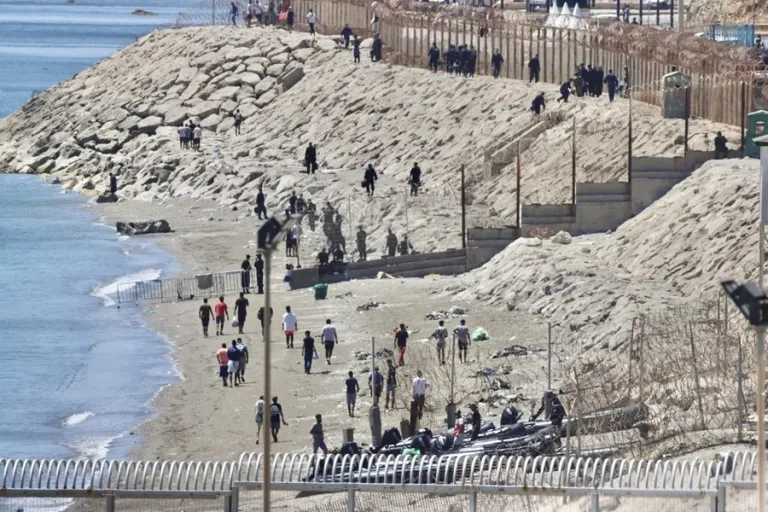

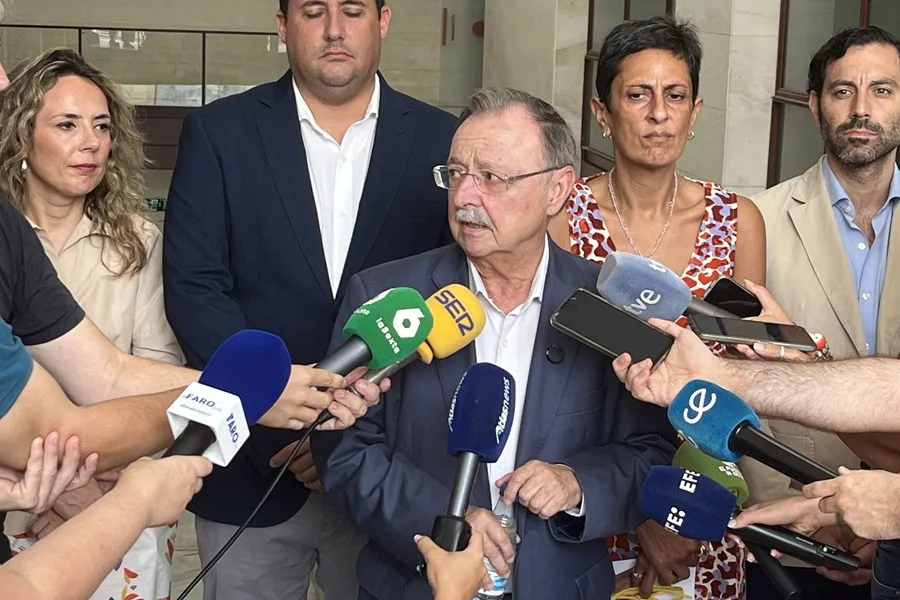

Ceuta .- The president of Ceuta, Juan Vivas, estimated this Saturday that between 8,000 and 11,000 people currently remain in the city due to the mass entry on July 30th and has demanded that the central government expedite their return to Morocco, considering it the “only way out” to resolve an “absolutely unsustainable” situation.
Vivas made these statements after the extraordinary meeting of the City’s Governing Council, convened to analyze the situation eight days after the massive entry of people from Morocco.
The president of Ceuta has rejected the idea that one can speak of normality in the city and has questioned the figures provided by the central government, which, as he indicated, place the number of people remaining in Ceuta at around 2,500.
“Estimates speak of between 8,000 and 11,000,” noted Vivas, who has demanded “transparency in communication” and an assessment of the situation that allows for a “proportionate” response.

Return to Morocco of the people who arrived in Ceuta
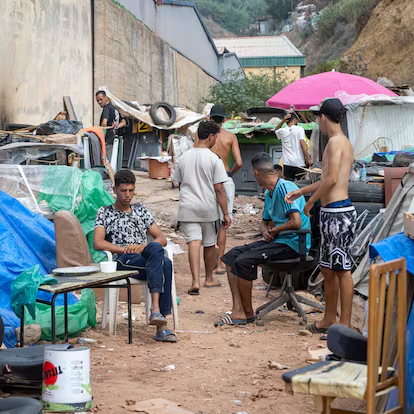
The president has described the current scenario as “absolutely unsustainable,” with thousands of people “wandering through our streets, through our neighborhoods, in the mountains, on the beaches, homeless, without having their basic needs met.”
In his view, this situation is generating insecurity, disrupting daily life, and putting coexistence at risk, which is why he has demanded immediate action from the nation’s Government.
Vivas has argued that the solution involves the return to Morocco of all the people who arrived in Ceuta during the influx and who remain in the city.
“The only way out is Morocco, through the Tarajal border,” he stated, before warning that those who remain in Ceuta must know that “there will be no papers here” nor “exits to the peninsula.”

The president has considered that the return constitutes a “lifeline” for the city because it would allow avoiding the creation of an expectation that could favor the repetition of similar situations in the future.
Material and human resources allocated to immigration
“If this is not done, the expectation will remain open and an unbearable uncertainty will remain for the future, for the stability and for the development of our city,” he warned.
To make this solution possible, Vivas has demanded that the central government reinforce the material and human resources allocated to the immigration department, with the goal that returns can take place “as quickly as possible”.
The request is in addition to two other measures proposed by the City: a notable increase in the presence of the National Police and Civil Guard on the streets and the maintenance of the Army in Ceuta to reinforce the sense of security among the population.

Vivas has insisted that the current situation is a consequence of a massive entry that, in his opinion, represented a violation of Spain’s territorial integrity and that requires a state response in accordance with its magnitude.
However, he has assured that the Government of Ceuta will maintain “institutional loyalty, responsibility, and a sense of State,” although he has demanded that the central Executive act with greater speed.
We recommend reading:
“What we are doing now is asking for what we are owed, because we are very aware that we are gambling with the future of our city,” he concluded.
A deployment of at least a thousand agents in Ceuta
The president of Ceuta, Juan Vivas, has demanded this Saturday a deployment of at least a thousand National Police and Civil Guard agents in the city and has demanded to “shield” the border with Morocco to prevent a massive entry like the one recorded on July 30 from happening again.
The president has considered the current number of personnel assigned to the city insufficient and has argued that, given the scale of the crisis, an extraordinary reinforcement would be reasonable.
“Don’t you think that the moment for Ceuta, the moment for Spain, was difficult and delicate enough that there should have been a deployment of at least a thousand police officers, between the Civil Guard and the National Police, who would have been conveying tranquility to the citizens?”, he asked.
Vivas has acknowledged the work being carried out by both the State security forces and bodies, as well as the Local Police and the Army, although he has warned that the police acknowledge that there is “precariousness in terms of the number of personnel”.
For this reason, it has demanded that the Government “significantly” increase the police presence on the streets while the current situation persists.
He has also defended that the Army should continue to be deployed in Ceuta as an element of security and tranquility for the population.
Border control with Morocco
The second major demand raised by Vivas refers to the border with Morocco, the control of which he believes must be fully guaranteed by Spain.
He stressed that what cannot be is for the border of Europe, of Spain, and of Ceuta to “be in the hands of a third country.”
In his view, Spain must have the necessary means to exercise effective control of the border and prevent a situation like the one on July 30 from happening again.
Vivas has called for the implementation of measures “of a preventive, deterrent and reactive nature” that allow for a response to any attempt at mass entry.
“It is unacceptable that situations like the one experienced on July 30th should happen again. Not in a few days, nor ever,” emphasized the Ceuta president.
Ceuta calls for calm ahead of a possible mass entry on August 15th
The president of Ceuta, Juan Vivas, acknowledged this Saturday the existing fear among citizens regarding the possibility that a new mass entry from Morocco could occur on August 15, although he has sent a message of reassurance and expressed confidence that the central government will adopt the necessary measures to prevent a repeat of the situation from July 30.
Vivas has admitted that the concern of the people of Ceuta is understandable after the massive influx at the end of July highlighted, in his view, the vulnerability of the border.
Following the extraordinary meeting of the Governing Council, the Ceuta president explained that the Autonomous City does not have sufficient capacity to guarantee on its own that a similar situation will not happen again, which is why he has transferred that responsibility to the nation’s Government.
“I hope the Government fulfills its obligation,” stated Vivas, who has demanded that preventive, deterrent, and reactive measures be adopted to address any eventuality.
Vivas has insisted that the priority must be to prevent a recurrence of a situation he has defined as a “trauma” for the city.
“I hope, therefore, that the pertinent preventive, deterrent, and reactive measures are taken so that neither on August 15th nor ever again do we experience a trauma like the one we lived through this past July 30th,” he stated.