
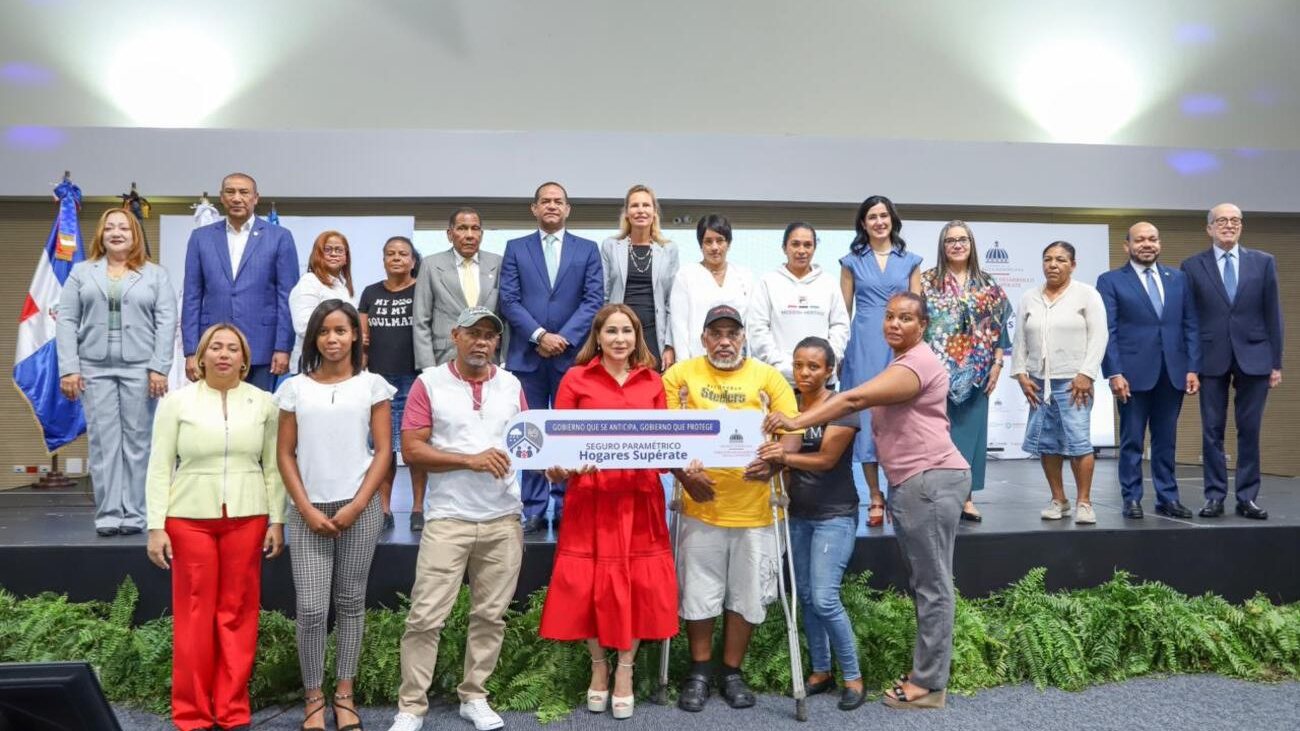

Santo Domingo.– The Dominican Government, through the Supérate Social Development Directorate, together with the United Nations Development Programme, presented the “Parametric Insurance Project for Supérate Households,” an initiative that will initially cover 3,030 vulnerable families in Puerto Plata and Santo Domingo Norte to protect them against risks associated with heavy rains and hurricanes, positioning the Dominican Republic as the first country in Latin America to integrate this model into an adaptive social protection strategy.
At the presentation ceremony, the Director General of Supérate, Mayra Jiménez, highlighted that, with this innovative initiative, the Dominican Republic is advancing towards increasingly preventive and humane social protection, placing the country at the forefront in the region in terms of adaptive social protection.
“This insurance represents an additional layer of protection for households that are most exposed to the effects of weather events. Its value lies in the speed and timeliness of turning the State’s response into concrete support when families need it most,” he/she expressed.
We recommend reading:Santiago Matías reports he has received threats from the Government

Meanwhile, the UNDP Regional Director for Latin America and the Caribbean, Michelle Muschett, stressed that, by integrating parametric insurance into its social protection system, “the Dominican Republic is promoting an innovative approach to advance towards resilient human development, protecting the achievements made and expanding people’s capacity to withstand and recover from climate shocks.”
For her part, the German ambassador to the country, Maike Friedrichsen, maintained that like many countries in the Caribbean and Latin America, the Dominican Republic is feeling the effects of climate change with increasing intensity, and “this pilot project constitutes an important step in the direction of building more solid, sustainable, and resilient protection systems.”
Likewise, the Superintendent of Insurance, Julio César Valentín, pointed out that the parametric insurance pilot plan is an initiative of great importance for the country, as it is aimed at addressing the needs of the most vulnerable sectors and strengthening their response capacity in the face of adverse situations.
This innovative initiative represents a major milestone for the Tripartite Agreement Program, a public-private partnership between Supérate, the United Nations Development Programme (UNDP), the Insurance Development Forum (IDF), with funding from the German Government, through the German Federal Ministry for Economic Cooperation and Development (BMZ), via the InsuResilience Solutions Fund (ISF), whose objective is to strengthen the resilience of developing countries against climate risks.

The success of this pilot has been possible thanks to the technical support of the UNDP and its commitment to sustainable human development. Joining this effort is the strategic collaboration of the Superintendency of Insurance and Seguros Reservas, whose participation strengthens the insurance component of the initiative and lays the foundation for a national regulation on parametric insurance.
Likewise, it highlights the contribution of the international consortium Insurance Development Forum—comprised of Guy Carpenter Mexico, AXA Climate, Blue Marble, and CelsiusPro—which has provided the specialized knowledge necessary for the execution of the project.
How it will work
Parametric insurance provides financial protection against climate-related threats through a parametric mechanism that automatically triggers payments when predefined thresholds of excessive rainfall or strong winds are reached.

The project is free of cost for the beneficiary families and is 100% funded with international resources.
A risk level is defined from the start of the policy. If the rainfall or hurricane category exceeds the risk level, the insurance is automatically activated. The greater the climatic event due to heavy rains and hurricanes, the greater the payment received can be. Currently, the implementation of the insurance mechanism is subject to the corresponding regulatory processes and authorizations.
The PSA is a public policy approach that seeks to strengthen the resilience of the most vulnerable households. Its goal is to prepare them, help them cope, and enable them to adapt to different crises, such as climate change, preventing people from falling into extreme poverty.