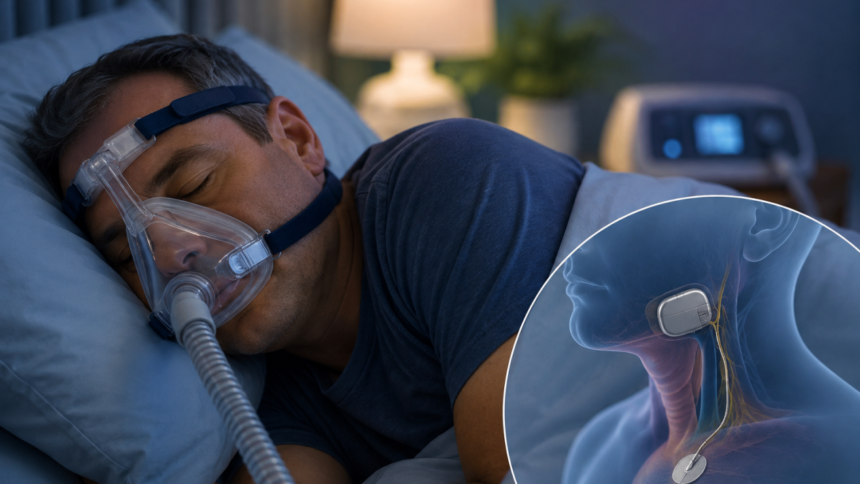
New York City has expanded treatment options for people with obstructive sleep apnea who have difficulty using traditional therapies. NYC Health + Hospitals/Kings County has begun offering the Genio system, an implant that stimulates the hypoglossal nerve to help keep the airway open during sleep.
The Brooklyn hospital is the first within the city’s public health system to offer the procedure, according to NYC Health + Hospitals. The technology is intended for selected patients with moderate to severe obstructive sleep apnea and does not automatically replace treatments such as continuous positive airway pressure, or CPAP.
How the new sleep apnea implant works
Obstructive sleep apnea occurs when the upper airway repeatedly becomes blocked while a person sleeps, causing interruptions in breathing.
The Genio system stimulates the hypoglossal nerve, which controls movement of the tongue. The stimulation helps move the tongue forward during sleep, reducing airway obstruction.
The U.S. Food and Drug Administration approved the Genio System 2.1 in August 2025 for certain adults with moderate to severe obstructive sleep apnea.
More Read

Unlike some earlier stimulation devices, Genio uses a component implanted beneath the chin through a single incision and does not have a conventional internal battery. The therapy is activated by an external component that the patient uses while sleeping.
What is the hypoglossal nerve?
The hypoglossal nerve, also known as the 12th cranial nerve, is a motor nerve responsible for controlling almost all tongue movements.

It allows the tongue to move during speech, chewing and swallowing. The nerve originates in the lower part of the brainstem and travels through the neck to the tongue.
More Read

Damage to the nerve can cause weakness or paralysis on one side of the tongue.
Who can receive the implant?
Not everyone with sleep apnea is a candidate for the treatment.
According to the FDA authorization, the system is indicated for adults ages 22 and older with moderate to severe obstructive sleep apnea, defined by an apnea-hypopnea index of 15 to 65 episodes per hour.
Candidates must also have failed, been unable to tolerate or been unable to use standard treatments, which can include:
- CPAP or BiPAP
- Oral appliances
- Lifestyle changes
- Certain medications
Before receiving the implant, patients at Kings County undergo a drug-induced sleep endoscopy. The procedure allows doctors to evaluate how the airway becomes blocked during sleep and determine whether the implant may be appropriate.