

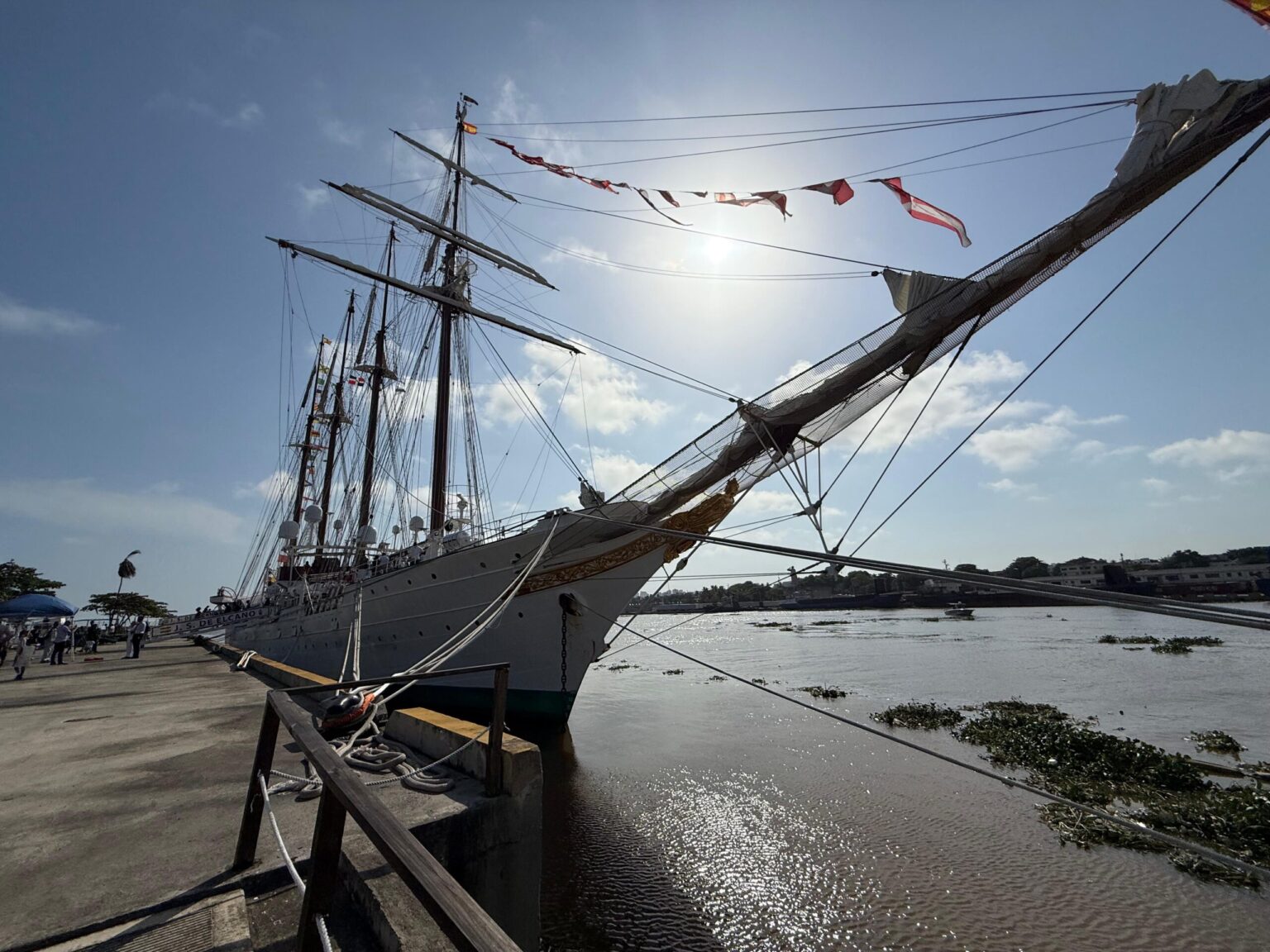

Santo Domingo,- Hundreds of people visited this Wednesday the training ship of the Spanish Navy Juan Sebastián de Elcano, with the heir to the Spanish crown, Princess Leonor, on board, during the stopover that the ship has been making since last Monday in Santo Domingo.
This was the first of the two days of public visits and Elcano registered a constant flow of visitors, especially Dominicans and Spaniards, but also of other nationalities, in many cases entire families with children.
You may be interested in: Juan Sebastián de Elcano Training Ship
After passing through security checks, the first image they see on the Punta Torrecilla pier, where the ship is docked, is that of a large vessel, with four tall masts and almost a century of existence, since it was launched in March 1927 and delivered to the Spanish Navy in August 1928.

Before boarding the ship, they are photographed with the vessel in the background and also with some of the more than 70 midshipmen who are part of this 97th training cruise, while comments such as “imposing”, “very nice”, “tremendous” or “beautiful” are generated.
Many acknowledge that they are especially attracted because this year the Princess of Asturias is being trained at Elcano: “We are delighted that they come to know this island,” says a group of Tourism Police (Politur) officers.
Dominican Daniel Otero, who is visiting the vessel with his wife, three daughters, and a son-in-law, highlights the “elegance” of the ship and the “good chemistry” between Spain and the Dominican Republic.
Otero also highlights the importance of the ship being in Santo Domingo for another year and this time with Princess Leonor on board, which “fills us with joy”.

A Spanish woman residing in the tourist town of Punta Cana in the Dominican Republic states that she is there out of curiosity because she had never seen the Juan Sebastián de Elcano before, and explains, “we have family who trained on the ship”.
Other visitors have belonged to the Dominican Republic Navy or have family members in it, so they are especially interested in the ship. This is the case of José Luis Ogando, who comes with his son, about 10 years old.
Likewise and from the pier, Ignacio Guillén narrates with his cell phone what he sees for a digital platform and underlines to EFE “the endearing brotherhood” between Spain and the Dominican Republic for centuries.
High turnout despite the heat
After yesterday’s flag swearing-in ceremony, this morning was the turn of the scheduled school visits, and this afternoon and tomorrow the ship will be open to the public.

According to some sailors, on each open day the Juan Sebastián de Elcano usually receives about a thousand visitors, although this may vary, for example if it is a weekend.
Proof of the influx is that, just two hours after it became accessible and despite the intense heat, some 500 people had already come to the ship this afternoon, in front of which the monument to Fray Antón de Montesinos can be seen.
The Juan Sebastián de Elcano is scheduled to remain in the Dominican capital until Saturday, when it begins its voyage to New York, its last stop in America, before embarking on its return to Spain, where it is expected to arrive in July.
Since it set sail from Cádiz in January, the Elcano has made stops in the Spanish Canary Islands, from there it set off for America and docked in Salvador de Bahía (Brazil), after nearly a month of crossing the Atlantic.
The following stop was Montevideo (Uruguay) and crossed the Strait of Magellan to call at Punta Arenas and Valparaíso (Chile), El Callao (Peru), Panama and Colombia (Cartagena/Santa Marta), to finally arrive on Monday in Santo Domingo.
As a training ship, the Elcano’s main mission is the comprehensive training of midshipmen (seamanship, military, social, and human), for which it usually carries out an instruction cruise every year, almost always outside of Spain, in which approximately three-quarters of the time is spent at sea.