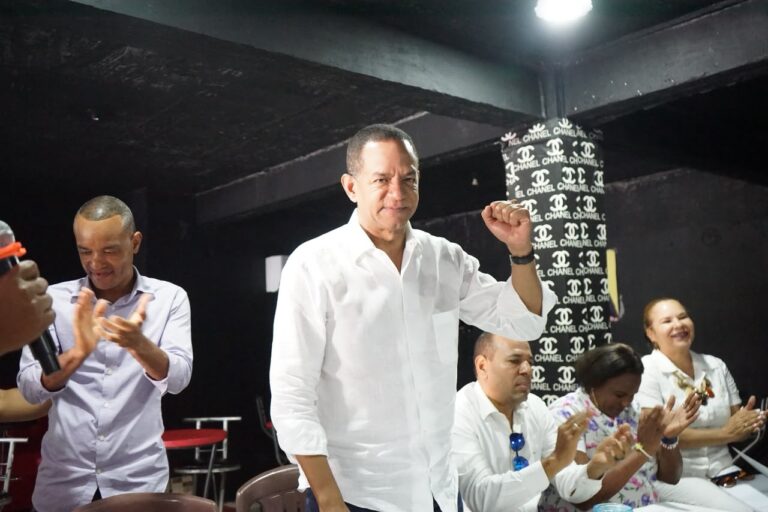



Three years after obtaining its recognition from the Central Electoral Board, the party highlights the results achieved in its first elections, the organizational process it is carrying out throughout the country, and the beginning of a new stage of institutional consolidation.
Santo Domingo.– The Social Justice (JS) party commemorates the third anniversary of its official recognition by the Central Electoral Board (JCE), with the goal of consolidating itself as a political force of influence and permanence in the country’s democratic life, after obtaining representation in local governments, making the largest contribution among minority parties to the 2024 presidential victory, and advancing in the formation of its territorial structures.
Legal recognition was granted through Resolution 33-2023 of the Plenary of the Central Electoral Board, published in July 2023, giving way to the formal birth of the political organization led by Julio César Valentín Jiminián.
Since then, the party’s growth has been accompanied by the National Directorate, led, in addition to Valentín, by the Secretary General Anyolino Germosén, mayor of Tamboril; the National Organization Secretary Rafael Hidalgo, mayor of Azua de Compostela; Vice President Benedicto Hernández; Vice President and former mayor of Hondo Valle, Nildo César; as well as by provincial, municipal, district, and community leaders who have contributed to the formation of the structures and the development of the political project in the different territories.

We recommend reading:DR reactivates development of decent work program with the ILO
From legal recognition to the construction of a national structure
Just eight months after obtaining its recognition, Justicia Social participated for the first time in an election, presenting candidates in the municipal elections of February 2024.
In that process, it obtained 13 mayoralties, 33 councilorships, and 7 vice-mayoralties, results that marked the beginning of its institutional representation in different districts of the country.
Subsequently, in the presidential and congressional elections of that same year, the organization obtained 49,419 votes on the presidential ballot as part of the RD Avanza alliance, placing itself among the main emerging political forces. According to official results, Social Justice was the allied party that made the greatest contribution to that coalition. In addition to this, it obtained a seat in the Central American Parliament (Parlacen).
As a result of that performance, the Central Electoral Board relocated Social Justice from the 34th position to the 10th position on the ballot for the 2028 elections.
Territorial organization and consolidation stage
Once the electoral stage concluded, Social Justice began an internal reorganization process aimed at consolidating its provincial, municipal, and district directorates.

Over the last few months, the National Directorate has been developing an agenda of tours throughout the different regions of the country, with the swearing-in of new structures, the incorporation of leaders, and work meetings aimed at strengthening political and organizational coordination. This process has had the active participation of territorial leaderships, who are responsible for driving the party’s growth and consolidating its presence in the communities.
For the president of Social Justice, Julio César Valentín, this stage prioritizes institutional consolidation over numerical growth.
“Here there is political quality. We do not aspire, at this stage, to a large organization; we aspire to an organization made up of women and men committed to the strategic objectives of building a more inclusive society and with a preferential commitment to the most vulnerable sectors,” the leader of the organization has expressed during his tours of the country.
Valentín has also pointed out that one of the party’s main challenges consists of strengthening political training and preserving the coherence of its project.
“Political parties that do not organize themselves and do not receive training in accordance with their declaration of principles end up losing coherence. We are building an organization with identity, preparation, and a vocation for service,” he maintains.
Principles, values and vocation for permanence
Justicia Social defines itself as a democratic, progressive, humanistic, feminist, and inclusive organization, supported by principles such as equal rights and opportunities, social justice, transparency, institutional strengthening, sustainable development, and environmental protection.