



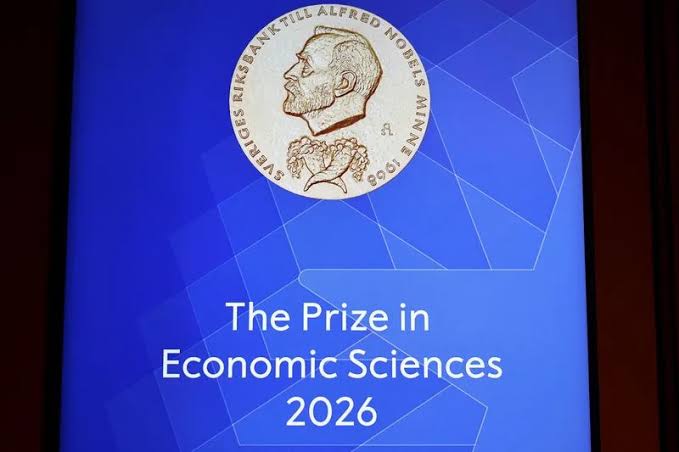
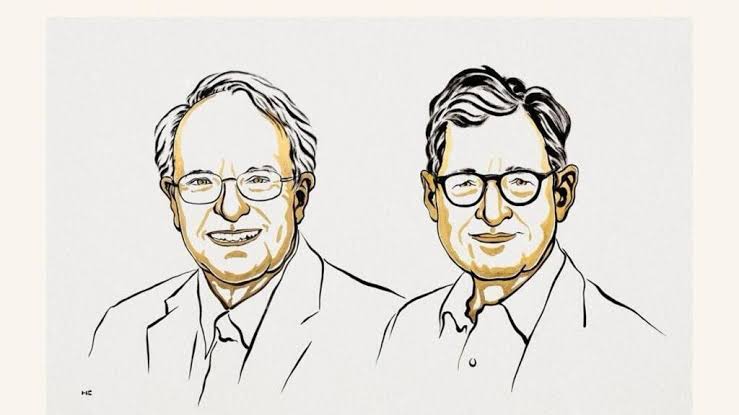
The Nobel Prize in Economics awarded Americans Robert E. Hall and Michael Woodford this Monday for the development of new micro-founded macroeconomic models that have improved the implementation of effective stabilization policies.
His research has driven a “paradigm shift” in those policies, incorporating the decisions made by individuals and companies, and has generated new Keynesian models that have allowed for better handling of crises, for example, during the coronavirus pandemic or the energy crisis of recent years.
“Recessions and episodes of high inflation have not disappeared, but they are less long-lasting,” noted the Royal Swedish Academy of Sciences in its motivation for the prize.
His work has provided a stable theoretical foundation for models that are now used by central banks and governments around the world.

“With them, we are better equipped to deal with disruptions in the economy such as energy crises or sudden changes in household consumption,” highlighted the chair of the Committee for the Nobel Prize in Economics, John Hassler.
The oil crisis calls the Keynesian model into question
The Academy recalled in its ruling that the economy alternates between phases of contraction and expansion and that stabilization policies have been key to addressing them since the economist John Maynard Keynes presented his theories nearly a century ago.
Traditional Keynesian models were based on the supposed stability of statistical correlations between macroeconomic variables such as inflation, consumption, or unemployment: during crises, the economy was stimulated by lowering rates and increasing the budget deficit, and vice versa.
But the oil crisis of the 1970s called those models into question, as they did not reduce unemployment and led to inflation spiraling out of control.
Economists such as Robert E. Lucas Jr. (1995 Nobel laureate) pointed out that the problem with those models was assuming that the relationship between those macroeconomic variables was stable and suggested that they should also include microeconomic relationships.
It was Robert E. Hall who, in an article published in 1978, solved the problems of those models and how private consumption is determined, initiating a new way of thinking, the Academy noted.
His central idea was that changes in consumption could not be forecasted, because they depend on new and, therefore, unpredictable information, which proved key to the development of modern consumption research.
In a later article, written with Fredric Mishkin in 1982, Hall showed -analyzing a series of households with microdata- that about 80% made decisions according to the theory, while the rest lived paycheck to paycheck.

New New Keynesian models
In 2003, Woodford presented a new Keynesian macromodel based on microfoundations, which has become the prototype for subsequent New Keynesian models.
Thus, when describing how consumption is determined, it includes Hall’s results on the dependence of household expectations on their future income or shows how central banks can stimulate or suppress economic activity by adjusting rates, rather than the amount of money in circulation.
Their model also explains how inflation is formed and helps to respond more effectively to shocks that can disrupt the balance between supply and demand, and which can be restored through a stabilization policy that reduces or increases the latter.
The Academy’s ruling highlights the simplicity of the model, which is nonetheless based on “pioneering” research.
“Its simplicity, combined with how well it adapts to reality, meant that it was soon accepted by those responsible for economic policy in central banks and ministries of Finance. The model can also be refined and adapted to the circumstances of each country,” the Academy explained.
Robert E. Hall (Palo Alto, 1943) serves as a professor at Stanford University (USA); Woodford (Chicopee, 1955) -awarded last year with the BBVA Foundation Frontiers of Knowledge Award- does so at the also American Columbia University.
Hall and Woodford succeed the American Joel Mokyr, the Frenchman Philippe Aghion, and the Canadian Peter Howitt in the Nobel list of winners, who were awarded in 2025 “for having explained economic growth driven by innovation”.
Both laureates share the 12 million Swedish kronor ($1.2 million, €1.1 million) that these awards are endowed with this year.
The Nobel in Economics, whose real name is the Prize in Economic Sciences in Memory of Alfred Nobel, is the only one of the six awards not created at the time by the Swedish magnate, but was instead instituted in 1968 from a donation to the Nobel Foundation by the Swedish National Bank on the occasion of its 300th anniversary.