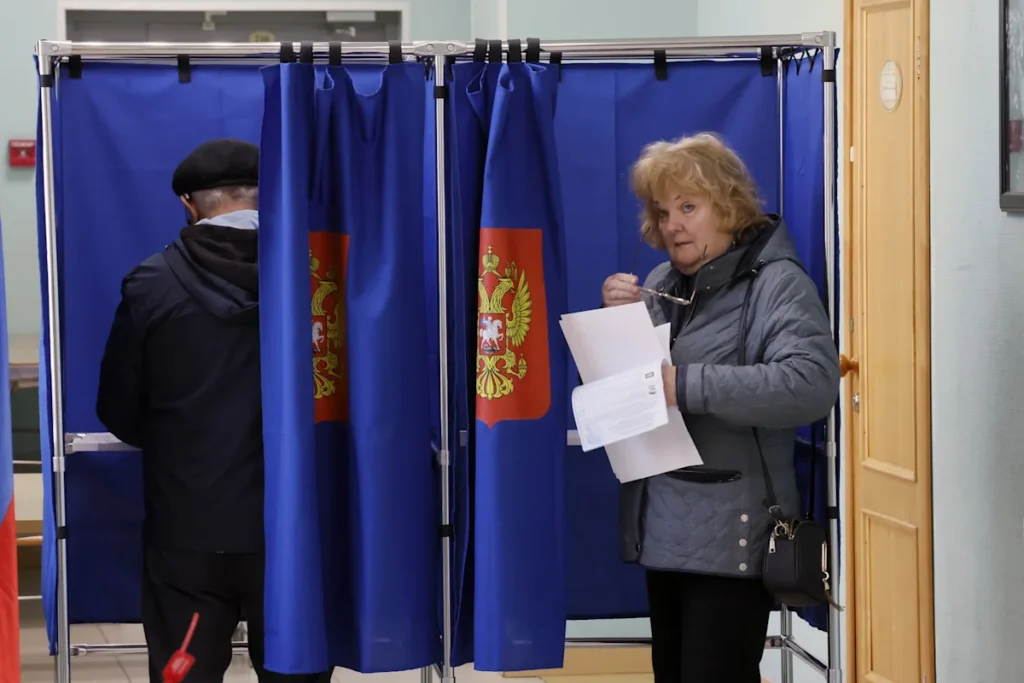
10% of Russian voters have already cast their ballots in the legislative elections that began this Friday and will continue until Sunday night, electoral authorities reported.
According to the website of Russia’s Central Election Commission (CEC), as of 2:00 p.m. Moscow time (11:00 GMT), 10.41% of voters had exercised their right to vote.
Voting in the Russian capital, as verified by EFE, was proceeding this morning without incident and amid tight security measures at the polling stations.
You might be interested in: Putin opts for ‘online voting’ again in Russian elections

Regarding electronic voting, heavily criticized by the opposition, the participation of Russians who chose that method in these elections exceeded 50% in the first hours of voting and reached 50% of registered voters.
Polling stations opened in the Russian capital, Moscow, at 08:00 local time (05:00 GMT), nine hours after they did in the Chukotka district and the Kamchatka peninsula, the two easternmost regions of this country.
Ban on the pacifist party and voting in occupied territory of Ukraine
More than 111 million Russians in 89 regions are called to the polls over the next three days to elect the 450 deputies who will make up the Duma or lower house of Parliament in more than 90,000 polling stations.
Russians residing in 152 countries will also be able to exercise their right to vote, where the Ministry of Foreign Affairs set up 333 polling stations, many of them in diplomatic missions.
Theoretically, more than 1.8 million Russians abroad can vote, although the number of polling stations has been reduced in countries like Germany, where there will be only two compared to the 16 in the previous vote, or in Israel with three instead of thirteen.
The Kremlin party, United Russia, will attempt to revalidate the constitutional majority it achieved in 2016, for which a low turnout among supporters of peace is in its interest.
According to official polls, he has a voting intention of 33-37%, although independent companies give him barely 25%. Be that as it may, experts believe that in the end he will obtain around 50% of the votes.
Three or four other parties are expected to enter the parliamentary arch, led by the communists, who have criticized electronic voting, considering it a tool for manipulation.
The only party that opposes the war, Yabloko, will not be on the ballot after being excluded by the Supreme Court, but a hundred of its candidates still have options to win a seat as a deputy in electoral districts.

The European Commission criticized this Friday the veto in the Russian elections of some opposition candidates and the organization of legislative elections in occupied Ukrainian territory, which it considered “one more violation of international law”.