

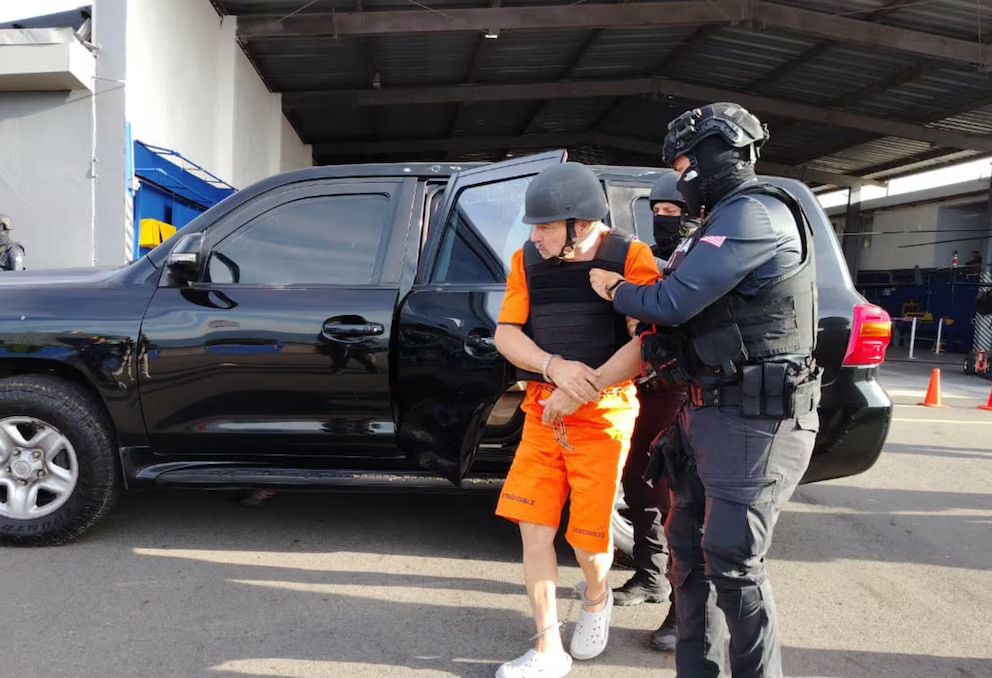

Gilbert Bell Fernández, alias “Macho Coca”, left Costa Rica this Thursday for the United States, where he must answer to federal justice for accusations related to international cocaine trafficking. His transfer involved an extensive security operation that began before dawn and ended with his formal handover to DEA agents at the Juan Santamaría International Airport.
The operation that culminated in the departure of “Macho Coca”
The extradition of Bell, 63, began before 5:00 a.m., when tactical police groups entered the La Reforma maximum security center, where he had been held since October 2024.
The operation involved officials from the Attorney General’s Office, police forces, the General Directorate of Migration and Foreigners, and agents from the United States Drug Enforcement Administration (DEA). The objective was to ensure the safe transfer of the requested individual to the Juan Santamaría International Airport (AIJS), in Alajuela.
Because he is considered a man of high danger by U.S. authorities, the deployment included armored vehicles known as “Beast”, motorcycles, police units, and specialized teams from the Judicial Investigation Agency (OIJ)

The formal handover of “Macho Coca” took place at the Juan Santamaría International Airport, where DEA agents took him into custody.
We recommend reading:
Bell was also equipped with a bulletproof vest and ballistic helmet, as part of the protection measures adopted during the journey. The authorities had to prevent both a potential attack against the extraditable person and an attempt to free him during the transfer.
The operation bore similarities to the deployments used to transport other extradited Costa Ricans, including former magistrate and former Minister of Security Celso Gamboa and Edwin López, alias “Pecho de Rata”.

Once at the air terminal, one of the most symbolic moments of the procedure took place. The Costa Rican officers removed the handcuffs Bell was wearing and, subsequently, the U.S. agents placed their own handcuffs on him.
That change formalized the handover and marked the moment when “Macho Coca” ceased to be under the responsibility of the Costa Rican State to remain under the custody of United States authorities, all under judicial supervision.
The aircraft with registration N387SC, belonging to the DEA, took off from Juan Santamaría at approximately 8:58 a.m. and is scheduled for a stopover in Bahamas before continuing to New York.
Along with Bell, Gabriel Lizano was also extradited, a Colombian naturalized Costa Rican known as “Compadre”, who is listed as a suspect in a parallel case in the United States

The operation to transfer Bell began before 5:00 a.m. at La Reforma maximum security center and included armored vehicles and tactical agents.
A fourth Costa Rican extradited
With his surrender, Bell became the fourth Costa Rican extradited to a foreign country by a judicial request and the third sent to the United States.
The most recent precedent occurred on March 20, 2026, when Celso Gamboa and Edwin López were handed over to U.S. authorities. Both became the first nationals extradited from Costa Rica following a constitutional reform that allowed for the surrender of Costa Ricans claimed by other countries.
Another case corresponds to Johnny Angulo, alias “John Cadenas”, who was handed over to Italy on a commercial flight.
In Bell’s case, however, U.S. authorities used a DEA aircraft to carry out the transfer.
Vehicle in which “Macho Coca” was transported to the Juan Santamaría Airport.
An investigation into a 700-kilo shipment of cocaine
The charges Bell faces in New York point to crimes related to the possession and distribution of large quantities of cocaine, in addition to an alleged conspiracy to illegally import drugs into the United States.
According to documentation related to the extradition process, the DEA profiles “Macho Coca” as the alleged leader of a transnational organization dedicated to drug trafficking, with operations that reportedly used strategic maritime routes to move shipments originating from South America.
One of the central episodes of the investigation occurred in August 2023, when Bell allegedly negotiated with undercover DEA agents the shipment of approximately 700 kilograms of cocaine to New York.
The meetings between the suspect and the U.S. agents were documented through audio and video recordings, which are part of the evidence collected during the investigation.
According to the file, during the negotiations a controlled sample of cocaine would have also been delivered, used to verify the quality of the drug before finalizing the alleged deal.
U.S. authorities maintained that Bell was not a secondary actor within the structure, but rather had occupied a leadership position and participated directly in negotiations regarding quantities, prices, and logistics for the transport of the shipments.
According to extradition process documents, Bell allegedly negotiated the shipment of approximately 700 kilograms of cocaine to New York with undercover DEA agents.
The United States had already sanctioned him
The persecution of Bell by the United States did not begin with the extradition request.
On November 15, 2023, the Office of Foreign Assets Control (OFAC), part of the U.S. Department of the Treasury, added “Macho Coca” to its list of sanctioned individuals.
The designation was related to allegations regarding the alleged use of fishing vessels to transport and conduct transshipments of cocaine cargoes.
The sanction involved the blocking of assets under U.S. jurisdiction and restrictions for citizens and companies of that country to conduct transactions with Bell.
The measure also had an international impact, due to the limitations it creates for a sanctioned person to operate within the U.S. financial system and maintain business relationships with companies linked to that country.
Bell became the first Costa Rican included in the so-called “Clinton list”.
Subsequently, on August 18, 2025, the United States included in that same list Celso Gamboa, Alejandro Arias, alias “Diablo”; Alejandro James, alias “Turesky”; and Edwin López, alias “Pecho de Rata”.
From fishing entrepreneur to DEA target
Bell’s profile also changed radically with the progress of the investigations.
Initially known in Limón as a fishing entrepreneur, authorities later linked him to investigations for more complex crimes, including alleged schemes of money laundering, environmental crimes, and fuel theft.
National investigations also linked him to an organization dedicated to fuel theft from public pipelines, a case in which he remained linked until a principle of opportunity was granted.
On June 12, 2026, the Limón Criminal Court granted said criterion and suspended the criminal proceedings against Bell while his legal situation abroad was being resolved.
The decision allowed for progress toward extradition, in a context where the U.S. process could represent for Bell an exposure to greater penalties than those he would have eventually faced for the acts investigated in Costa Rica.
Gilbert Bell Fernández, alias “Macho Coca”, went from being known as a fishing entrepreneur in Limón to becoming, according to U.S. authorities, one of the main targets in the fight against drug trafficking in Costa Rica. Source: Centroamerica 360
Your destination: the Southern District of New York
Upon his arrival in the United States, Bell will remain in the custody of the U.S. Marshals Service, a federal agency of the Department of Justice responsible, among other functions, for executing federal court orders, capturing fugitives, and guarding and transporting detainees.
His judicial destination will be the Southern District of New York Federal Court, one of the main federal courts in the United States and the setting for high-impact proceedings related to organized crime and drug trafficking.
With the departure of “Macho Coca”, Costa Rica concludes one of the most significant extradition processes initiated following the constitutional reform that allowed for the surrender of nationals to other countries.