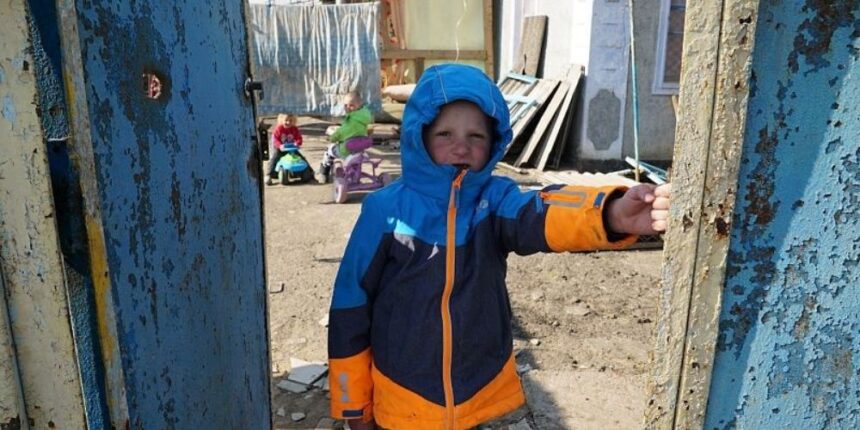
Lviv (Ukraine).- About 2.2 million children in Ukraine have returned to school this Tuesday after their summer holidays, while 1.4 million minors have resumed their classes remotely or in a hybrid format amidst constant Russian attacks.
Despite the authorities’ recommendations to avoid mass events, some schools celebrated the start of the school year this morning with brief ceremonies.
Read more: Ukraine created a “long-range” command to intensify attacks against Russia
“My children like school, but who really wants summer to end?” Anastasia Zolotariova, a resident of the town of Petropavlivska Borshchahivka, in the Bucha district of the Kyiv region, told EFE.
Zolotariova and her two children have returned home to start the school year after spending much of the summer traveling to avoid exposure to the smoke that has recurrently covered their town due to repeated Russian attacks on the area.
In the last 72 hours alone, there have been two drone attacks within approximately one kilometer of his home. And, overnight, a Russian missile strike killed at least 13 people in the Kyiv region itself.
More Read

“Some public schools have suspended the ceremonies. They will hold classes online during the first week and then see how the situation is,” said Zolotariova.
The private school their children attend planned to hold the ceremony in a bomb shelter in case the alarms announcing the arrival of missiles and drones sounded during the time scheduled for the event.
“We are never completely at ease about our children’s safety, but we cannot help but get used to the danger,” said the mother.
More Read
Like other parents, Zolotariova has received detailed instructions from her school: children should not go to class if there are massive missile attacks; when the attacks are only with drones, minors can go to their center and must immediately go down to the shelters.
Safety and quality of education
These measures seek a balance between security and the need to maintain educational standards after four and a half years of Russian military aggression.
Since the beginning of the full-scale invasion, Russia has destroyed 423 educational institutions and caused damage to 4,227 more, according to official data from Ukraine.

80% of Ukrainian schools now have access to air-raid shelters, according to the Ministry of Education. But shelters do not always solve the problems.
In areas near the front, Russian drones arrive in a matter of a few minutes, which leaves little time for schoolchildren to reach shelters. Classes are difficult to conduct inside crowded shelters, many of which do not have enough space to accommodate all students at once.
Given this situation, between 700,000 and 800,000 minors are studying in a hybrid format, with the week divided by days between in-person classes and remote classes.
More Read

This regime is used in cities like Kharkiv, the second largest in the country and one of the Ukrainian cities closest to both the front line and Russia. Dozens of underground schools operate in the city, which do not have the capacity to accommodate all their students.
Added to this situation recently is the destruction of 1.2 million textbooks in Russian attacks. While the Government prints new copies of these books, digital versions will be used.
Remote classes
About 200,000 students living near the front line will study in a fully remote regime, as will some 400,000 Ukrainian children who are refugees outside their country’s borders, according to MP Irina Borzova, who is a member of the Parliament’s Committee on Youth Affairs.
Remote classes are the only option for students at the school in Gontarivka, a village in the Kharkiv region located just 15 kilometers from the front line.
“Despite everything, we are working and that is the most important thing,” the director, Liudmila Mironenko, told EFE after giving the first class of the year this Tuesday morning through a digital platform designed for it.
All the children and teachers, including Mironenko, left the village a long time ago, which continues to be attacked by Russian drones. The school building is completely destroyed, says the teacher, who shows photos of what remains of the roofless structure and what used to be classrooms covered in rubble.
“The Russians believe they will destroy us, but this will not happen. We will continue teaching our children no matter what,” Mironenko said defiantly.