
Venezuelan ambassador condemns the U.S. for its deployment of nuclear ships in the Caribbean


6:13 pm
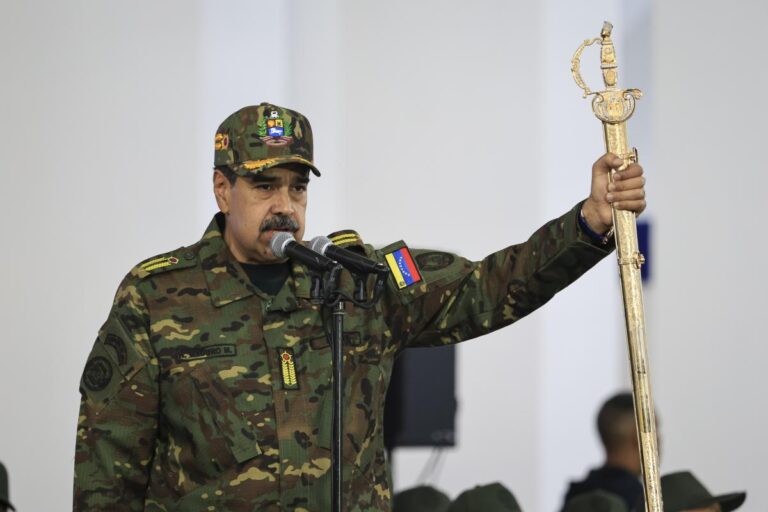
Port of Spain.- The Venezuelan ambassador to Trinidad and Tobago, Álvaro Sánchez Cordero, condemned this Saturday the United States for the deployment of nuclear warships in the Caribbean and accused the American government of endangering the entire region and violating the hemisphere’s security treaty.
This was stated by Sánchez Cordero in San Fernando, in the southwest of Trinidad and Tobago, at a time when the U.S. Armed Forces have deployed ships, submarines and 4,000 marines in the Caribbean to reinforce operations against drug trafficking, in which the Government of Venezuela is allegedly involved.
Faced with this, Sánchez Cordero demanded that US military forces should be deployed and stationed in the Pacific Ocean, where the UN has admitted that the largest amount of illegal narcotics are trafficked.
According to the official, “all cocaine and other drug shipments are transported from the Pacific Ocean to the United States,” while denying that Venezuela is not a country where illicit drugs are cultivated or processed. Sánchez Cordero insisted that Venezuela “has nothing to do with drug trafficking”, for which he accused the international media of unjustly projecting the country “as a drug-selling, failed and fugitive state”. In response to this, he asserted that the presence of United States warships near Venezuelan waters are signs of an attempt at regime change. “Any qualified person who appreciates peace, stability, and progress in Latin America and the Caribbean should reject this action by the United States. This is more related to preserving the region as a zone of peace,” said Sánchez Cordero. The ambassador also warned that the mobilization of a U.S. nuclear submarine in Caribbean waters violates the 1967 Treaty of Tlatelolco, which declared Latin America and the Caribbean as nuclear-weapon-free zones. “This reckless and irresponsible action endangers not only Venezuela, but the entire Latin American and Caribbean region. It’s not just a threat to our country, but to everyone,” he emphasized. On Tuesday, the Maduro government, through its permanent mission to the UN, warned that the U.S. plans to send “a missile cruiser” and “a fast attack nuclear submarine” to the Venezuelan coast next week, among other “warships” deployed in the Caribbean Sea, as part of, it noted, the “hostile actions” of the Donald Trump Administration.“This powerful and aggressive U.S. template should be in the Pacific Ocean and not in the Caribbean,” said Sánchez Cordero.
You may be interested in:Maduro: “We were born to win, never to be defeated”
This, according to the mission, represents “a serious threat to regional peace and security”. Therefore, he demanded “the immediate cessation of the US military deployment in the Caribbean, including the nuclear submarine USS Newport News”, and called for “clear and verifiable guarantees” from the US “that it will not deploy or threaten to use nuclear weapons” in Latin America and the Caribbean. For his part, the U.S. Secretary of State, Marco Rubio, assured this week that Washington’s initiative has the support of countries such as Argentina, Paraguay, Ecuador, Guyana or Trinidad and Tobago, and that their Governments have expressed their willingness to collaborate in joint actions against drug trafficking. Venezuela also announced a deployment of “larger” vessels in the Caribbean to combat drug trafficking, after the U.S. warned that it is prepared to “use all its power” to stop the “flow of drugs” towards its territory, which would include sending ships and soldiers to waters near Venezuela. The U.S. also recently doubled to $50 million the reward for information leading to the capture of Maduro, whom the North American country accuses of “violating U.S. narcotics laws.”
We are a multiplatform outlet offering news and television content. The fastest-growing news outlet in audience in the history of Caribbean communication.



#Most read
- 1.Magnitude 8.0 earthquake reported off Panama’s Pacific coast
- 2.VIDEO: Earthquake reportedly causes damage inside building in Panama
- 3.VIDEO: Father throws chair at judge after driver gets 120 hours of community service for killing his daughter
- 4.Biography of Juan Ramón Gómez Díaz: The Media Mogul in the Dominican Republic
- 5.Dominican woman sentenced to 25 years for killing fellow Dominican friend in Orlando
- 6.British man found dead and naked in Italy had attended pagan gathering involving drugs
- 7.Pamela Infante clarifies situation with Wander Franco
- 8.Dominican man shot by ICE agents in New York identified as Oscar Belgal
- 9.NYPD searches for Dominican man wanted in death of young woman who fell from 15th floor
- 10.5D Cinema in Japan surprises the world with an immersive experience that goes viral

Newsletter
Subscribe to our newsletter to receive our latest articles instantly!