

A new era of lunar exploration and African science will take place in 2029, when the Africa2Moon mission completes the deployment of the first African radio astronomy network on the surface of the Moon.
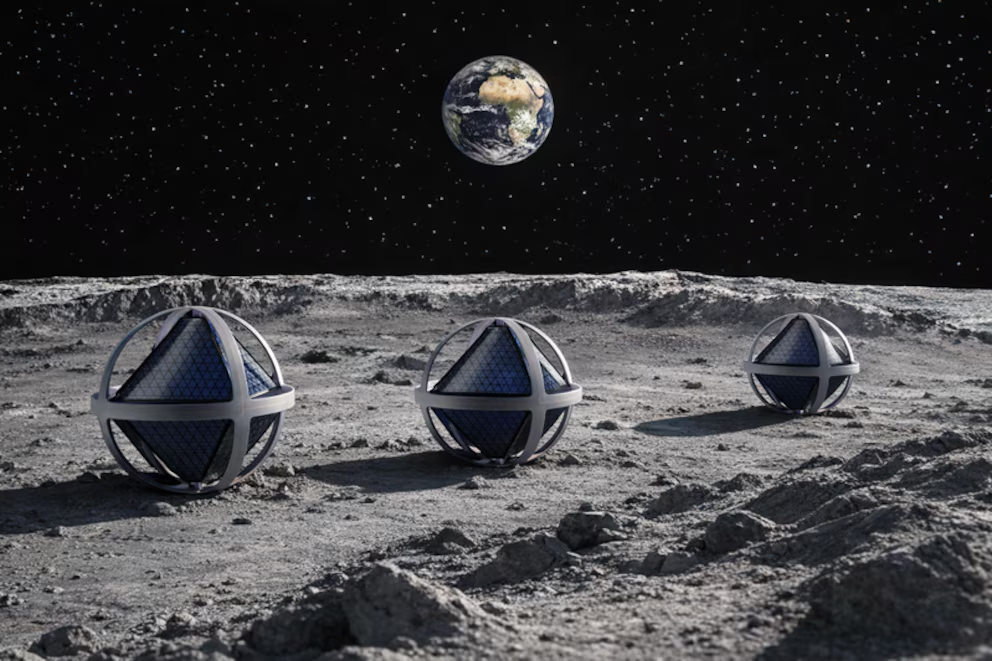
The ambitious project, led by the African Space Development Foundation and accompanied by a wide network of scientific institutions on the continent, will install a trio of spherical probes at the lunar south pole.
Known as BALLS (Bounced African Lunar Low-frequency Spheres), these probes will form an antenna network capable of listening to low-frequency radio signals coming from the oldest and most distant parts of the universe, signals that are impossible to observe from the Earth’s surface.
The Africa2Moon mission deploys African radio astronomy probes at the lunar south pole, seeking to explore radio signals from the distant universe starting in 2029.

The mission, considered the first completely African radio astronomy experiment on another world, represents a technological and scientific leap for the southern hemisphere.
We recommend reading:India fails in the launch of its spy satellite and loses a prototype of a Spanish spacecraft
The far side of the Moon—the site chosen for the deployment—is recognized by astronomers as the place with the least radio interference in the vicinity of Earth. This region, protected from terrestrial radio emissions and benefiting from the absence of an atmosphere, allows for the capture of frequencies that Earth blocks.
“The Moon is an ideal place to conduct these studies, since the low-frequency signals that will be measured are unobservable from Earth due to the interference created by our planet’s atmosphere,” emphasized Carla Mitchell, mission director and manager of the Africa Program at the South African Radio Astronomy Observatory (SARAO).
African technology at the lunar south pole: a collaborative and scientific challenge
Carla Mitchell, director of the Bounced African Lunar Sphere mission, and Japie Ludick, an engineer at the South African Radio Astronomy Observatory, alongside one of the BALLS spheres that underwent testing.
The region chosen for the experiment, the lunar south pole, presents one of the most extreme environments in the Solar System, with temperatures dropping below -200 degrees Celsius. Despite the difficulties, the location is crucial for future space research, as it contains permanently shadowed craters with water ice reserves, essential for upcoming lunar bases. Africa2Moon aims to become the first lunar instrument of its kind to successfully operate in that geography, following previous failures of American and Chinese technologies.
Each of the BALLS consists of a spherical structure with interlocking rings, enclosing two triangular sets of solar panels. These panels, oriented in opposite directions, allow for the capture of solar energy to power the antennas’ electronic systems. Once deployed, the three BALLS sensors will be distributed uniformly across the lunar surface. The detected signals will first be sent to the Chinese Chang’e-8 mission lander—a key partner in the project—and then relayed to Earth for scientific processing.
The development and assembly of the structural and functional models of BALLS was carried out in Africa by Petrawell teams in Cape Town, the Aerospace Systems Research Institute of the University of KwaZulu-Natal, and the Electronic Systems Laboratory of Stellenbosch University.

The design of BALLS allows for the capture of radio frequencies blocked by the Earth’s atmosphere, opening a unique window into the early universe (NASA)
The collaboration also included the South African National Space Agency, the National Institute for Theoretical and Computational Sciences, and entities from Kenya, Ghana, Botswana, and other African countries. “The power of collaboration, education, and hope for Africa’s future in space science and technology cannot be underestimated,” stated the mission director.
The prototype that will travel in 2029 will be the first step of an initiative with even more ambitious goals: the installation, in a future mission, of 55 antennas on the far side of the Moon, one for each African country. This total deployment would make Africa2Moon the largest lunar radio astronomy network in the world and a symbol of intercontinental scientific cooperation.
Pioneering science and opportunities for new African generations
The signals detected by BALLS will be sent to the Chang’e-8 module and then relayed to Earth for scientific analysis.
Radio astronomy is the discipline that studies outer space through radio waves, a different window from visible light. From the Earth’s surface, the atmosphere only allows for the observation of certain frequencies, while low-frequency radio waves remain blocked.
In those frequencies resides key information to understand the structure of the galaxy, the behavior of planets, the composition of interstellar molecules, and the origins of the universe. Future measurements from Africa2Moon promise revolutionary scientific breakthroughs regarding phenomena still unexplored in the Milky Way and beyond.
The electromagnetic frequency band below 20 megahertz is especially difficult to study from Earth. That is why the Moon represents a unique observatory. During the lunar night, the far side offers unparalleled protection against human and solar radio interference, allowing us to listen to signals coming from the farthest and oldest corners of the cosmos.
The project seeks to inspire young Africans to get involved in science, technology, engineering, and mathematics through space exploration.
“The BALLS antenna array will work together to observe low-frequency radio signals coming from space that are not observable from the Earth’s surface,” explained Mitchell.
Africa2Moon is a low-cost, low-mass project designed to inspire new generations of young scientists, engineers, and technologists in Africa and developing countries. The team highlights the importance of voluntary collaboration and training in science, technology, engineering, and mathematics (STEM) for the development of the continent.
“I am amazed that it is being carried out with such a small budget thanks to the work of volunteers. This demonstrates the inspiration that space sparks and, if successful, it will boost space exploration on the African continent,” stated Clive Neal, a lunar exploration specialist and professor at the University of Notre Dame.
The BALLS electronic functional model was built by the team at Stellenbosch University. During the testing phase, the model sent data between the model and a simulated lander unit.
The project also represents a technological demonstrator for future lunar missions and an advancement in the manufacturing and operation of scientific instruments in extreme environments. The design of the BALLS allows for improvements for the second mission, such as a larger diameter and a faster, more dispersed deployment from the lander.
These innovations will enrich scientific research and facilitate the integration of new African technologies into international space exploration.
The future of Africa2Moon involves planning new instruments and the continuous improvement of observation systems. Collaboration with the Chinese Chang’e-8 mission not only provides experience and technological capability for its launch, but also opens the door to future alliances with international agencies and scientific communities.
The protected environment of the lunar far side will offer key data on the galactic background, the Sun, and the Earth, and on the origins of the universe (NASA)
The Africa2Moon initiative symbolizes Africa’s potential to lead global scientific projects and generate frontier knowledge. Lunar radio astronomy will allow astronomers from the continent and the world to explore the oldest signals in the universe, understand phenomena invisible from Earth, and lay the foundations for a new generation of African explorers and innovators.
The technical and human challenge of deploying instruments in the extreme environment of the Moon reveals the power of collaboration, ingenuity, and the shared vision of those who bet on the future of science and technology in Africa.