

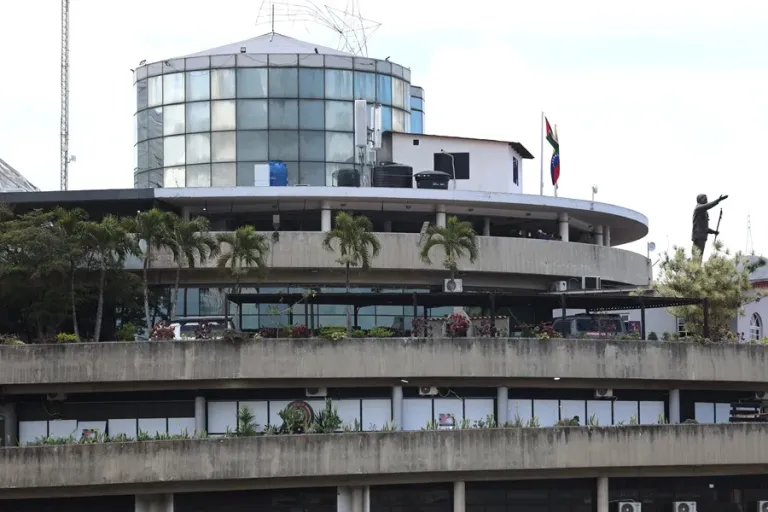

Caracas.- At least six female political prisoners were released in Venezuela, the NGO Foro Penal, a leader in the legal defense of these detainees, reported this Friday, an event that comes two days after the conclusion of the first round of negotiations between Chavismo and a sector of the opposition led by former deputy Dinorah Figuera.
«Now: Political prisoner Emirlendris Benítez and five other women released», said the NGO’s president director, Alfredo Romero, in a message on X, without offering further details.
Benítez was allegedly linked to an attempted assassination in 2018 against then-president Nicolás Maduro, currently detained in New York following his capture last January by U.S. troops.
Foro Penal also did not report on the conditions of release, although the NGO usually uses the term “excarcelado” (released) to refer to people who leave prison under restrictive measures.

The new releases come one day after Figuera pledged on Thursday to work toward achieving more releases of political prisoners in the “coming days”.
Dialogue with the opposition
The opposition leader held a meeting on Tuesday with a group of former Venezuelan political prisoners regarding the dialogue initiated with Chavismo, under the watchful eye of the United States, a country that bombed Caracas last January to take Maduro away.
Since Maduro’s capture, hundreds of releases have taken place, as well as the approval of an Amnesty Law that has benefited more than 8,000 people, mostly with restricted freedom.
We recommend reading: Venezuela and Israel agreed to reactivate consular coordination after 17 years of diplomatic rupture
Chavismo and the opposition agreed on Wednesday to renew all the judges that make up the Supreme Tribunal of Justice (TSJ), accused of serving the Government, as part of the first agreements reached in the first cycle of dialogue promoted by the United States for a transition in the Caribbean country.
In a joint statement, the parties announced that they will also seek to recover the country’s assets deposited in the Bank of England, for the care of the victims of the double earthquake on June 24, which has left at least 6,301 dead, nearly 18,000 people homeless, and material damages that the World Bank estimates at 19.6 billion dollars.
More than 8,000 prisoners
A total of 8,192 prisoners died in Venezuelan prisons over the last fifteen years, the NGO Venezuelan Prisons Observatory (OVP) indicated this Friday, after urging the authorities to be held accountable for how penitentiary centers have been managed.
«Thousands of deaths in 15 years. 8,192 people deprived of liberty died during the years in which (Iris) Varela, (Mirelys) Contreras, (Celsa) Bautista, and (Julio) García Zerpa have led the Penitentiary Ministry», said the OVP -in a message on X- when citing data from its registry, without detailing the causes of the deaths.

The OVP stated in the publication that fifteen years after the creation of the Penitentiary Ministry, with the goal of having an institution more specialized in inmates, penitentiary problems continue to exist.
Deaths in Venezuelan prisons
“The prison problem in Venezuela is not the existence of prisons or prisoners, but how they have been managed,” the text indicated.
In that sense, the NGO pointed out that it has warned that “the management of the penitentiary system cannot become a space for improvisation” and that those who are appointed to lead it “must have training, experience, and specialized knowledge in penitentiary matters and human rights.”
“You cannot learn, experiment, or invent policies on the fly when the consequences fall directly on human beings in the regime’s custody (…) it is not enough to change ministers, create plans, or increase bureaucratic structures. It is time to be held accountable and measure results in the comprehensive assistance of people deprived of liberty,” the observatory noted.
In its 2025 annual report, the OVP stated that 181 people died in state custody that year and cited as the main causes of death the lack of timely medical attention for cardiovascular and cardiorespiratory conditions, as well as cases of multi-organ failure and hypovolemic shock.