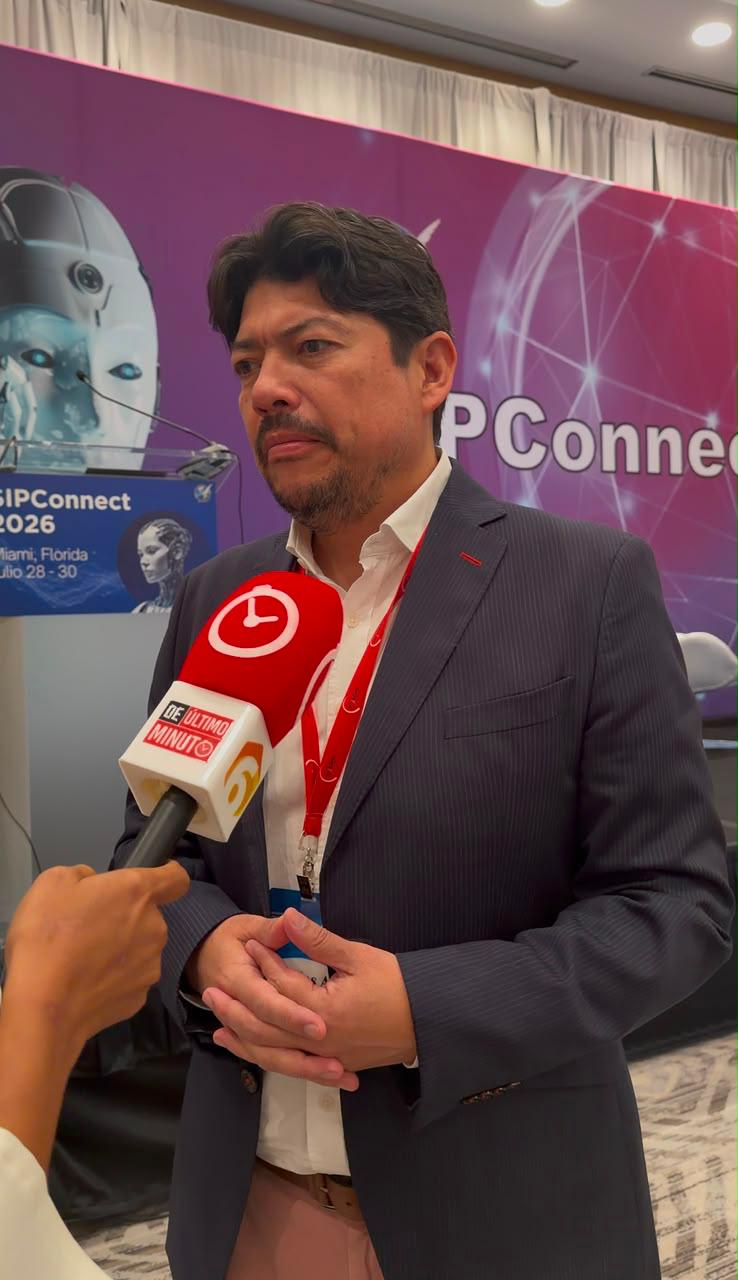
Carlos Ardila, commercial manager for Latin America at Protecmedia, stated during SIP Connect 2026 that artificial intelligence and automation will allow for the optimization of editorial processes
Miami.- Newsroom automation and the use of artificial intelligence represent an opportunity for print media to be more efficient and competitive in a digital transformation scenario, stated Carlos Ardila, commercial manager for Latin America at Protecmedia, at the closing of SIP Connect 2026.
In an interview with De Último Minuto, Ardila explained that automation is already part of practically all journalistic processes, from content production to the layout of printed editions and the generation of audiovisual materials.
“Today, content is born digital. What we are looking for is for technology to make the creation of the printed product much more efficient so that it remains profitable,” he/she expressed.
You can also read: Dominican leads the digital transformation of El País
The executive pointed out that Protecmedia, a company with 45 years of experience developing solutions for media outlets, has focused its efforts on automating the production of print editions through unattended layout processes, allowing newsrooms to dedicate more time to journalism and less to operational tasks.
“Responsibility is about making the business as competitive as possible. Efforts must be concentrated on content creation; the layout of the print edition must be done by a machine,” he maintained.
Will the printed newspaper disappear?
More Read

Regarding the forecasts that anticipate the end of print media, Ardila considered that the sector will continue to shrink, although he ruled out a total disappearance in the short term.

He explained that the print media industry in Latin America has declined significantly in recent years and estimates that the trend will continue over the next decade. However, he understands that it will remain a relevant business for many journalistic companies.
“I don’t think it’s going to disappear until it reaches zero. We are talking about a 10, 15, or 20-year scenario. As long as it remains a multi-billion dollar industry, we must make it as competitive as possible,” he stated.
Ardila acknowledged that the main difficulty in implementing automation processes is not technological, but human.
More Read

In his view, change management represents the most important challenge, which is why he recommended involving editors and journalists with leadership within the organizations from the beginning to facilitate the adoption of new ways of working and reduce resistance to change.
When evaluating the conference organized by the Inter American Press Association (IAPA), in which he had a masterful participation under the theme “Cold Ink Journalism”, the executive highlighted that the meeting once again consolidated itself as a space to learn about the main trends that will mark the future of the industry.
As a key takeaway, he pointed out that technological transformations must be implemented with the entire organization in mind, rather than solely focusing on optimizing the work of a specific area.
“We should not implement a change because it benefits a small group, but only when that change truly transforms the entire organization,” he concluded.