

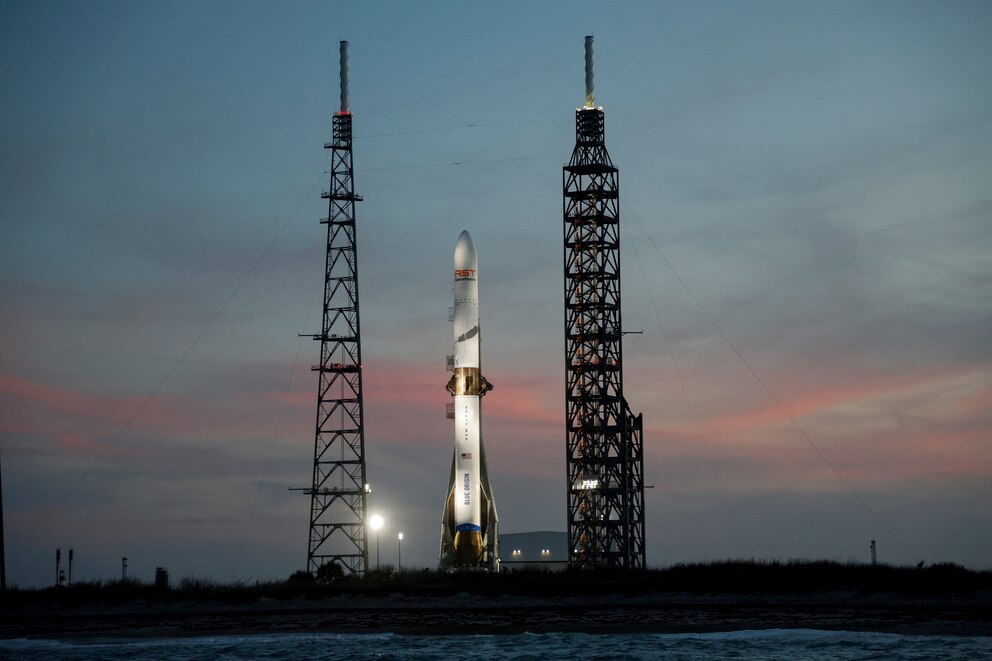

Blue Origin, the space services company founded by Jeff Bezos, has initiated a strategic shift in how it finances its expansion. The company is seeking to raise USD 10 billion at a valuation of USD 130 billion, excluding new funds, to intensify competition with SpaceX, owned by Elon Musk.
For the first time since its founding, Blue Origin is accepting external capital. Until now, all resources came from Bezos himself, who used part of the fortune generated by Amazon to drive the space venture.
This funding round will be led by Coatue Management, which plans to invest USD 4 billion. Other investors would contribute a similar sum, and Bezos himself would inject nearly USD 2 billion more. The decision to open up the shareholding structure marks a turning point in the company’s strategy.
Jeff Bezos leads Amazon’s technological advancement with the deployment of hundreds of satellites for its Leo broadband network.

We recommend reading:NASA astronauts repair an ISS robotic arm in a seven-hour spacewalk
Accidents, milestones and investor confidence
Despite a recent incident at the Blue Origin launch pad in Florida, where a rocket exploded at the end of May, investor interest did not wane. Before the accident, the company had successfully completed two launches and landings of its reusable New Glenn rocket. These advances are considered steps toward creating a self-sustaining business model.
The United States aerospace and defense industry is going through a period of strong institutional support. This trend, added to the stock market success of SpaceX, which recently debuted on the stock exchange and exceeded a market capitalization of two trillion dollars, has generated a renewed investor appetite for the sector.
In January, Blue Origin announced the TeraWave project, which aims to install data centers in orbit. This initiative promises to open a new revenue stream for Bezos‘ company. Furthermore, the company maintains contracts with NASA to transport astronauts and exploration vehicles to the Moon. These agreements position Blue Origin as one of the central players in the current American space race.
The rivalry between Blue Origin and SpaceX intensifies global investment in the aerospace industry.
Amazon Leo: Bezos’ satellite arm
Jeff Bezos‘ push in the space sector is not limited to Blue Origin. Amazon confirmed the launch of 396 satellites for Amazon Leo, a low Earth orbit broadband network, which was previously known as Project Kuiper. The goal is to compete directly with Starlink, SpaceX‘s satellite constellation.
According to released data, the latest block of 29 satellites was placed into orbit on July 2 aboard a United Launch Alliance (ULA) Atlas V rocket, marking the fourteenth mission of the program and the end of the use of that rocket model by Amazon. In total, Amazon deployed 224 satellites in eight flights without recording any failures, and now plans to use ULA‘s Vulcan rocket for future launches.
Outlook and expansion of the satellite network
Currently, Amazon Leo ranks as the third-largest constellation of satellites in orbit. The company has secured more than 100 additional launches to expand its network and plans to begin the commercial deployment of the internet service before the end of the year.
The reusable New Glenn rocket completed two successful launches before the recent incident in Florida.
In June, the U.S. Federal Communications Commission (FCC) granted Amazon a limited waiver of the requirement to deploy half of its Gen1 constellation by July 30.
These developments consolidate Bezos and his companies as central protagonists in the new American space race, in a scenario dominated by the rivalry with Musk and the growing technological competition on a global scale.