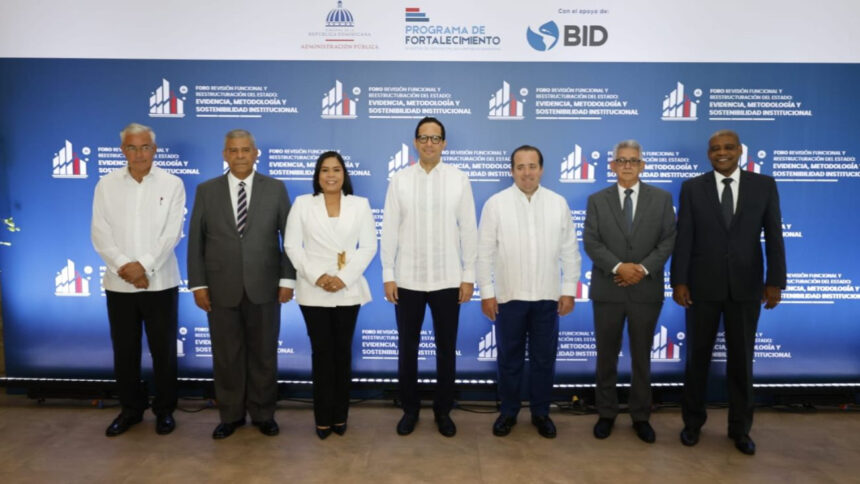
Santo Domingo.- The Ministry of Public Administration (MAP) held the forum “Functional Review and Restructuring of the State: Evidence, Methodology and Institutional Sustainability,” to take stock of the reform and restructuring process that the Dominican State is undergoing and to socialize the methodology of the functional review processes.
In his opening remarks, the Minister of Public Administration, Sigmund Freund, highlighted the progress made during the implementation of the Restructuring and Rationalization Plan of the Dominican State.
Freund pointed out that since September 2024, 21 reorganization processes have been carried out, including eliminations, mergers, functional restructurings, and creations, all with published legal basis, managing to achieve more efficient, coherent, and aligned institutions with the Government’s priorities.
The minister indicated that the largest-scale merger was that of the Ministry of Economy, Planning and Development with the Ministry of Finance. “Two ministries with overlapping mandates in planning, public investment and fiscal policy were unified into a single governing entity, thus achieving the formation of a single institution that articulates fiscal policy and the national planning system,” stated Freund.
In the first panel on “State Restructuring: Strategic direction, administrative rationalization and fiscal sustainability”, moderated by the Vice Minister of Reform and Modernization of the MAP, Sheyla Castillo, the Minister of the Presidency, José Ignacio Paliza, called on the incumbents of each of the State institutions to be efficient with the resources they already possess and in that way optimize the functioning of their entity.
More Read
You can also read: Government develops strategy to make public services proactive
The Budget Director, José Rijo Presbot, emphasized that the efficiency of a State is not measured by how many institutions it has, but by whether the functions and tasks of public bodies are transformed into improving the lives of citizens.
Likewise, the Commissioner for State Reforms, Darío Castillo Lugo, indicated that after this macro reform process, sectoral reforms must be resumed, which would help to continue rationalizing the State.

The second panel: “Functional Review: Methodology, Evidence and Challenges for State Restructuring” featured the participation of the director of the National Institute of Public Administration (INAP), Gregorio Montero, along with international experts Manuel Arenilla and Jaime Rodríguez Arana.
More Read

During the conversation, moderated by Virna Peña, Director of Organizational Development at MAP, the experts highlighted the work carried out by the governing body of the Public Administration and the INAP to face the challenges presented by the modernization of the State.
They also addressed the challenges facing the transformation of the State for the efficiency of its structure and human capital, pointing out the vital importance of continuous training and education for public servants, including high-ranking authorities.
The closing remarks were delivered by the Director of Coordination of Reform Processes at the MAP, Laura Díaz, who highlighted the importance of this forum as a strategic space where experiences, methodologies, findings, and lessons learned derived from the functional review processes developed and currently underway were shared, promoting technical dialogue on the challenges and opportunities of the institutional transformation of the Dominican State.
“In the end, this entire methodology has a single focus: people. A public administration centered on people means that every function that is reviewed, every process that is redesigned, is thought out for the people who provide the service and for the people who receive it,” stated Díaz.
The Forum was held within the framework of the Program for Strengthening Civil Service Management in the Dominican Republic, which is being executed by the MAP, with the support of the Inter-American Development Bank (IDB).