Hungary will close its only nuclear power plant next week, announced Prime Minister Péter Magyar, due to the low level of the Danube river caused by the heatwave hitting Central Europe.
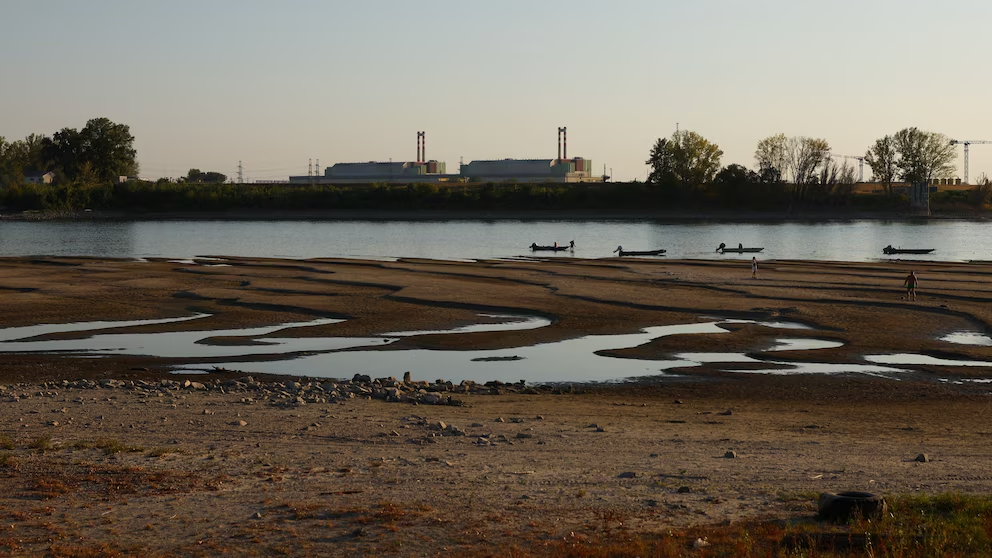
The Paks power plant, located about 90 kilometers south of Budapest, is currently operating at less than half of its usual capacity: it is producing 965 megawatts instead of the normal 2,000. Its four reactors, built with Soviet technology, depend on water pumped from the Danube for cooling, but the drop in water levels has compromised the pumps’ ability to supply the system.
Magyar specified in a press conference held at the plant that the shutdown would occur “on Tuesday or Wednesday.” He stressed that the closure can be carried out safely and does not pose any risk to the population or the environment.
The plant provides about 40% of the country’s annual electricity, making its shutdown an immediate challenge for the national energy supply. The operator had previously warned that the closure was “inevitable.”
Péter Magyar and Paks deputy CEO Laszlo Nagy at the press conference where the imminent closure of the plant was announced, in Paks, Hungary.
More Read

We recommend reading: Meloni defends her controls with Spain for “national security”

Magyar specified that the river level could drop to -144 centimeters, well below the previous record of -98 centimeters recorded in 2018. The -134 centimeter threshold forces a total shutdown of the power plant; a negative reading indicates that the water has dropped below the gauge’s zero reference level, not that the riverbed is dry. The closure could last for several weeks, as in the last 20 years the flow has only risen during August on three occasions and no significant precipitation is expected in the coming days.
Hungary is not the only country affected: Romania has already shut down one of its nuclear reactors for the same reason and announced the suspension of the second one.
More Read

Faced with the loss of nearly half of its electricity generation, the government requested that large companies voluntarily reduce their consumption during peak hours, between 5:00 PM and 10:00 PM. The energy conglomerate MOL committed to cutting its demand by 65 megawatt-hours, a 40% reduction from its usual levels. Magyar also ordered the decorative lighting of all state institutions to be turned off, recommended suspending parliamentary sessions on Monday and Tuesday, and banned outdoor bonfires.
The impact on the population is direct. A 12-day heatwave at the end of June left an estimated 304 additional deaths in Hungary, according to calculations by climate data scientist Peter Szabo. In Szentendre, north of Budapest, thousands of residents are facing water supply cuts; the regional company sent tanker trucks, although the provision is insufficient to cover basic needs. “Although I can get enough water to drink, it is not enough for me to wash,” stated Janos Keresztes, a 75-year-old retired translator.
The crisis is spreading throughout the region. In Slovenia, meteorologists warned of an “extremely high” fire risk in the western area and authorities banned any activity that could generate flames. Climatologist Gregor Vrtacnik, from the ARSO meteorological agency, warned that the heat wave will be “extraordinary for its duration, not just for the high temperatures.” In Bratislava, the Slovak capital, authorities set up more than 30 cooling centers with air conditioning and drinking water.
In Austria, thermometers hit 40.3 °C on Friday in Wieselburg, west of Vienna, the highest temperature ever recorded in that country during July. The meteorological agency Geosphere Austria specified that the accumulated rainfall since January is 30% below normal levels.