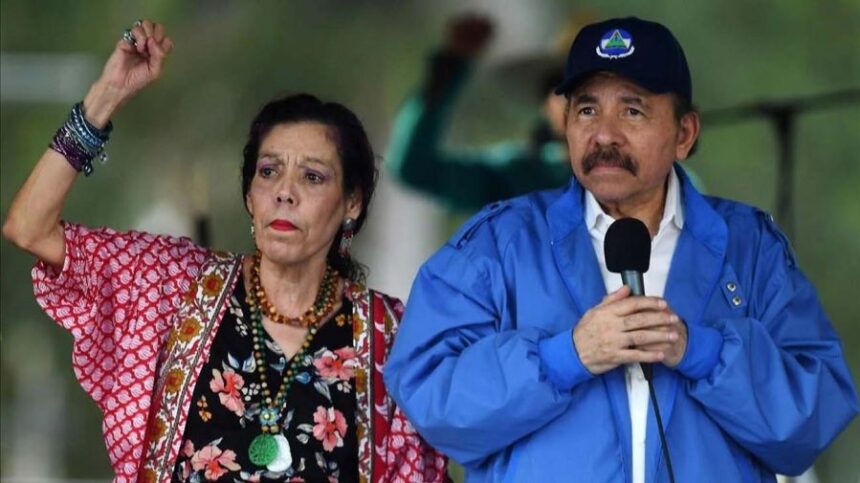
San José.- The spouses and co-presidents of Nicaragua, Daniel Ortega and Rosario Murillo, intend to impose a “dynastic dictatorship” in the country through a new constitutional reform, according to an analysis by the Center for Transdisciplinary Studies of Central America (Cetcam) released this Tuesday in Costa Rica.
The starting signal was given by Ortega himself last July 19 when he announced that there would be no more elections in Nicaragua and also anticipated that he would send a package of reforms to the National Assembly (Parliament) to materialize that decision, argues that think tank composed of Central American researchers from different disciplines.
Indeed, shortly after, the president of the Parliament, the pro-government Gustavo Porras, announced a constitutional reform initiative “to definitively annul the possibility of fair, competitive, and transparent elections“, the report points out.
The reform package contemplates the extension of the presidential term to seven renewable years, a measure extended to more than 7,000 public positions, including those elected by popular vote, the Army, and the Police, warns Cetcam.
You can also read: Daniel Ortega asserts that “Terrorists and coup plotters” will have no place in the elections in Nicaragua

That Center recalls that between 2024 and 2025 Ortega and Murillo “took another step in their authoritarian radicalization to impose a dynastic dictatorship in Nicaragua: they ordered the Political Constitution to be reformed to subordinate all branches of the State, as well as municipal and regional governments, to the Presidency“.
In addition, they created two co-presidencies, limited the right of citizens to run for public office if they were considered “traitors to the homeland“, and extended the presidential term from five to six years.

Those reforms, plus Ortega’s announcement to end elections, “is much more serious because it sets a precedent for Latin America and for the rest of the world,” experts assess.
More Read

However, this Center notes that Ortega’s announcement has not gone unnoticed by the international community, including the Organization of American States (OAS) and the European Union.
Particularly, according to the report, the United States has been one of the most belligerent with successive messages at the highest level, and recently requested to convene an extraordinary session of the OAS Permanent Council to address the situation in Nicaragua, generating many expectations regarding the hemispheric positioning.
For Cetcam, the announcement is no minor matter, as it marks the culmination of a process in which the Ortega-Murillos have buried the last vestiges of democracy and civil rights in Nicaragua, eliminating the most fundamental of all: the right to choose one’s leaders.
For pro-democracy organizations and actors in exile, the intentions of Ortega and Murillo represent a more significant and urgent challenge, “but it clears the path because it becomes much clearer where advocacy needs to be directed,” the report notes.
“The international community, especially the American hemisphere, has an inescapable responsibility: to decisively support the efforts of all Nicaraguan society to restore democracy or to assume its share of the blame for having allowed a new family dictatorship to be installed in America,” reasons Cetcam.
Nicaragua has been governed since 2007 by Ortega, an 80-year-old former Sandinista guerrilla who, since 2017, has led the country alongside his wife, Rosario Murillo, first as vice president and, with the 2025 constitutional reform, as co-president.