

Bogotá.- The President of Colombia, Abelardo de la Espriella, delivered to the Prosecutor’s Office and other oversight bodies this Tuesday a document with 82 cases of alleged corruption in the Petro Government, compiled during the transition process.
“I formally place the White Paper in your hands, with the hope that you will do what is legally appropriate,” stated De la Espriella during an event held in Bogotá on the occasion of the National Day against Corruption.
According to the Government, the information collected in the document emerged during the meetings held as part of the failed transition process between the De la Espriella and Petro teams.
The transition process took place after both leaders decided not to meet in person at the end of Petro’s administration and the beginning of the new Government.

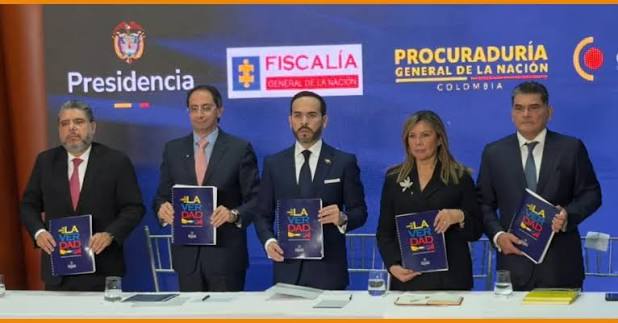
The vice president, José Manuel Restrepo, also reported on the delivery of the document through the social network X. “We delivered the Book of Truth to the country, with 82 cases documented during the transition process,” he wrote, along with photographs of the report.
What does the Book of Truth contain?
The document consists of 135 pages and gathers 82 cases grouped into files related to alleged irregularities in different entities and areas of the public administration.
Among the sectors mentioned are the National Unit for Disaster Risk Management (UNGRD), the health system, state-owned companies, and social programs.
The report also collects information related to contracts, administrative agreements, and budgetary decisions that, according to the current Colombian government, could evidence patterns of alleged corruption and a possible irregular use of public resources.

De la Espriella pointed out that the submission of the document responds to a citizen demand to know the destination of public resources and to determine who may have participated in or benefited from the reported irregularities.
We recommend reading: President of Colombia dismisses five ambassadors appointed during Gustavo Petro’s government
“The country wants to know what happened, it wants to know where the resources ended up, it wants to know who participated in the looting, who benefited, and who allowed this whole disaster to happen,” the president stated.
The Colombian president explained that during the transition process, documents and information from various state entities were reviewed, from which the cases included in the report were identified.

The delivery of the document to the Prosecutor’s Office and other oversight bodies seeks to have the corresponding authorities analyze the information collected and determine if there are administrative or criminal liabilities in the cases indicated.
82 cases of alleged corruption under review
The content of the so-called “Book of Truth” gathers information obtained during the transition process between the Gustavo Petro Government and the new administration. The document seeks to bring to the attention of oversight agencies a series of situations that, according to the current Government, need to be examined to determine if there were actions contrary to the law.
The cases included cover different areas of public administration, so the authorities must review each file individually and determine if there are elements that allow for the initiation of formal investigations.
Among the entities mentioned is the National Unit for Disaster Risk Management (UNGRD), an agency that during the Petro administration was involved in various controversies related to contracts and the management of public resources.
The document also includes observations related to the health sector, state-owned enterprises, and social programs, areas that manage significant budget allocations and have a direct impact on the population.
The Prosecutor’s Office must analyze the complaints
With the delivery of the document, the Prosecutor’s Office and other oversight bodies will have access to the information collected during the transition process. It will be up to the authorities to determine whether the described facts may constitute administrative offenses, crimes, or other irregularities.
The presentation of the report does not mean that the allegations have been judicially proven. Each of the cases must be investigated and the individuals eventually accused will have the right to due process and to exercise their defense before the corresponding authorities.
The De la Espriella administration maintains that the review of these cases seeks to establish what happened with public resources and determine potential responsibilities in the event that the investigations find sufficient evidence.
The delivery of the “Book of Truth” thus opens a new stage in the review of the previous administration’s actions and once again places the management of public resources at the center of the political and judicial debate in Colombia.
So far, the complaints contained in the document correspond to allegations of presumed irregularities and must be evaluated by the competent authorities through the procedures established by law.