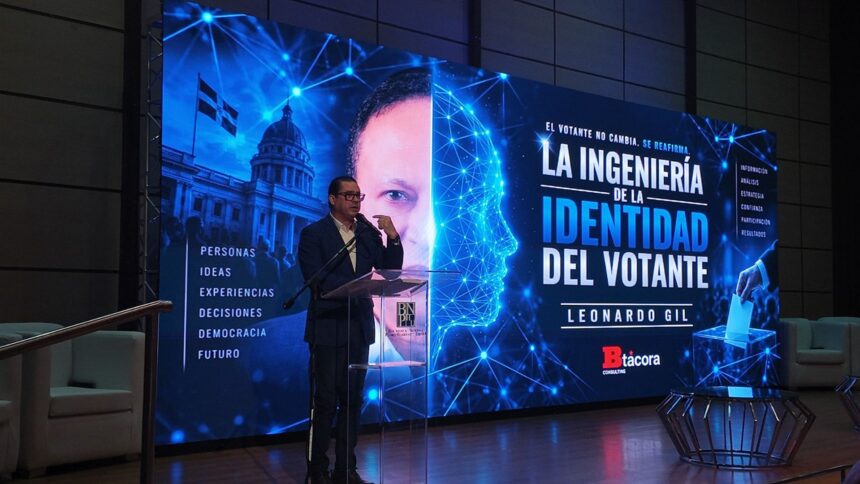
Santo Domingo.- Political analyst, writer and lecturer Leonardo Gil released this Tuesday the book “The Engineering of Voter Identity”, a work in which he proposes how to win the mind of the voter.
“The first thing is to understand that the voter does not vote for a candidate, that the voter votes for themselves. When they see themselves reflected in some action of the candidate, then there is a connection and an emotionality for that candidate arises, because in the end, the vote is emotional,” indicated the writer Leonardo Gil.
The text proposes a conceptual framework to study the identity, experiences, emotions, and context of participants in political interpretation and electoral decision-making.
The research starts from a question: what happens in the voter’s mind before deciding their vote?, where the paper posits that the citizen does not arrive at a campaign empty-handed.
Before receiving a political message, you already possess values, beliefs, affiliations, memories, experiences, emotions, and expectations that can intervene in the way you interpret candidates, leadership, and messages.
More Read

“The voter does not vote for a candidate, they vote for themselves,” the writer explained.
Read also: Fine Arts Week 2026 opens five days of art, training, and culture dedicated to Natacha Sánchez
With this statement, Gil summarizes one of the central ideas of the work: in certain circumstances, the vote can also be an expression of identity.
More Read


The voter does not only evaluate what a political figure claims to represent; they can recognize in them values, fears, aspirations, affiliations, or an idea of the future linked to their own way of seeing themselves.
Among the writer’s wishes is that the reader “can delve into the study of the professionalization of political marketing, and that it can be seen that the starting point of an electoral campaign investigation must be identity,” asserted Gil.
Read also: Prince Harry, who turns 42 today
A conceptual proposal
The core of the book is Voter Identity Engineering, presented as a conceptual proposal in development and not as an already established scientific theory.
The author uses “engineering” in the sense of analytical architecture: a way of studying the relationships between context, experience, identity, interpretation, evaluation, and decision.
Within this framework, the Voter Identity Reaffirmation Model (VIRM) is developed: Context → Experiences → Identity → Interpretation → Evaluation → Decision → Reaffirmation or adjustment. “The voter does not change. They reaffirm themselves.”
More Read

Leonardo Gil specified that the phrase does not mean that the voter never changes their opinion or preference.
It is proposed as a working hypothesis to investigate to what extent an electoral decision can confirm, protect, or reorganize a The researcher and writer, Leonardo Gil, presented this Tuesday, at the Juan Bosch Auditorium of the Pedro Henríquez Ureña National Library, his book The Engineering of Voter Identity: How to win in the voter’s mind.