

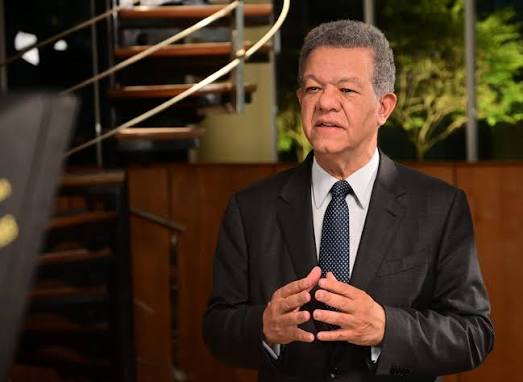

Santo Domingo.- The former President of the Republic and leader of the People’s Force, Leonel Fernández, assessed the impact of Santiago Matías, known as Alofoke, in communication and in an important sector of Dominican society, although he considered that turning that communicational phenomenon into a political project represents a different challenge.
Fernández described Matías as a “communicational phenomenon” and highlighted his ability to innovate in ways of communicating, noting that his style has managed to connect with an important segment of the population.
You might be interested in: Luisín Mejía asserts Santiago Matías has enough followers to formalize his party
“He has become a communicational phenomenon. I believe he has innovated a way of communicating that pleases an important sector of the Republic,” Fernández expressed when referring to Matías.

However, when questioned about whether Santiago Matías represents a new generation of politicians with the potential to lead the destiny of the Dominican Republic, Fernández drew distinctions between success in the field of communication and the construction of a political organization with real possibilities of attaining power.
The political leader maintained that in order to venture into electoral politics with possibilities, one needs territorial strength, to be part of a project of historical significance, and to have a vision for the future.
In that sense, Fernández explained that it is one thing to develop a political project of power and another to promote a project of communicational transformation.
When asked about the possibility of Matías forming a political party and eventually becoming a candidate, the former president pointed out that the creation of a party organization implies a process of national organization.

“A party has to be organized at a national level, as we have done with the Fuerza del Pueblo. That is something else”, he stated.
Santiago is not new to politics
The foray of Santiago Matías, “Alofoke,” into Dominican politics is not recent. In July 2022, the businessman and communicator announced his aspirations for the senate of the Santo Domingo province and asserted that he had “clear aspirations and ideas,” although at that time he did not belong to any party. He even suggested that the organization that backed his candidacy could count on significant electoral support from him.
Four years later, Matías has taken a more ambitious step. On July 22, 2026, he announced that he decided to create his own political party with the aim of participating in the 2028 elections, ruling out the proposals that, as he claimed, he received from more than 15 political organizations to assume a presidential candidacy.
In his announcement, Matías explained that the decision responds to the need to build an organization based on “innovative ideas and principles”, with a vision for the future and leadership committed to leaving behind what he termed the “old politics”. He also informed that he will travel across the national territory to collect the necessary signatures and request the recognition of the new organization before the Central Electoral Board.
The announcement came after weeks of discussion regarding the possibility of Matías heading the presidential ticket for the Social Christian Reformist Party (PRSC). The communicator himself had previously conditioned an eventual candidacy for that organization on changes within its ranks, but ultimately opted to promote his own political structure.
The project still faces the challenge of transforming from a platform based primarily on its enormous capacity for digital communication and mobilization into a political organization with territorial structure, members, leaders, and national presence. An analysis published by Acento points out that Matías would have to gather more than 87,000 signatures and build a national structure to achieve recognition from the JCE.