

They call to avoid speculation and wait for official explanations regarding the reasons that led to the expulsion
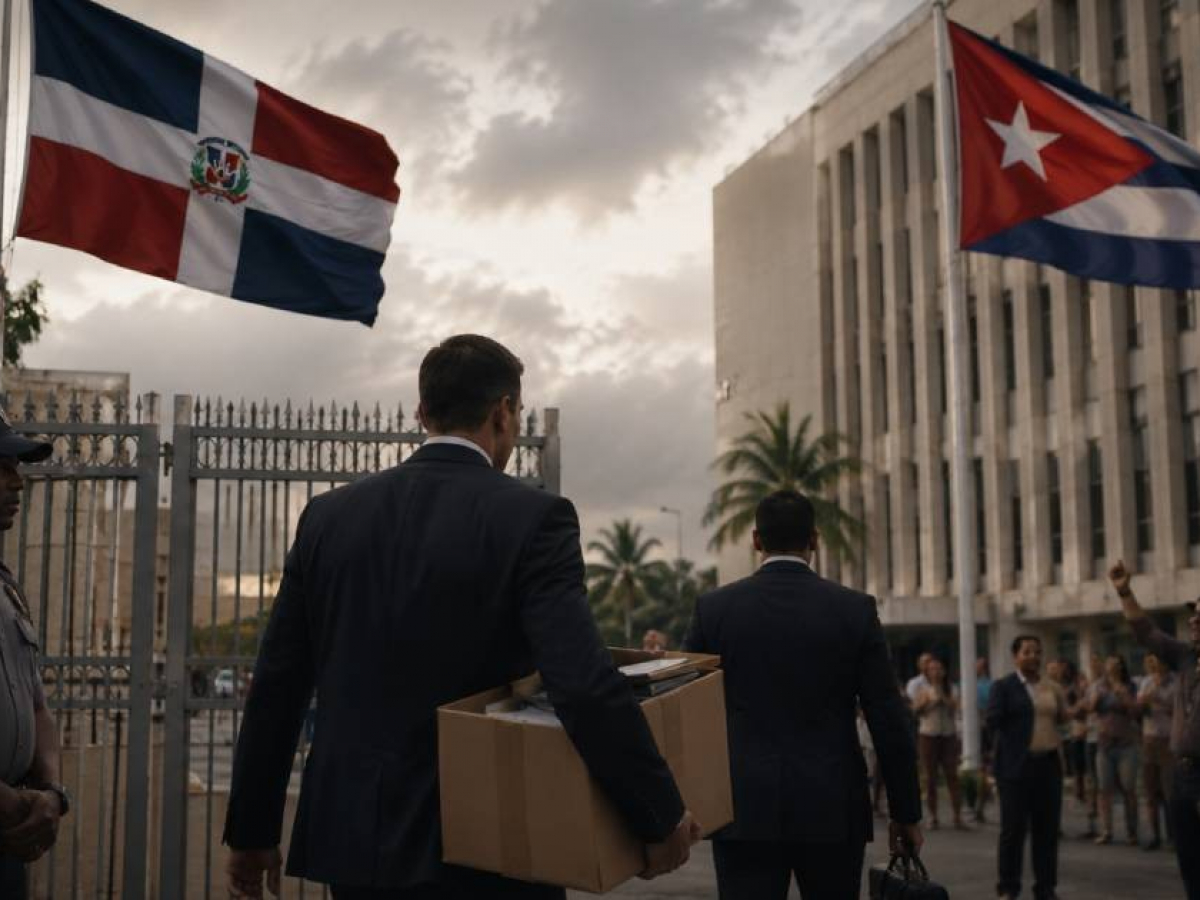
Santo Domingo.– The decision of the Dominican Government to order the departure of nine members of the Cuban Embassy has generated reactions from various sectors, while the Ministry of Foreign Affairs keeps the specific reasons that motivated the measure under wraps.
Legislators consulted defended the right of the Dominican Republic, as a sovereign State, to adopt decisions to preserve national security, although they believe that the Government should offer explanations in due course.
You might be interested in: Cuba claims that DR expelled its 9 diplomats due to US “pressure”

In this regard, the president of the Chamber of Deputies’ International Relations Commission, Ignacio Aracena, expressed his support for the position taken by the Government and recalled that diplomatic actions are subject to international agreements.
“We respect the position of the Ministry of Foreign Affairs, the governing body for managing the international policy of the Dominican Republic,” he indicated.
Aracena maintained that the Government “has the right to assume the positions it must assume to preserve national sovereignty” and emphasized that the decision does not affect the entire diplomatic representation of Cuba.
“It was not the entire delegation that was expelled, it is some members of the delegation,” clarified the legislator, who raised the possibility that the affected officials were not complying with the rules established by the Dominican Republic.
Deputy Elías Wessin Chávez maintained that a measure of this magnitude must be supported by reasons that, up to this moment, the authorities have decided not to disclose.
“We are a sovereign nation and one of the obligations that a president and a government have is to protect the integrity and national security. It is assumed that a measure of this nature and of this magnitude has its reasons,” he expressed.
In that sense, deputy Elías Wessin Chávez considered it prudent to avoid speculation as long as there is no broader version from the authorities and pointed out that the Dominican Republic has the right to order the departure of foreigners when it understands that there are situations that compromise its order or security.
“I understand that if an anomalous situation is found, as it seems to be, I believe that the correct action is being taken,” he stated.

When questioned about whether the Government should explain the reasons for the decision to the country, he replied that “in due course it must give them,” considering that the authorities need to process the incident before offering further details.
Likewise, the executive vice president of the Institutionalism and Justice Foundation (Finjus), Servio Tulio Castaños Guzmán, also pointed out that ordering the departure of members of a diplomatic mission constitutes a power of the Dominican State.
“At the end of the day, the head of foreign policy is the President of the Republic. We will have to see what the reasons are that society is unaware of. There must be a reason,” he expressed.
Castaños Guzmán explained that these types of situations occur in international relations when a State considers that members of a diplomatic corps might not be properly fulfilling their functions.
He warned, however, that decisions of this nature can have consequences on the relations between the countries involved, which is why he understands it is necessary to wait for official explanations.
It is recalled that the Dominican government has not yet publicly revealed the specific causes that motivated the departure of the nine members of the Cuban mission, keeping open the expectation of an eventual official explanation.
Meanwhile, the notified members must leave the country along with their family members within a period of 7 days.
Context of the situation between the Dominican Republic and Cuba
The relationship between the Dominican Republic and Cuba spans more than a century. Both countries formally established diplomatic relations in 1902, although they went through periods of interruption during the 20th century. Ties were definitively restored in 1998, giving way to a stage of bilateral cooperation and rapprochement.
Since then, both countries have maintained agreements in areas such as migration, consular affairs, education, science, culture, and transport. Among these instruments is a Migration Memorandum signed in 2014, which remains in force, in addition to other bilateral cooperation agreements.
However, during 2026 there have been signs of greater political distancing between Santo Domingo and Havana. The most recent episode occurred this Thursday, when the Dominican government formally requested the departure of nine officials from the Cuban Embassy and their relatives, about 21 people in total, with a deadline that expires on August 16. The Dominican authorities did not make the specific reasons for the decision public.
The measure was based on Article 9 of the Vienna Convention on Diplomatic Relations, which allows the receiving State to declare a member of a diplomatic mission persona non grata without being obliged to explain the reasons for its decision to the sending State.
The Cuban government rejected the decision and questioned the reasons for the expulsion, while from Havana the measure has been interpreted as part of greater U.S. pressure on Cuba.
The episode comes after other signs of cooling in the bilateral relationship, including the public positions taken by the Dominican government regarding the Cuban political situation and its decision to exclude Cuba from the X Summit of the Americas, held in the Dominican Republic in 2025.
Despite the tension, the expulsion of diplomatic officials does not automatically equate to a rupture of diplomatic relations. The Dominican Republic and Cuba maintain official ties and a series of bilateral agreements that are part of a relationship built over decades.