AI redefines the business model in financial entities

12:48 pm
Santo Domingo.- Artificial intelligence has ceased to be an emerging innovation to establish itself as a strategic pillar within the financial system. Its impact goes beyond operational efficiency, as it is reconfiguring business models, enabling new services and strengthening risk management in an increasingly dynamic and regulated environment. Firms like EY, with extensive experience in digital transformation of the financial sector, are setting the standard on how to adopt these technologies safely, ethically and with a long-term vision.
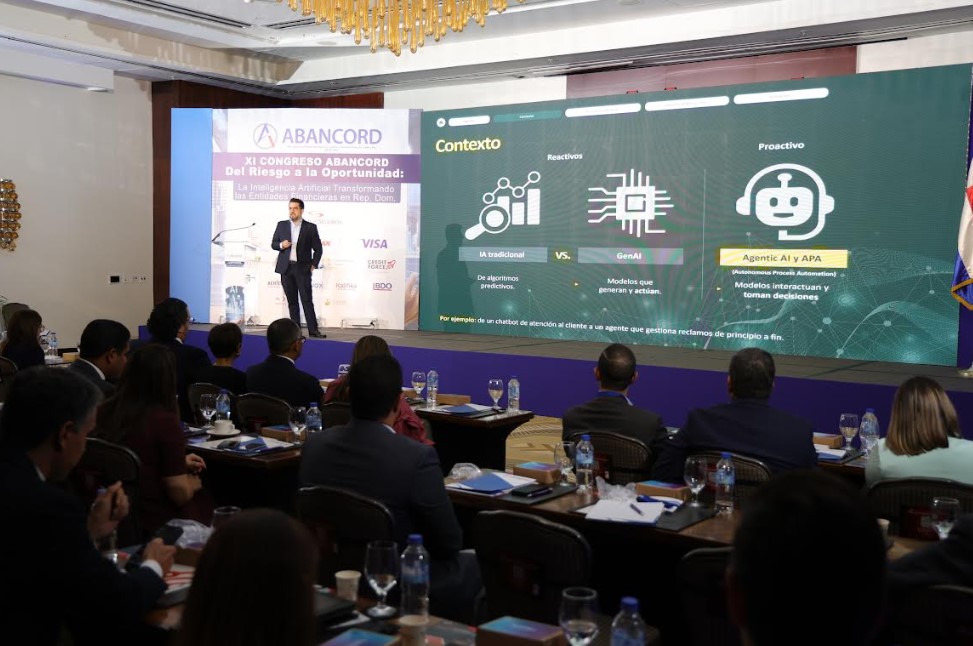
In the financial field, this technological revolution has given rise to a new generation of solutions. From models focused on prediction, there has been a transition towards generative systems and autonomous agents capable of executing tasks, generating content, and making decisions autonomously. These capabilities open up unprecedented opportunities to optimize processes, reduce cost structures, diversify income sources, and advance financial inclusion. However, they also require addressing complex challenges in terms of governance, regulatory compliance, and the availability of specialized talent.
Read more: DR will host the most important regional summit on artificial intelligence ethics
“In the organizational environment, artificial intelligence requires more than technological curiosity. It demands a clear vision, robust control structures, and a well-defined strategy. What simplifies our lives as users, in a company involves redesigning processes, training teams, and building technological autonomy. It is not about traditional software, but about a technology that trains, adjusts, and evolves,” said José Rafael Sánchez Vecchini, Business Consulting Panama – FSO of EY, during his participation as a spokesperson in a recent congress of the financial sector in the Dominican Republic. From EY’s perspective, this type of solution should not be understood as isolated tools but as a new business operating system. The development of proprietary architectures, the use of open-source models, and the customization of data and prompts are positioning themselves as strategic assets that drive technological independence, reinforce security, and foster constant innovation. At a local level, the banking sector has before it a range of possibilities that includes the intelligent automation of operations, virtual assistants that enhance the work of analysts and commercial teams, more fluid and personalized customer experiences, as well as the creation of digital products and embedded solutions. However, these advances must be managed alongside critical challenges such as traceability in decision-making, regulatory compliance, ethical and cyber risks, and the shortage of trained professionals.
Redacción de De Último Minuto



#Most read
- 1.Solange Omon, from Cameroon, is chosen as the new Victoria’s Secret angel
- 2.VIDEO: Tourists stranded with suitcases amid violent protests in Paris
- 3.Leonardo DiCaprio’s “dad bod” sparks discussion about belly fat and health risks
- 4.Armed men attack U.S.-flagged vessel in Haiti’s Port-au-Prince Bay
- 5.VIDEO: Cross involved in priest’s death reinstalled at Ecuador church as investigation continues
- 6.Now in Italy! Riots erupt in Milan as protesters loot stores and clash with police
- 7.Haitian gang Chen Mechan linked to alleged capture of four Salvadoran soldiers in Haiti
- 8.Cross falls on a priest inside a temple in Colombia and generates reactions on social media
- 9.LATAM plane’s wing catches fire before takeoff at Peru airport
- 10.5D Cinema in Japan surprises the world with an immersive experience that goes viral

Newsletter
Subscribe to our newsletter to receive our latest articles instantly!