

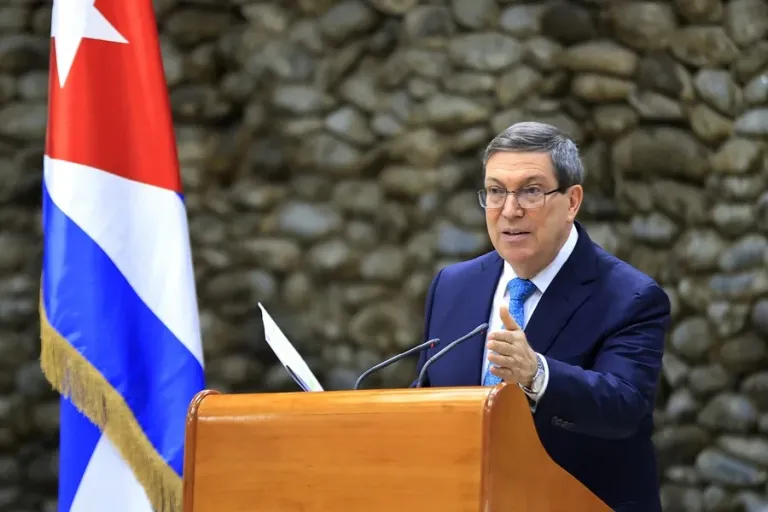

Havana.- The Government of Cuba rejected this Tuesday the announcement by the president-elect of Colombia, Abelardo de la Espriella Otero, to close that country’s embassy in Havana, an action that the island describes as an “act of subordination to the United States’ policy of aggression.”
A statement from the Ministry of Foreign Affairs in Havana issued today states that “these are statements that depart from the historic relations of friendship and brotherhood between Cuba and Colombia.”
“Should this decision be finalized, which has not the slightest justification and does not respond to Colombian national interests either, it would clearly demonstrate the clear subordination of the next government of Colombia to the policy of division and confrontation between our nations, always promoted by the United States,” the statement emphasizes.
The Cuban Foreign Ministry also points out that the island maintains with Colombia “a fluid bilateral relationship, which exhibits important progress in the economic-commercial sphere, in cooperation and academic exchanges, for the benefit of both peoples”.

Likewise, it states that this “hostile and unfounded action does not represent the feelings of the brotherly Colombian people,” and reaffirms that Cuba “will honor its commitments to the students studying Medicine in our country, as part of the Peace Agreements signed in Havana in 2016.”
Recommend
“Cuba knows that this hostile and unfounded action does not represent the feelings of the brotherly Colombian people, whom we have tirelessly supported for decades in the search for peace through a negotiated political solution to their internal armed conflict,” the foreign ministry’s note points out.
The announcement of embassy closures
Colombia’s president-elect, Abelardo de la Espriella, announced last Sunday that he will close at least fourteen embassies, including those in Cuba, Haiti, and Nicaragua, as part of a reorganization of the country’s diplomatic network once his administration begins on August 7th.
De la Espriella assured that these measures “do not mean breaking diplomatic relations” with the affected countries, except for Cuba and Nicaragua, regarding which he said that “there will be no ties whatsoever with tyrannies.”
The president-elect detailed in an address on his social media that “in a first stage” he will also close the embassies of Algeria, Azerbaijan, Barbados, Czechia, Ethiopia, Ghana, Hungary, Malaysia, Romania, Senegal, and South Africa.
Abelardo de la Espriella’s statements took place amidst the escalation of tensions that has placed relations between Washington and Havana at one of their worst moments since January, when the U.S. imposed an oil blockade on the island, to which it added additional sanctions in May, especially on foreign companies that maintain relations with the island’s government.