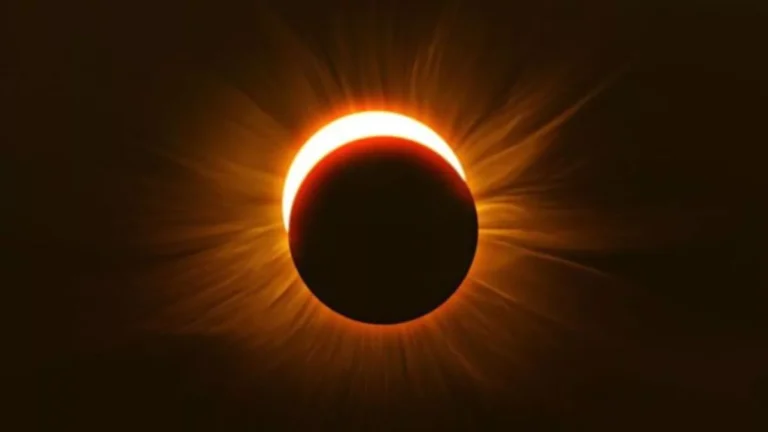



The recent total solar eclipse still leaves its images fresh in our minds when we are already thinking about the one that will arrive in twelve months, which scientists consider the eclipse of the century due to its unusual duration, which will be more than six minutes in Egypt. A trio that will conclude in 2028 with another annular one.
In August, specifically on the 2nd, but in 2027 the Moon will once again completely cover the Sun and its longest totality phase will be 6 minutes and 23 seconds, which will make it one of the longest total eclipses of the century, according to data from the Spanish National Geographic Institute (IGN).
The phenomenon will begin in the Atlantic Ocean, after which it will cross the Strait of Gibraltar, follow the North African coast until it enters Egypt, cross the Red Sea and some regions of Saudi Arabia, Yemen, and the extreme northeast of Somalia, to end in the Indian Ocean.
You might be interested in: An eclipse sweeps across North America and Europe before triumphing with its totality in Spain

The first eclipses of the trio already underway have, among others, two differences. The first only exceeded two minutes of totality near Iceland, while the 2027 one will be more than six.
The other difference is the time; while the one that just passed was in the afternoon and near dusk in Spain, where it was best seen, next year’s will be in the morning, so the contrast between daylight and the momentary night will be more pronounced.
From the time it begins in the Atlantic at 07:30 GMT until it ends in the Indian Ocean at 14:43 GMT, 313 minutes will pass. The locations of centrality in Egypt will be the best in the world to observe this eclipse, adds the IGN.
And after two totals, the year 2028 will begin with an annular one, which will occur on January 26. On that date, the Moon will not fully cover the solar disk, so an intense ring of fire will form around the silhouette of our satellite.
The maximum of the eclipse will be reached in Brazil, where the duration of the annularity will be 10 minutes and 27 seconds, which will make this annular eclipse one of the longest of this century.
The annularity phase will begin in the Pacific Ocean, and will cross a large part of South America (Ecuador, Peru, the southern tip of Colombia, Brazil, Suriname, and French Guiana), to then enter the Atlantic Ocean before reaching Portugal (entering first through the Azores Islands) and ending in Spain.
The partiality zone will also cover Central America, a large part of North and South America, southern Greenland, the westernmost area of Europe, and some regions of northern Africa.
The eclipse will begin at 11:06 GMT in the Pacific and will end at 17:08 GMT in Spain, so it will have a total duration of 362 minutes, according to data from the IGN.