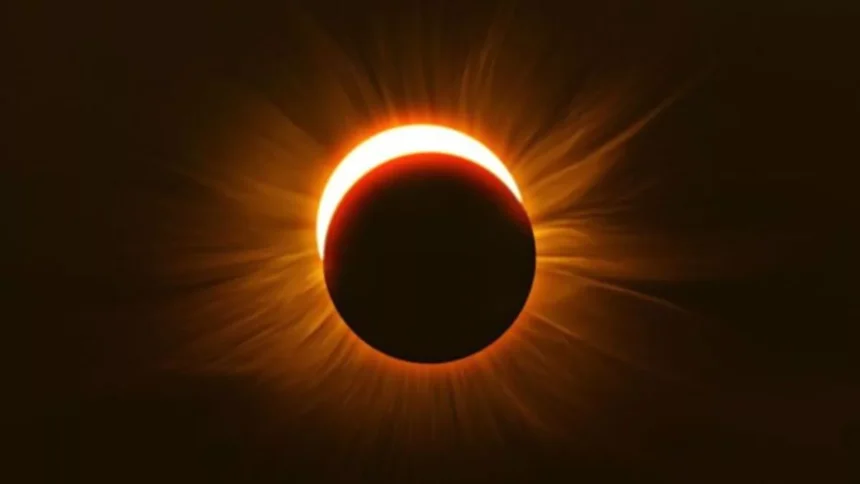
Spain is preparing to witness an exceptional and historic solar eclipse tomorrow, an astronomical phenomenon that will begin in the Bering Sea and, in its totality phase, will cross the Arctic Ocean, northwestern Greenland, and western Iceland before fully entering the Iberian Peninsula.
As a partial eclipse, it will be visible across much of North America and Europe and in western Africa, and the Moon will begin to cover the Sun at 15:34 (GMT) in the Bering Sea and will leave it completely uncovered again at 21:58, after an astronomical event that will have lasted for 264 minutes (a little less than four and a half hours).
You might be interested in: The world will observe a total solar eclipse on August 12, the 16th of the 21st century
The maximum of the eclipse will occur at 17:46 (GMT) near Iceland, where the duration of the totality phase will last for 2 minutes and 18 seconds, a longer time than it will have in the wide strip that will cross Spain from west to east, a strip that occupies nearly 40 percent of the national territory and over which there are up to 23 provincial capitals.
On the eve of the event, the first in a series of eclipses unprecedented in Spain (a total solar eclipse will repeat in 2027 and an annular one in 2028), millions of people are awaiting the weather forecast to see if the clouds will allow them to observe (in all its splendor, because the darkening or twilight will occur) a phenomenon that has transcended the scientific realm to become a social, cultural, and economic event.
More Read

The forecasts from the State Meteorological Agency indicate a situation of stability in most of the country with slightly cloudy or clear skies; only in Galicia, the Cantabrian area, the upper Ebro, and in areas of the Mediterranean, the day will begin with cloudy skies or intervals of low clouds, but with a general tendency to clear up, although the cloudiness could be more persistent on the coasts of Galicia and the Cantabrian Sea.
From Galicia to the Balearic Islands
Thus, the north of Galicia will be the peninsular ‘kilometer 0’ of the eclipse, the first ‘balcony’ from which to begin contemplating the phenomenon on the peninsula, when around 19:30 (peninsular time) the Moon begins to eclipse the Sun, until it covers it completely a few seconds after 20:26.
After a phase of totality that will last for just under two minutes (until 20:28), the star will begin to regain its brightness until the end of the phenomenon, at 21:21.

The same sequence will occur, with very few minutes of difference, on a path from west to east, and the Balearic Islands will bid farewell to the eclipse, although, as in many places in the eastern peninsula, the end of the eclipse (of the partial phase) will not be visible because the Sun will have already set on the horizon.

Government data indicates that between 400,000 and 1.5 million trips motivated by the eclipse will be recorded tomorrow, which is why all authorities have emphasized the importance of planning those movements, not waiting until late in the afternoon to make them, and staggering the return for those who will not be staying overnight at the location they choose to observe it.
Recommendations for safe observation
The recommendations for safely observing this exceptional astronomical phenomenon have been grouped into five main areas of risk: health-related (heat stroke, dehydration, overcrowding, or the effects of sudden darkness); eye protection (among which the use of glasses duly certified with the ISO 12312-2 standard to prevent retinal damage is paramount); or mobility-related.
You must plan the trip, avoid stopping on the hard shoulder, carry supplies, anticipate possible communication saturation, and always use designated areas.
Among the recommendations, those regarding environmental impact (respecting natural areas, avoiding waste, disturbances to wildlife, and not trespassing on private land) or the risk of forest fires (prohibition of fire, avoiding parking on dry vegetation, and respecting emergency access) also stand out.
Autonomous communities and numerous city councils, universities, space agencies, research centers, and media outlets have scheduled live broadcasts and numerous activities for the eclipse and have selected hundreds of observation points that may be optimal for safely enjoying the event.
More Read

A sensory experience and an opportunity for science
In addition to the extraordinary natural spectacle that an eclipse of this nature represents and the sensory experience that its contemplation can provide, the peninsula will be for a few minutes the best natural laboratory in the world to study the Sun.
The event will provide scientists with the opportunity to explore the physics of the star, to better understand the processes that determine space weather, and to deepen their knowledge of the interactions between the Earth and its star.
It will also be the first one visible from the peninsula and the Balearic Islands in more than a century (the last one in Spain occurred in 1959 and could only be seen in the Canary Islands archipelago), although next year an eclipse will repeat -which in its totality phase will only be visible in the extreme south of the peninsula and in the autonomous cities of Ceuta and Melilla- and in 2028 an ‘annular’ type one -the Sun will look like a golden ring- that will cross the peninsula from southwest to northeast.
For the following ones, we will have to wait longer, because Spain will not see another total solar eclipse this century until the years 2053 and 2090.