

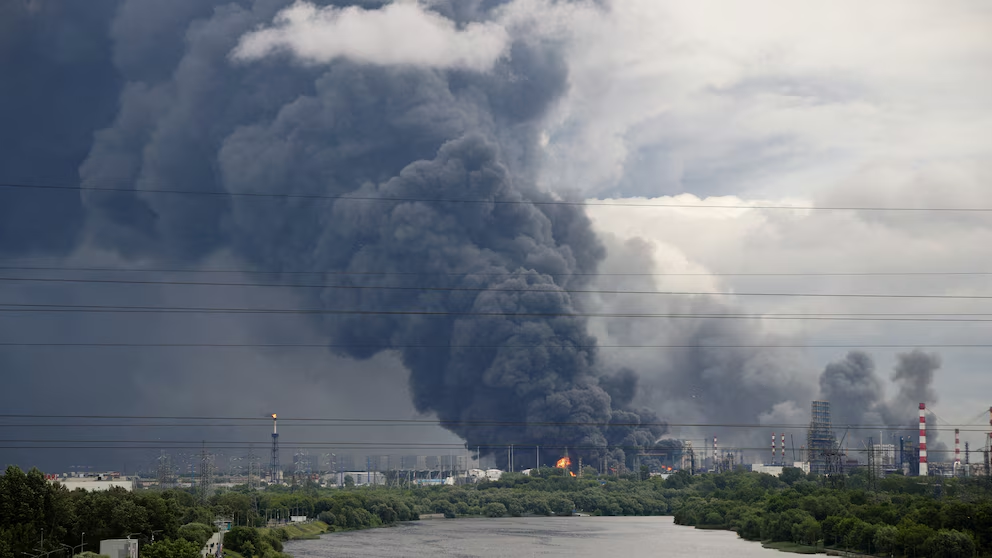

Ukraine is creating a “long-range strike” command within its armed forces, announced President Volodymyr Zelensky, as Kyiv’s campaign against Russian energy and logistics has forced Moscow to ban diesel exports and restrict maritime transport near the Sea of Azov, which borders the Black Sea.
For months, Ukrainian attack drones have been striking key energy infrastructure thousands of kilometers inside Russia, in what Kyiv presents as long-range sanctions against the main contributor to the Russian state budget, which supports its war effort.
In recent weeks, Ukraine has reported near-daily attacks, and authorities claim it is fair to bring the war to Russia more than four years after Moscow launched its full-scale invasion.
“Today I signed a decree establishing a special command within the Armed Forces, a command intended to have a long-term and, in effect, global impact on Russia in response to this war”, said Zelensky in his evening address to the nation.

“This command must concentrate 100% of available resources on further reducing Russia’s ability to wage war.”
We recommend reading:Russia launched a second massive wave of missiles and drones against Ukraine in less than three days
A satellite image shows smoke and damage at the Omsk oil refinery following a drone attack, July 7, 2026.
In what has become an almost daily ritual for Ukrainians, exhausted by the relentless Russian attacks that have caused a devastating number of civilian casualties, Kiev’s military bloggers begin each morning by reporting on the results of long-range strikes, sharing images of burning Russian energy facilities.

Just on Friday, Ukraine attacked the Ilsky oil refinery in the Krasnodar region, one of the largest in southern Russia, and the Ust-Luga oil refinery complex in the Leningrad region, according to the Ukrainian General Staff. Both are frequent targets.
An oil terminal and an oil depot in the Rostov region were also attacked, with explosions and fires, according to the statement.
On Wednesday, Russia banned diesel exports to ensure domestic supply due to the fuel crisis in the Crimea peninsula, which has been occupied for weeks, and significant shortages in other regions. Several Russian refineries have been forced to temporarily suspend their operations.
Russia banned diesel exports due to the fuel crisis in Crimea and domestic gasoline production fell to nearly 65% of its capacity.

National gasoline production has been reduced to around 65% of its capacity as a result of the attacks, according to two industry sources and Reuters calculations.
Economic impact
Zelensky and high-ranking military officials have been urging Russian President Vladimir Putin to stop the war immediately, before the intensification of attacks on Russian territory, something unimaginable for its smaller and less war-prepared neighbor, further damages its economy.
Putin rejects calls to negotiate peace, and the attacks reinforce his determination to continue the fight, according to sources.
On Friday, Ukraine also attacked 10 tankers in the Sea of Azov, among the nearly 50 fuel vessels damaged in the last five days, according to Robert Brovdi, commander of Ukraine’s drone forces and one of the architects of the long-range campaign
Moscow’s “shadow fleet” is shrinking, Brovdi stated.
Russia has temporarily suspended maritime traffic through the canal connecting the Don River to the Sea of Azov, according to two sources in the grain export industry.
Ukrainian President Volodymyr Zelensky, whose long-range strike campaign has begun to fracture the Kremlin’s inner circle. (REUTERS/Thomas Peter)
According to experts, this decision could affect nearly a quarter of Russian wheat exports in the area, which would represent another potential blow to the Russian economy.
Zelensky stated that Ukraine’s proposals to move towards peace have the support of Putin’s inner circle.
“They understand what is happening and that there is no alternative to peace”, he declared.
The successful attacks mark a significant shift from the early days of the invasion and the years of war of attrition, but experts warn that it is too early to claim that Ukraine has turned the tide of the conflict.
Ukraine, chronically deficient in air defense, remains exposed to Russian ballistic missile attacks, which Zelensky considers Moscow’s last advantage in the war.