Buenos Aires (EFE).- Five years after the death of Diego Armando Maradona, on November 25, 2020, the trial that sought to determine responsibilities for his death – annulled due to the poor performance of Judge Julieta Makintach – exposed some keys to the tragic outcome of the idol.
Maradona died a few weeks after turning sixty, while receiving medical care in a house on the outskirts of Buenos Aires from eight health professionals, seven of whom have already sat in the dock to be tried for his death.
As revealed during the failed trial, which began in March of this year and was annulled on May 29th after it was learned that Makintach starred in a documentary about the process, the health of the star was seriously compromised.
Un grupo de simpatizantes muestran una bandera con la imagen de Diego Maradona en una fotografía de archivo. EFE/ Demian Alday Estévez
The autopsy reveals serious pathologies
The autopsy revealed hepatic cirrhosis, a long-standing lung pathology, a “monstrous increase in the abdominal cavity” and severe alterations in his kidneys and especially in the heart, which according to the experts weighed “more than double the normal”. In addition, it specified that the cause of death was “acute pulmonary edema secondary to a chronic heart failure that had worsened”.
In early November 2020, Maradona was recovering from surgery at the Clínica Olivos. His daughters stated that, at the time of discharge, the neurosurgeon Leopoldo Luque, the doctor in charge of the team, was the one who convinced them to continue with care at a private residence and not in a rehabilitation clinic, as other professionals had recommended.
The quality of medical and human care that the former soccer player received from November 11 to 25 is central to understanding whether his death was avoidable and what responsibilities fall to the health professionals who were in charge.
Didn’t have basic medical equipment
Dalma Maradona, one of the star’s daughters, stated that they had been promised that the care he would receive would be “the same as in the Olivos Clinic” and that the doctors in charge had deceived the family “in the cruellest way.”
Numerous witnesses stated that the high-complexity ambulance that had been assured to the family was present at the home only during the first two days.
The house, which didn’t even have a bathroom that met the reduced mobility requirements the patient needed, also lacked emergency medical equipment, such as a defibrillator.
Gianinna Maradona, another of his daughters, stated that the doctors promised a “serious home hospitalization” and, in practice, it was “a disastrous staging”.
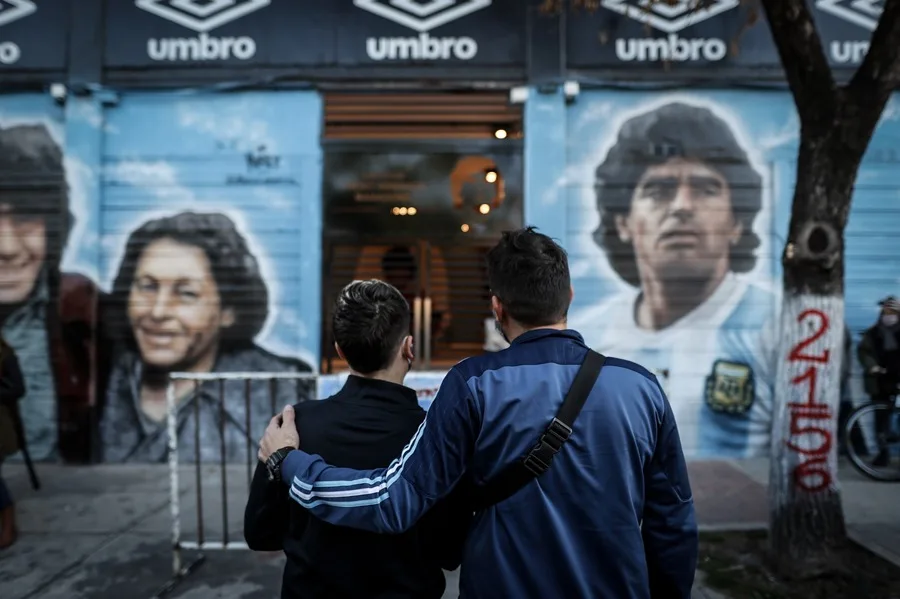
Un hombre camina en una fotografía de archivo frente a un mural con la imagen del astro del fútbol Diego Maradona en el barrio Chacarita, Buenos Aires (Argentina). EFE/ Enrique García Medina
The treatment focused on his addictions and neglected other pathologies
The autopsy revealed that Maradona died without alcohol or drugs in his blood. However, an expert stated that he presented “generalized edema, from head to toe”, an accumulation of four and a half liters of fluid which, according to the specialist, “does not occur overnight”, but in “a minimum of ten days”.
Gianinna reported that Luque ignored her warnings about her father’s deterioration. According to her statement, she told him that she saw him “worse and worse” and the doctor replied: “He has ups and downs, but I see him better.”
Maradona died alone
Maradona was clinically checked for the last time at 00:30 on November 25 and his death was reported to the Police at 13:00 that day. The nurses were sleeping in a room away from his, which made it difficult to assist him in an emergency.
The first doctor who came to resuscitate him, following a call at 12:26 that day, stated that, based on his knowledge of the subject, he could affirm that the star was dead “one or two hours” prior.
One of the forensic experts who participated in his autopsy went further, stating that the footballer’s heart had unequivocal signs of having suffered “a long agony”, of “up to twelve hours”.
The daughters of the star detailed how Maradona’s assistant and legal representative, Maximiliano Pomargo, to whom the medical team answered, hindered their contact with their father.
During the last days of ‘Diez’, the family refrained from visiting him on the recommendation of the doctors in charge, who conveyed that he needed to “be calm”.
We are a multiplatform outlet offering news and television content. The fastest-growing news outlet in audience in the history of Caribbean communication.