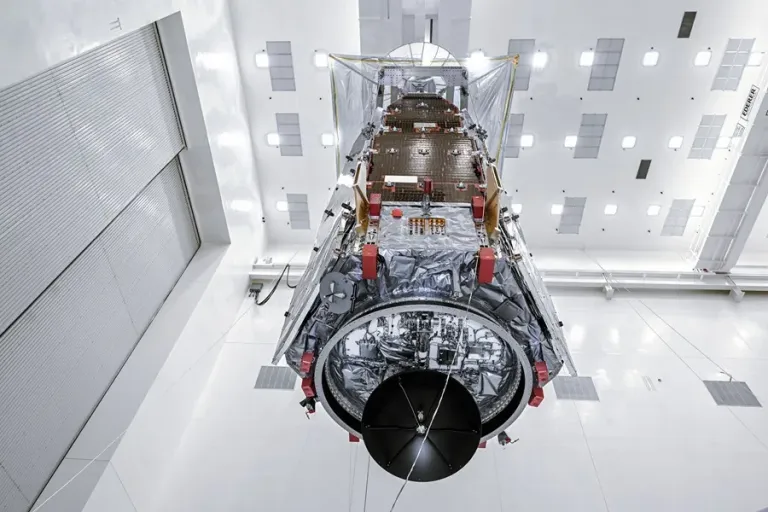



Roman will capture images of an area of the sky 50 times larger than those covered by Hubble in 30 years
Miami (USA).- NASA has everything ready for the launch this Sunday of the Nancy Grace Roman telescope, the largest panoramic observatory ever built, which will monitor more than 2,000 galaxies thanks to a field of view 100 times larger than that of the Hubble.
The launch, aboard a SpaceX Falcon Heavy rocket, is scheduled for 7:26 a.m. Eastern Time (11:26 GMT) from NASA’s Kennedy Space Center in Cape Canaveral, Florida.
Experts from the U.S. space agency gave the green light to the mission this week after conducting the final readiness review, which will allow its start to be moved up by nine months compared to the date originally planned by NASA.
You might be interested in: New images of the sun show its surface in the greatest detail to date

From launch, the immense telescope will take a hundred days to reach its final destination: a gravitationally stable zone between the Sun and the Earth known as the L2 Lagrange point, from where it will track the universe, in search of answers for dark energy, exoplanets, and infrared astrophysics.
It will capture images of an area of the sky 50 times larger than Hubble
Roman will observe more than 2,000 galaxies, contributing to measuring the expansion of the universe and discovering new exoplanets thanks to a coronagraph that cancels out the brightness of stars and allows for photographing planets in their vicinity.
Its work will be complementary to that of the rest of the space observatories deployed by NASA. The Roman telescope’s enormous field of view, one hundred times larger than Hubble’s, will allow for observing large areas of space at the same time to detect targets of interest, which will then be examined in greater detail with other telescopes.
In a single month, Roman will capture images of an area of the sky 50 times larger than those covered by Hubble in 30 years and will be able to detect up to half of the stars in the Milky Way, according to NASA experts.
This observation capability will generate 11 terabytes of data per day, equivalent to downloading about 350 4K Ultra HD resolution movies every 24 hours.

One of Roman’s main goals in its first five years of activity will be the observation of the center of the Milky Way, which it will monitor every 12.5 minutes.
After that first five-year period, the telescope’s objectives will be updated based on its discoveries.
Although it is expected to run out of fuel in ten years, NASA designed it to be refueled even though it currently does not have the capacity to service this type of observatory at the L2 Lagrange point.
The telescope takes its name from NASA’s first chief astronomer, Nancy Grace Roman, who was one of the architects of the U.S. agency’s modern space program in the 1960s and 1970s.