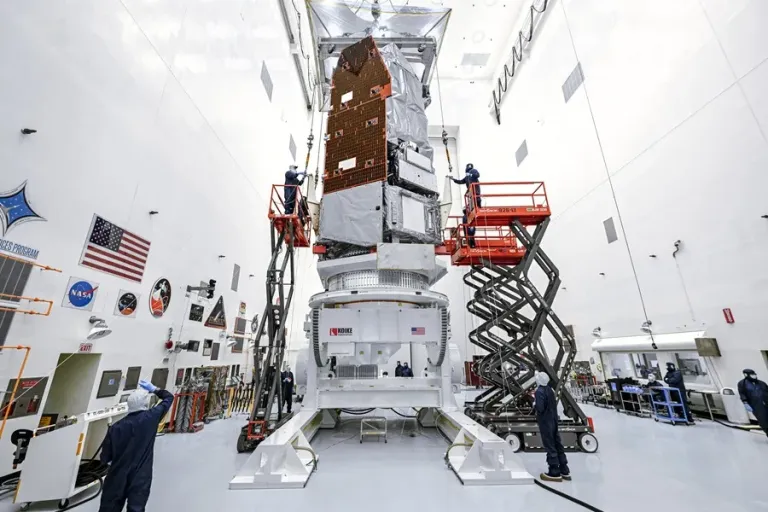

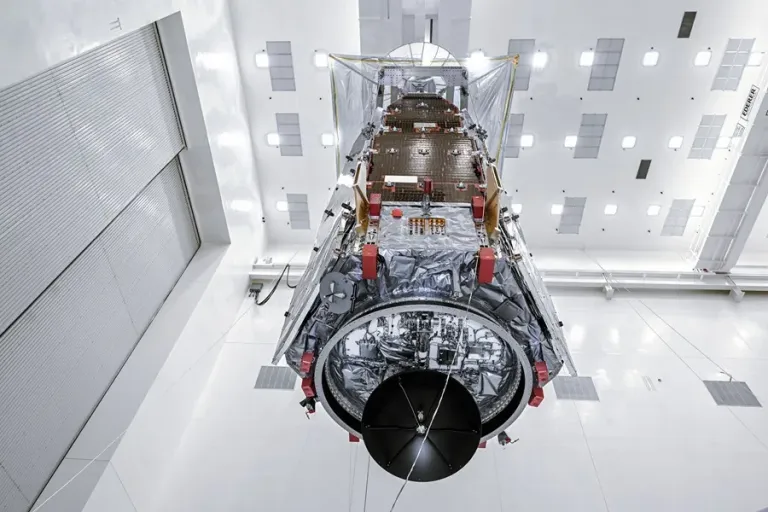

Miami.- NASA is finalizing the launch of the Nancy Grace Roman Space Telescope, the largest panoramic observatory ever built, which will have a field of view 100 times larger than Hubble and could challenge the current understanding of the universe, experts from the space agency announced this Wednesday.
“A single month of Roman observations could trace our own Milky Way and detect up to half of its stars, generating a catalog larger than any existing one,” said scientist Julie McEnery in a press conference.
In comparison, the historic Hubble telescope, launched into space in 1990, needs a century to map the galaxy.
The launch of the Roman telescope, named after NASA’s first chief astronomer, is scheduled for no earlier than August 30. It is expected to take one hundred days to reach its final destination: a gravitationally stable area between the Sun and Earth known as the L2 Lagrange point.

The Roman telescope mission
This colossal observatory will track the universe, in search of answers for dark energy, exoplanets, and infrared astrophysics, which could change our physical models.
“In the last 5 to 10 years, there have been indications that our ‘standard model’ of the universe is not entirely correct—due to discrepancies in the Hubble constant. It is very likely that Roman will prove the standard model wrong,” explained McEnery.
We recommend reading:La Nación editor affirms that journalistic judgment and experience remain the primary value in the face of AI advancement
As part of this research, the telescope will observe more than 2 billion galaxies, which will allow for measuring the expansion of the universe and, according to McEnery, will help discover “up to 40 times more exoplanets than we know today,” thanks to a coronagraph that cancels out the brightness of stars and allows for photographing the planets in their vicinity.

“Findings such as isolated black holes, neutron stars, and exoplanets with disks will become routine,” he highlighted.
The difference from its predecessors
The main difference of the Roman compared to the Hubble or the James Webb -the most powerful telescope created by humans-, is its wide field of view, which allows observing many more regions of space at the same time.
“Hubble and James Webb allow us to see the leaves and birds in distant trees with clarity, and missions like SPHEREx give us a panoramic view of the entire forest. Roman does both at once: it has the wide-angle view of the forest and the sharpness to see the birds and leaves,” explained NASA Astrophysics Director Shawn Domagal-Goldman.
Thanks to its technology, it will transmit 11 terabytes of data per day, equivalent to downloading about 350 movies in 4K Ultra HD resolution every 24 hours.

Furthermore, McEnery specified that more than half a million 4K screens would be needed to display a single complete image of the trace, which would be equivalent to covering 45 Manhattan blocks.
The goal of the Roman
The new telescope will have three initial objectives in its first five years of activity, according to experts. After that time, the goals will be updated based on the discoveries made by Roman.
One of its main focuses of attention will be located on the center of the Milky Way, which it will scan every 12.5 minutes.
Regarding technical preparations, the project manager, Jackie Townsend, confirmed that the observatory completed fueling last week and that in three weeks, integration with SpaceX will begin to install the telescope into the fairing of the Falcon Heavy rocket that will carry it into space.
“Roman’s ‘Dream Team’ continues to do great things and I can proudly say that Roman is ready for the launch,” concluded Townsend.