
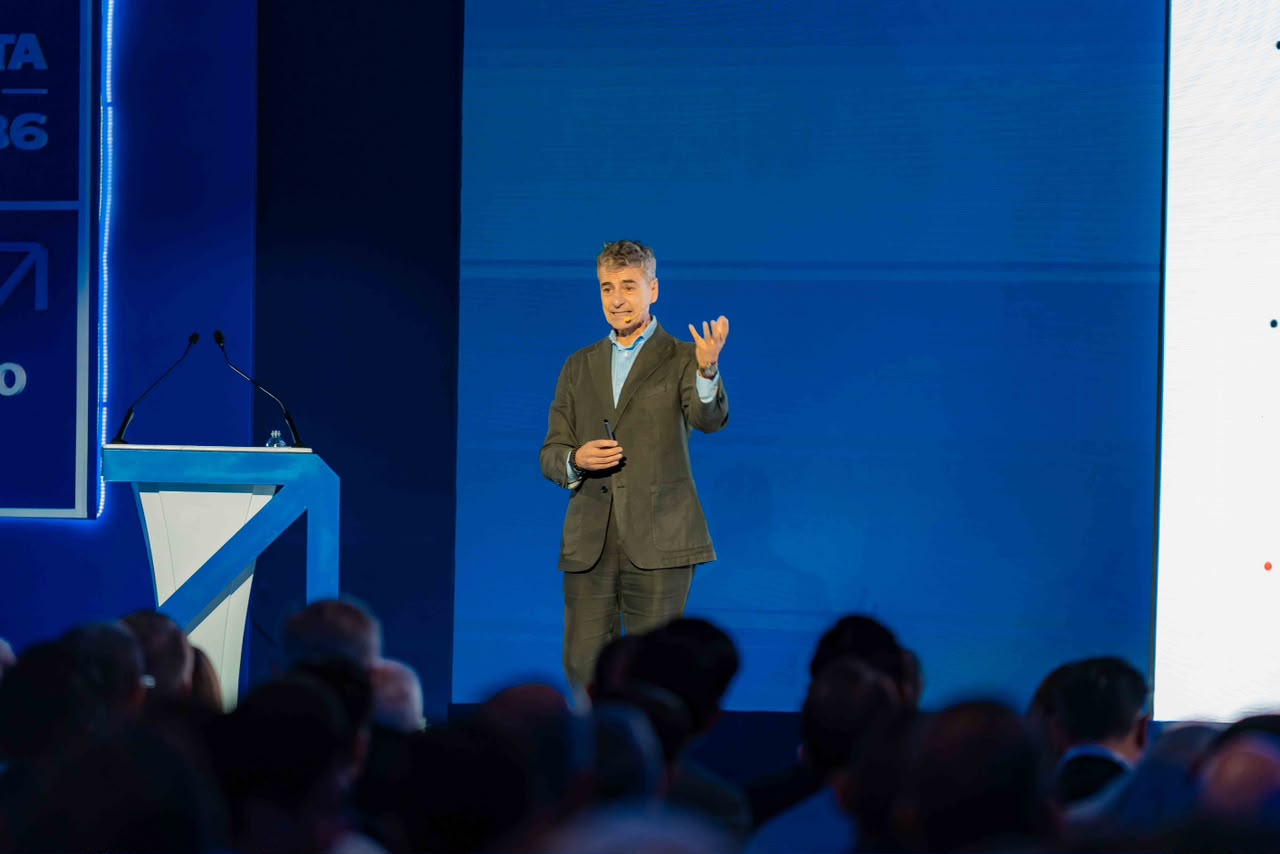

During the first Meta RD 2036 Forum, the Ministers of Finance and Economy, Magín Díaz, and of Industry, Commerce and MSMEs, Eduardo Sanz Lovatón, presented alongside international economists Andrés Velasco and Federico Sturzenegger some ideas and actions that the Dominican Republic could implement to avoid the middle-income trap and grow as much as the Government has proposed.
In the “Economic Outlook for Latin America and the Caribbean” panel, moderated by the Ombudsman, Pablo Ulloa, Minister Magín Díaz highlighted the importance for the country of “creating fiscal space” to maintain investment spending that allows for the construction and renovation of public service infrastructure.
“A country with this level of income needs to have public infrastructure and an annual investment equivalent to 4% of the Gross Domestic Product,” he stated.
For his part, Minister Eduardo Sanz Lovatón stated that plans such as Meta RD 2036, which involves collaboration between the public and private sectors, academia, and civil society, grant legitimacy to the public policies that the Government wishes to implement to guarantee development.

“Those Meta RD 2036 committees foster alliances that make it easier for the Government to take on long-term challenges,” he pointed out.
Chilean economist Andrés Velasco, dean and professor at the London School of Economics’ School of Public Policy, spoke about the middle-income trap and what measures the Dominican Republic must take to avoid replicating this economic phenomenon.
The expert pointed out that the Dominican Republic is right at the point where other countries have fallen into the middle-income trap. However, he emphasized that, although it presents itself as a difficult challenge, the country can overcome this trap.
“The risk is that, as the country leaves poverty behind, the per capita growth rate will gradually decrease. This happens everywhere, but the idea is that it doesn’t happen too quickly,” simplified the economist, who recalled that rich countries tend to grow less than developing nations.

In turn, economist Federico Sturzenegger, Minister of Deregulation and State Transformation of Argentina, stated that fiscal balance and economic freedom are essential principles to guarantee the right to property.
On the other hand, the Argentine official considered it pertinent for societies to learn to identify regulations designed exclusively to protect particular interests.
The first National Forum for Full Development is held by the Ministry of the Presidency and the National Competitiveness Council, and brings together representatives from the public and private sectors, academia, and multilateral organizations in thematic working sessions aimed at gathering sectoral contributions for the implementation of the RD 2036 Goal.