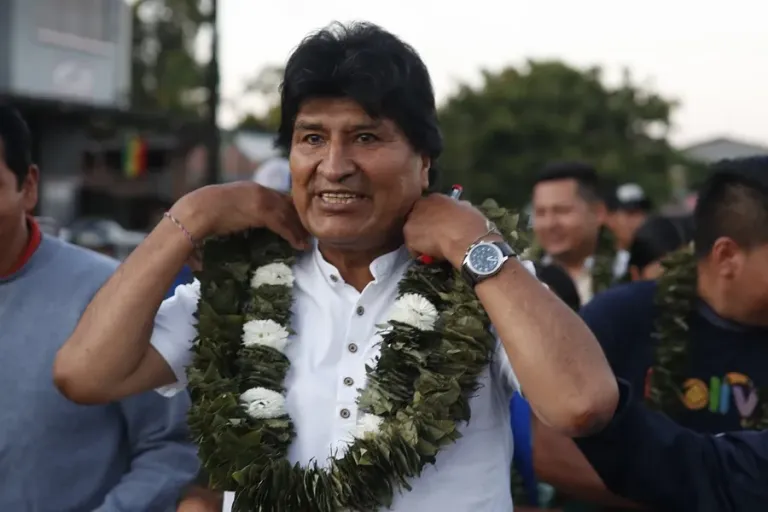



The Bolivian Prosecutor’s Office issued an arrest warrant against former president Evo Morales, accused of terrorism, armed uprising, and other crimes in the context of the massive blockades that paralyzed the country for 53 days. The document, signed by anti-corruption prosecutor Brayan Melgar, instructed the Police to apprehend and transfer Morales to the Specialized Police Unit for the Fight Against Corruption, in response to complaints filed by the Pro Santa Cruz Civic Committee and the Ministry of Government.
“They will not intimidate us. We will continue fighting alongside the people, as we have always done, with the conviction that Bolivia deserves a different path: one of dignity, sovereignty, social justice, and the recovery of hope for everyone,” Morales asserted today on his X account.
The investigation against Morales focuses on six crimes: armed uprisings against the security and sovereignty of the State, terrorism, attack against the security of means of transport, criminal association, public incitement to commit a crime, and attack against the security of public services.
The accusations arose following the formal criminal complaint filed on July 1st by the Pro Santa Cruz Committee, represented by Stello Cochamanidis Garcés, which identified Morales as the main instigator of the protests and blockades that affected the country between May and June.

We recommend reading:
During those seven weeks, peasants, members of the Bolivian Workers’ Center (COB), and organizations affiliated with Morales set up more than 100 blockade points in different regions, particularly in La Paz, Cochabamba, and Santa Cruz. The protests were in response to the demand for the resignation of President Rodrigo Paz, a requirement that the mobilized sectors considered the only way out of the conflict.
The shortage of food, fuel, and medical oxygen reached critical levels in several cities.
Traffic disruptions and road blockades caused the death of at least 22 people and left a toll of 88 injured, according to data from the Ombudsman’s Office and reports from civic and social organizations.

Roadblocks in Bolivia paralyzed traffic for 53 days and triggered a national crisis (EFE)
The economic impact was devastating. Losses exceeded USD 3 billion, and sectors such as production, especially in Santa Cruz, suffered severe damage. Goods could not leave the production areas or be transported to other departments, which worsened the supply crisis in the country. Clashes and social tension marked the climate during the 53 days of conflict.
“They seek to hold us responsible for the social mobilizations to hide the true drama that Bolivia is experiencing: a deep economic and social crisis, the result of a model that has abandoned the people and protects corruption,” stated Evo Morales.
Along with Morales, the arrest warrant reached the top leader of the Bolivian Workers’ Center (COB), Mario Argollo, and the leader of the Túpac Katari Peasant Federation, Vicente Salazar. The latter has been held in preventive detention at the Chonchocoro prison since July 6, identified as one of the main organizers of the blockades in western Bolivia.

The arrest warrant was issued based on articles 121, 130, 132, 133, 213, and 214 of the Penal Code.
Morales denied having promoted Paz’s resignation and attributed the mobilizations to social pressure due to unmet demands. On May 24, Morales posted on social media that the president faced “two paths”: to militarize the country or to call for elections within the next 90 days.
The former president remains sheltered in the Tropics of Cochabamba while the investigation against him progresses.
Finally, after agreements with sectors such as the COB and given the persistence of the blockades, President Paz decreed a state of emergency on June 20 and ordered the deployment of the Police and the Army to restore traffic on the roads.
“Our position has always been clear: we stand with those who suffer from austerity, fuel shortages, the rising cost of living, insecurity, and the advance of drug trafficking. With legal proceedings and political persecution, they will not solve the problems they themselves have caused; they are only trying to divert attention with a new headline,” the former president added today on X.
Morales remains in the Trópico de Cochabamba, his main political stronghold, protected by supporters since October 2024. In addition to the case regarding the blockades, he faces another investigation for aggravated human trafficking, related to an alleged relationship with a minor during his term. In May, a court in the Tarija region declared him in contempt and issued an arrest warrant due to his absence at the opening of the corresponding trial. The Police stated that they are evaluating the appropriate moment to execute that pending order.