
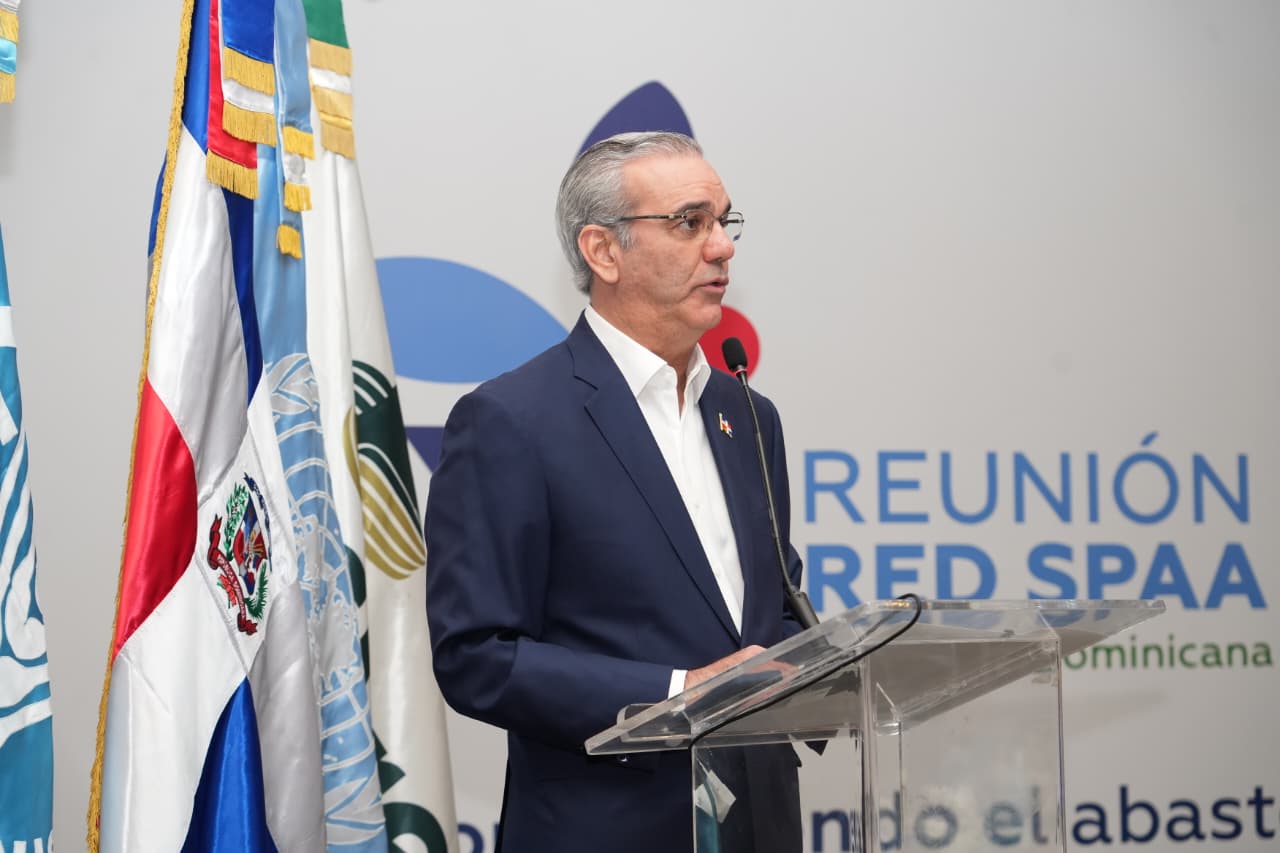

With the presence of President Luis Abinader, the XI Meeting of the Network of Public Food Supply and Marketing Systems was inaugurated in the country, a regional space aimed at strengthening public institutions responsible for food supply and marketing.
The conclave, which will take place over four days, is organized by the Price Stabilization Institute (INESPRE), with the support of the Food and Agriculture Organization of the United Nations (FAO) and the governments of the Dominican Republic and Brazil.
During this international meeting, Dominican officials will present the experience and actions implemented by the country to achieve the Zero Hunger goal, recognized by the FAO.
President Luis Abinader stated that this achievement is the result of the joint work of various government institutions, among which he highlighted the fundamental role played by the Price Stabilization Institute.

The president assured that the Government will continue working to strengthen the public food supply network of the Dominican Republic and highlighted the contribution of national producers to achieve this important international recognition.
“This is not an arrival point, this is a new starting point. Our responsibility does not end with reaching a new indicator; our obligation is to ensure that no economic crisis, no climatic phenomenon, no alteration of international markets makes us go backwards,” asserted the head of State.
For his part, the FAO representative in the Dominican Republic, Rodrigo Castañeda, stated: “This Network meets today at a time of high uncertainty: climate crisis, logistical disruptions, geopolitical tensions, and food inflation that does not subside. That is the reality that the food systems of Latin America and the Caribbean face today.”
He added that public supply and marketing systems are not an accessory instrument, but rather, on the contrary, they constitute a State policy.
Likewise, it meant that these correct market failures, reduce price volatility, support family farming through public procurement, and ensure that food security does not depend exclusively on market logic.
Meanwhile, Eric Moura, head of the Special Advisory Office of the Ministry of Agrarian Development and Family Farming (MDA) of Brazil, said he hopes the SPAA Network will be strengthened as a permanent space for cooperation, mutual learning, and the construction of a lasting regional agenda to fight hunger and promote food and nutritional security.
For his part, Arnoldo Campos, Director of Operations and Supply at Brazil’s National Supply Company (CONAB), explained that public food supply systems are becoming increasingly important in the face of growing uncertainty and the consequences derived from the climate and geopolitical crises, forming part of the solution to these new challenges in the region.
The Minister of Agriculture of the Dominican Republic, Francisco Oliverio Espaillat, highlighted the commitment of President Luis Abinader’s government to support national production to guarantee quality food for the population.
He said that joint work has been the fundamental factor for consumers to have access to products throughout the national geography.
Meanwhile, the executive director of INESPRE, David Herrera Díaz, stated that this meeting represents an opportunity to promote analysis, the exchange of experiences, and the strengthening of public food supply and marketing systems in Latin America and the Caribbean, as fundamental tools to face challenges related to inflation, ensure sustainable access to food, and combat hunger in the region.
Likewise, he highlighted that the meeting is taking place in an international context marked by scenarios of uncertainty, armed conflicts, and economic pressures that impact global food security.
The meeting includes delegations from Brazil, Bolivia, Chile, Colombia, Costa Rica, Cuba, El Salvador, Guatemala, Honduras, Mexico, Panama, Paraguay, Peru, and Uruguay, as well as the Dominican Republic, who will analyze public policies, best practices, and innovative strategies to improve food supply systems.
Representatives of the participating countries also seek to identify concrete actions that strengthen food security, support local producers, and contribute to price stability, as well as to the access and availability of food in urban and peri-urban areas.
Similarly, the meeting, which will take place on August 11, 12, 13, and 14, seeks to foster collaboration between governments, international organizations, the private sector, and civil society to build more inclusive, resilient, and sustainable food systems.
At the opening of the 11th Meeting of the Network of Public Food Supply and Marketing Systems, the director of INESPRE was accompanied by officials from the agricultural sector to present a gift to President Luis Abinader.