

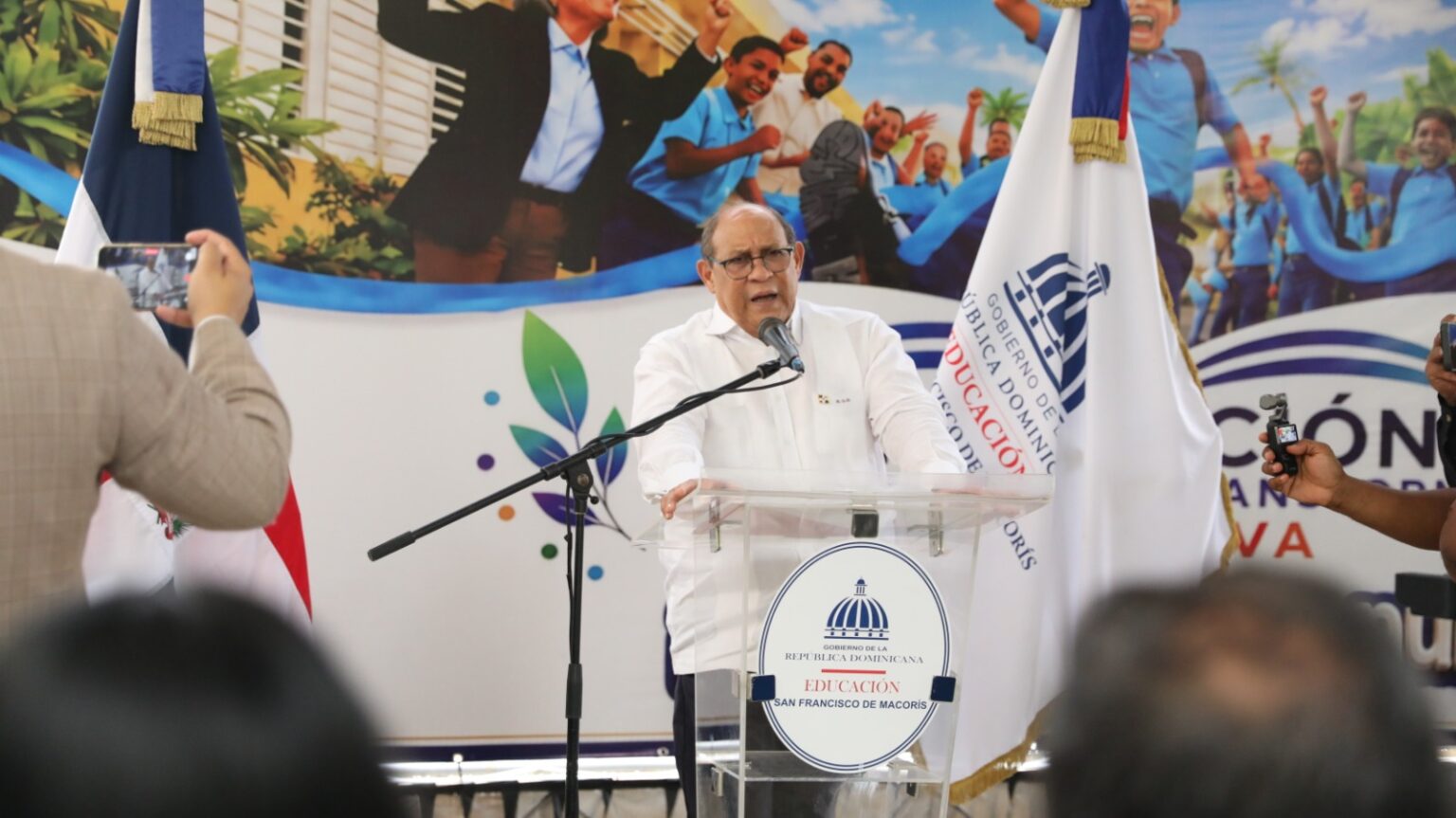

San Francisco de Macorís.– The Minister of Higher Education, Science and Technology, Rafael Evaristo Santos Badía, announced this Monday the beginning of a comprehensive transformation process for the Dominican educational system, which includes a legal reform, curricular changes, a reorganization of high school and higher education, as well as the granting of 10,000 national scholarships.
During the opening ceremony of the 2026-2027 school year, held at the José Francisco Peña Gómez Arts Educational Center in San Francisco de Macorís, Santos Badía explained that the initiative seeks to build a system capable of responding to social, labor, and technological transformations.
The official, who represented President Luis Abinader during the activity, announced that the first step will be to submit to the National Congress the reform of the legislation that will govern the educational system. The proposal would be presented to the Senate in mid-to-late October, with the goal of guaranteeing the continuity of the changes as a State policy.
“We are talking about transformation. We are talking about building a new educational system that teaches young people to learn, to unlearn, and to adapt to the changes of their time,” he stated.
Proposes two paths for high school
Santos Badía explained that a curricular transformation will subsequently be developed that will reinforce fundamental areas such as reading, writing, mathematics, history, natural sciences, socialization, and solidarity from the initial and primary levels.

Likewise, he maintained that the system must prevent students from being promoted to the next grade without having acquired essential competencies, due to the difficulties that these deficiencies can generate during the following stages of their education.
For the secondary level, the proposal contemplates two training paths. One will be oriented towards scientific-technical education, through equipped high schools and polytechnics that grant degrees in coordination with the National Institute for Technical Professional Training (INFOTEP).
The second will correspond to scientific-humanistic academic high schools and will be aimed at young people who have the capacity and willingness to continue university studies.
The minister pointed out that students who require technical-vocational training must also be identified and supported, so that they can acquire a profession or trade that facilitates their incorporation into the labor market.

They will review university degrees
The transformation will also reach higher education institutions. Santos Badía indicated that curricula, the duration of degree programs, and the relevance of academic offerings will be reviewed, taking into account the demands arising from the fourth industrial and technological revolution.
“Higher education cannot continue without relevance or quality. University training must respond to the country’s needs and allow young people to pursue a career, whether as employees or as entrepreneurs,” he stated.
Among the planned changes is also the incorporation of short-term university certifications to make it easier for workers and professionals to update their knowledge and acquire new skills in the face of the transformation or disappearance of certain occupations.
Santos Badía guarantees that the 4% will not be touched
The head of MESCyT rejected that the integration of the educational system implies eliminating or reducing the 4% of the gross domestic product allocated to pre-university education.
“The integration of a single educational system has nothing to do with taking away the 4% from education. There is no such intention on the part of the President of the Republic. Funding will not be reduced,” he emphasized.
You can also read: Santos Badía: “Education is trapped in the 19th century”
Santos Badía pointed out that pre-university education receives more than RD$300,000 million, while more than 1% is allocated to higher education and culture, and INFOTEP receives the contribution corresponding to 1% of the companies’ payroll.
He also denied that there is any intention to privatize education and assured that the transformation process will maintain the autonomy of the Autonomous University of Santo Domingo (UASD), as well as the tripartite nature of INFOTEP and the particular characteristics of the different educational subsystems.
Government to grant 10,000 scholarships
Santos Badía also announced that President Abinader ordered the delivery of 5,000 full scholarships to high school graduates who completed their studies with grades above 95 points, also taking into consideration the results obtained in the four basic subjects of the National Tests.
As explained, these scholarships will be awarded directly based on the students’ academic merits, without letters of recommendation or political, religious, or institutional intermediation.
To these will be added another 5,000 national scholarships for young people who submitted their application through the corresponding platform and achieved an academic GPA higher than 3.20.
Because the number of candidates who meet the requirements exceeds the available spots, socioeconomic and territorial criteria will also be considered for this second group, in order to guarantee representation from all provinces.
The 10,000 scholarships will be intended for pursuing degrees considered relevant to national development at Dominican higher education institutions, including data science, mathematics, physics, agronomy, arts, and areas related to the orange economy.
Request to guarantee classroom teaching
During his speech, Santos Badía praised the decision of the Dominican Association of Teachers (ADP) to sanction the branches that do not join the start of classes in a timely manner.
“Schools must be open, teachers must be in the classrooms, and students must receive instruction. The right of our children and young people to education must be placed above any differences,” he/she expressed.
The minister maintained that the 2026-2027 school year marks the beginning of a new stage for Dominican education and stated that the transformation of the system must count on the participation of teachers, families, administrators, universities, churches, business leaders, legislators, and other sectors of society.