
The EU bets on diplomacy in the Middle East and refuses to get involved in Hormuz

7:40 pm
Brussels.- European Union (EU) leaders sent a unified message on Thursday against the escalation of war in the Middle East, bet on the diplomatic path to resolve the conflict and rejected for now the sending of military aid to the United States in the Strait of Hormuz.
The heads of state and government of the Twenty-Seven showed this common stance in the face of the expansion of the conflict in the Persian Gulf, whose economic consequences generate growing concern in European capitals, and which have also affected the security of EU member states and NATO allies.
In a summit held today in Brussels, which was initially going to focus on how to improve the EU’s competitiveness, leaders were forced to switch to “crisis mode” to discuss the common response to the events in the Middle East and whether or not to heed the requests for military aid from US President Donald Trump to escort ships in Hormuz.
After a few weeks that showed differences within the EU regarding the conflict triggered by the United States and Israel, the messages sent today were closer to the “no to war” of the Spanish Prime Minister, Pedro Sánchez, than to the more lukewarm positions expressed by the President of the European Commission, Ursula Von der Leyen, or by the German Chancellor, Friedrich Merz.
We recommend reading:U.S. attacks Iranian missile facilities located near the Strait of Hormuz
Moratorium for energy infrastructures
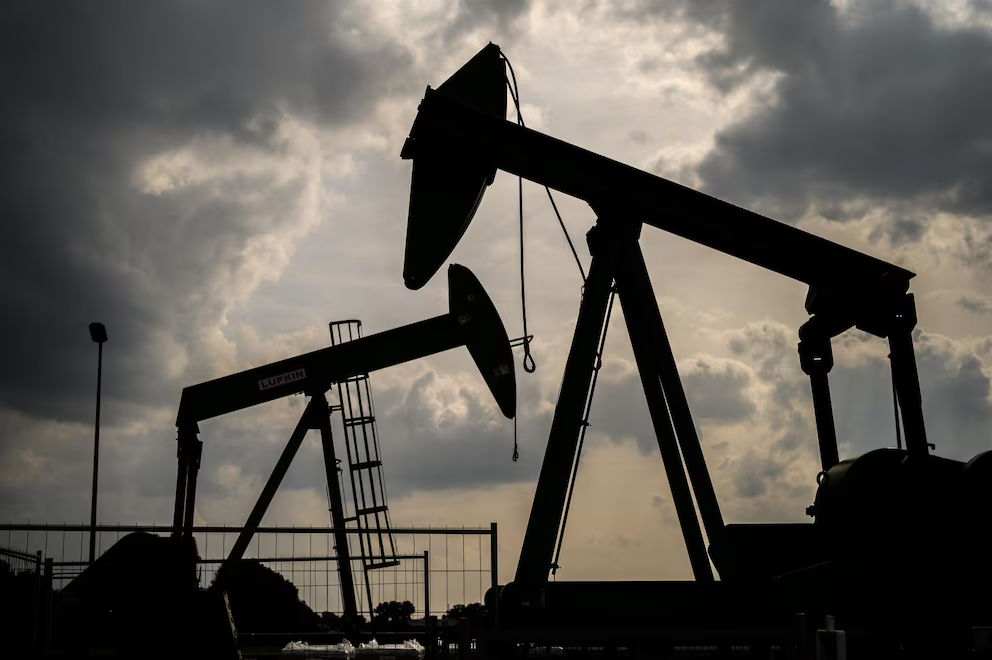
In the conclusions adopted today at the summit, the leaders urge “maximum restraint” and respect for international law to all parties, and underline that the conflict “threatens regional and global security.” The text, which does not directly mention the United States, calls on Iran and its “partners” to immediately cease attacks in the region, and underlines the “firm and unequivocal support” for Cyprus through the sending of military assets to the eastern Mediterranean. The Twenty-Seven called for safeguarding the regional airspace, requested a moratorium on attacks against energy and water facilities, and “guarantee maritime security and respect for freedom of navigation in Hormuz,” which contrasts with the common refusal to send the military support requested by the United States. They also asked to “reinforce with more resources” the two maritime defense operations they have in the region, Aspides and Atalanta, but within their “respective mandates” in the Red Sea. They also bet on diplomacy, involving all parties as a way to resolve the conflict. The EU’s High Representative for Foreign Affairs and Security, Kaja Kallas, urged upon her arrival at the summit to “find a way out” that avoids a further spiral of war and confirmed that she maintains diplomatic contacts with Iran and other countries in the region to seek “different solutions”.No military support to the U.S.
Leaders of countries such as France, Germany, Belgium, Italy or the Netherlands also individually expressed the rejection that their Foreign Ministers already showed on Monday to send military assets to Hormuz, and expressed their discontent for not having been consulted by Trump before launching his “Epic Fury” operation against Iran and for the apparent lack of a clear strategy behind it. French President Emmanuel Macron urged a “rapid de-escalation” in the conflict, and spoke of a phone call the previous day with Trump in which the US president “called for an end to all those bombings against civilian, gas or oil infrastructure,” following the attacks on Thursday morning that resulted in extensive damage to gas fields. The German chancellor, who at the beginning of the month showed himself favorable to the US-Israeli offensive and later criticized it, today welcomed what he considers a “signal” from Trump aimed at reducing tensions, and said that Germany would only get involved in the Persian Gulf region “when the weapons fall silent.” The Spanish Prime Minister, Pedro Sánchez, one of the first European leaders to openly condemn the offensive by the United States and Israel against Tehran, reiterated that it is an “illegal” war that, in addition to costing human lives, affects the economy and citizens are already beginning to suffer its effects.You can also read:Tokyo does not rule out sending warships to the Strait of Hormuz, but asks for «cautiousness»
Sánchez urged the EU to defend its values and principles, those enshrined in its Treaties, and to defend the rules-based international order, instead of the “law of the strongest”.
Yerandi Santana es una periodista dominicana, graduado de Comunicación Social en la UASD. Ha trabajado en medios como TNI Canal 51, CDN y De Último Minuto, desarrollando experiencia en periodismo digital y televisivo.


#Most read
- 1.Solange Omon, from Cameroon, is chosen as the new Victoria’s Secret angel
- 2.VIDEO: Tourists stranded with suitcases amid violent protests in Paris
- 3.Leonardo DiCaprio’s “dad bod” sparks discussion about belly fat and health risks
- 4.VIDEO: Cross involved in priest’s death reinstalled at Ecuador church as investigation continues
- 5.Armed men attack U.S.-flagged vessel in Haiti’s Port-au-Prince Bay
- 6.Haitian gang Chen Mechan linked to alleged capture of four Salvadoran soldiers in Haiti
- 7.Cross falls on a priest inside a temple in Colombia and generates reactions on social media
- 8.VIDEO: Haiti gang suppression force reports deaths as search continues for four missing Salvadoran soldiers
- 9.LATAM plane’s wing catches fire before takeoff at Peru airport
- 10.Haitian gang leader challenges Bukele as search for missing Salvadorans continues

Newsletter
Subscribe to our newsletter to receive our latest articles instantly!