
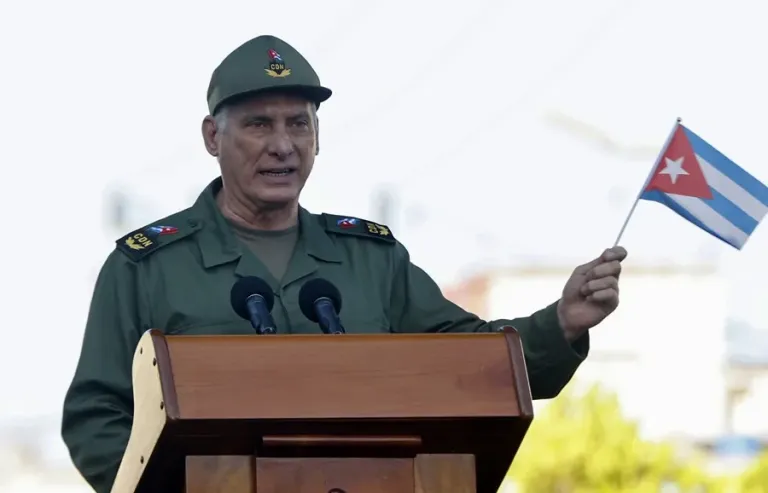

Havana.- The president of Cuba, Miguel Díaz-Canel, asserted that the U.S. “resorts to lies to generate pretexts upon which to sustain aggressions” against his country, in reference to the U.S. government report that describes the island as a “threat” to its national security.
State media broadcasted statements by Díaz-Canel this Tuesday in which he affirmed that “Cuba has never acted to harm the American people, nor has it intended to affect the national security of the U.S.”.
“What the Cuban Revolution has done throughout its history is to defend itself from these successive and endless aggressions, by legitimate right,” wrote the Cuban leader in an extensive message.
The U.S. report
The U.S. Department of State released a 100-page document this Monday titled: “Cuba: The Capital of Communism in the 21st Century,” in which it reviews the history of the island since the revolution led by Fidel Castro in 1959 and accuses Havana of attempting to “undermine, degrade, and destabilize the United States” with spies and soldiers, as well as with students, intellectuals, and NGOs.

The report maintains that, for 67 years, the Cuban regime has “trained terrorists, sheltered fugitives, and infiltrated the U.S. government,” a campaign that “has achieved a success that its founders could hardly have imagined.”
For his part, Cuban Foreign Minister Bruno Rodríguez described the text as the “latest fallacy of the U.S. State Department against Cuba,” and said that it “is part of the construction, by the Secretary of State (Marco Rubio), of a pretext to sustain his cruel and criminal economic war that punishes every Cuban family, and his aspiration to militarily attack.”
“It is further evidence of the macabre plan designed by that South Florida U.S. politician, which only satisfies the interests of those who have always paid him,” pointed out the head of diplomacy of the Caribbean island.
Cuba denies the presence of military bases
The report from the administration of U.S. President Donald Trump also reiterates that the island hosts “a growing number of foreign military, intelligence, and terrorist facilities,” one of the arguments used by the U.S. government to draft the executive order of January 29, which declared Cuba an “unusual and extraordinary threat” and established the oil blockade.

We recommend reading: Díaz-Canel: “The U.S. resorts to lies to generate pretexts upon which to sustain its aggressions against Cuba”
Cuban authorities have repeatedly denied the presence of military bases, especially Chinese ones, on their territory in various scenarios, describing Washington’s accusations as “mendacious and unfounded” and as “fallacious pretexts” to try to justify a possible military intervention.
Washington has applied a maximum pressure policy on Havana since the beginning of this year, first with the oil blockade that has multiplied blackouts on the island and paralyzed the economy, to which it added new sanctions in May, especially on foreign companies. Furthermore, it has kept the possibility of a military intervention on the island on the table.